Puttin' on the Paleo
Jason Poole is dusty and canvas-clad. His leather satchel and Indiana Jones hat rest near the feet of Hadrosaurus foulkii, a Cretaceous-period dinosaur skeleton.
Jason Poole is dusty and canvas-clad. His leather satchel and Indiana Jones hat rest near the feet of Hadrosaurus foulkii, a Cretaceous-period dinosaur skeleton.
But Poole isn't digging - he's drawing. Swiveling his head from a larger-than-life blackboard to the bones at his right, he fleshes out a rib cage. A few broad chalk strokes here, a softening of the palm there, and the creature creeps closer to life.
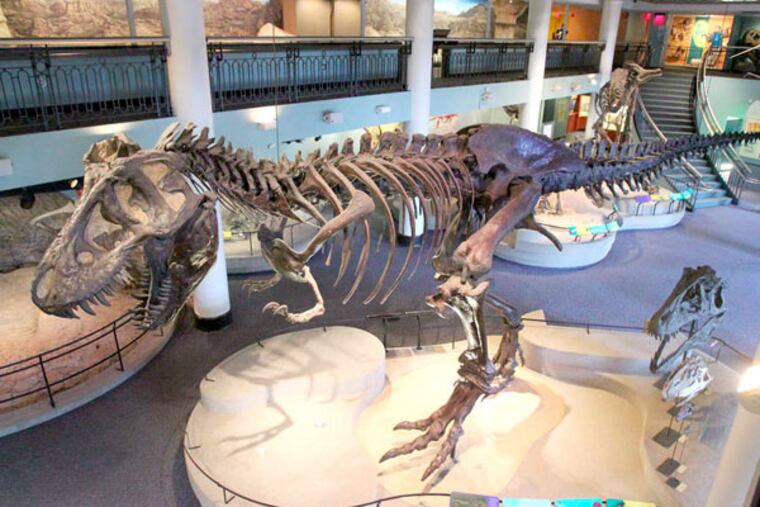
"This dinosaur probably got eaten by T. rex," blurts 7-year-old Juan Wilson. Poole takes the opportunity to teach him a lesson.
"Well, T. rex wasn't on this coast, as far as we can tell," he explains. "He had a relative called Dryptosaurus that was on this coast. He was a bit smaller than T. rex."
"Just like a little T. rex," Juan echoes.
The educators at the Academy of Natural Sciences thrive on these aha! moments.
It's Fossil Month at the academy, capping off a year of themed months in celebration of the institution's bicentennial. Poole's project is part of the exhibition "Drawn to Dinosaurs," one of a series of events leading up to "Paleopalooza": a festival of "all things fossils, all things dinosaurs," according to paleontologist Ted Daeschler.
"Oh my gosh," Daeschler exclaims at the mere mention of Paleopalooza. The two-day event, now in its fifth year, is expected to fill the house with patrons eager to rub elbows with experts. The opportunity for interaction is what Daeschler most looks forward to every year, and what he believes sets Paleopalooza apart from similar events.
"A museum like the academy is really the only place where you can get a face-to-face experience, where you can have a conversation with people who make this their business," he says. This "authenticity," he emphasizes, dates to 1868, when the academy became the first place in the world to mount a dinosaur skeleton - a Hadrosaurus foulkii, the same type that Jason Poole fleshes out for an audience.
"We've been doing dinosaurs for a long time," Daeschler affirms, elongating the "o's." "So of all places, we have the credentials."
Come Saturday, Daeschler will be stationed at a table equipped with dinosaur fossils to stimulate discussion with "brilliant little kids and curious adults." Like Poole, he's there to answer questions and foster an interest in paleontology.
"I hate to tell you how many kids' parents tell me, 'This kid wants to be a paleontologist,' " he says, laughing. "I look at them and say, 'It's a long road. Don't give away the bedroom.' "
Nine-year-old Lucas Sullivan fits the mold. Oversize goggles swimming on the bridge of his nose, chisel in hand, he picks at an emerging skeleton in Dinosaur Hall's mezzanine exhibition, where people can get firsthand experience of what it's like to dig for dinosaur bones.
"I think it's an arm," Lucas observes as he works diligently. "I'm actually reading about fossils at school and they're really neat," he casually adds.
Five-year-old brother Liam James isn't itching to become a dinosaur expert, but he's still enthusiastic about his favorite dinosaur: "T. rex!"
For patrons like Liam James, Paleopalooza still offers plenty of fun. In addition to the team of scientists at the public's disposal, there will be a slew of activities that cater to dino-weary and younger visitors.
Chad Peeling of Reptiland of Allenwood, Pa., will bring along live reptiles to present "Life in Scales," an animal show that illuminates the similarities between reptiles and ancient animals. Fossil juggler Randy Lyons will roam the halls, teaching and throwing fossils into the air. The Diggity Dudes will perform "hip music for hip kids and their equally hip parents" twice daily. Face-painting, puppet shows, and trilobite races are also on the agenda.
"Anybody who's interested in Paleo, you've got to come down," Poole says. Taking a break from sketching, his hands and arms covered to the elbow in green chalk, he says scientists don't really know what color dinosaurs were.
Like Daeschler, Poole values above all else the interactions with patrons interested in art and paleontology. "That's what really keeps me going," he says.
There could be plenty of these moments at the academy this weekend, for adults as well as children. And it's not all work for the scientists, either.
"It's a lot of fun for us, too," Daeschler admits, as if you couldn't tell.