Two exhibitions display Tacita Dean's complex films
No stranger to Philadelphia, the British, Berlin-based artist/filmmaker Tacita Dean was given her first museum survey here, at Penn's Institute of Contemporary Art, in 1998.
No stranger to Philadelphia, the British, Berlin-based artist/filmmaker Tacita Dean was given her first museum survey here, at Penn's Institute of Contemporary Art, in 1998.
Now she has returned with concurrent exhibitions of two film projects. JG, a new film commissioned by and made for the Arcadia University Art Gallery (and funded by the Pew Center for Arts & Heritage) is being shown at Arcadia through April 21. A 2008 work, Merce Cunningham performs STILLNESS. . .(six performances, six films), has a floor of the Fabric Workshop and Museum through March 17.
(Headed to New York? Dean's monumental chalk-on-blackboard drawings from her "Fatigues" series, and a film, The Friar's Doodle, can be seen at Marian Goodman Gallery (mariangoodmangallery.com) through March 9.
JG is one of Dean's most visually complex works. Her premise is that the late British writer J.G. Ballard's 1960 short story "The Voices of Time" - an apocalyptic science fiction tale with a desert setting - may have inspired Robert Smithson to create his famous Great Salt Lake earthwork and film Spiral Jetty 10 years later. Dean explores this in a looped 35mm, 261/2-minute anamorphic film using her recently developed (and patented) system of aperture gate masking.
The process, similar to stenciling, allows her to use various shaped masks to expose and re-expose the negative within a single film frame. A mask that could pass for a facsimile of the template and sprocket holes of a strip of 35 mm Ektachrome slide film is meant to reference Ballard's 35 mm camera; other masks, clearly traced by hand, take the forms of spirals, pools, and other images. A drawn clock face appears at regular intervals, accompanied by Ballard's words, spoken by a British male voice (Ballard died in 2009).
Woven together, Dean's film sequences of the eerily bright, saline landscape of Utah, its isolated architecture, its desert creatures - lizards, armadillos - and her masked interventions bring the enigmatic paintings of Giorgio de Chirico to mind. (This was intentional on Dean's part, as Ballard was known to have favored the metaphysical painter's work, as well as the paintings of Salvador Dali and Paul Delvaux).
Shortly before he died, Ballard wrote to Dean that she should "treat the Spiral Jetty as a mystery her film would solve." It doesn't - despite its symbols and clues, JG remains resolutely, sublimely mysterious - but it certainly gives pause for thought.
The first time I saw Merce Cunningham performs STILLNESS. . . (six performances, six films) at the Fabric Workshop and Museum, all six of Dean's 16mm, five-minute color films of Merce Cunningham sitting motionless in a chair in his New York dance studio "performing" to John Cage's composition 4'33" were running simultaneously on different walls and screens, as they're supposed to. On my second visit, a week later, only three of the original six projectors were still working, leaving a somewhat diminished version of the installation. (I hope three replacements have been tracked down by now).
But even in its reduced version, STILLNESS succeeds in capturing the remarkable subtlety of Cunningham's controlled poses as he is being timed in each one by his company's director, Trevor Carlson - and also, how uncannily Cunningham conjures his late partner Cage's presence.
'Catch as Catch Can'
It's not every day that Locks Gallery turns over its first- and second-floor galleries to one exhibition, but that is the privilege that "Catch as Catch Can" has been accorded, and its curator, Fionn Meade, has made the most of the largesse.
Using Cubist painter Francis Picabia's dynamic 1913 Catch as Catch Can as his centerpiece and guiding spirit (the Philadelphia Museum of Art, which owns the work, has lent it for this show), Meade looked for works by contemporary artists that evoke a similar state of rupture and divestment of stylistic stances.
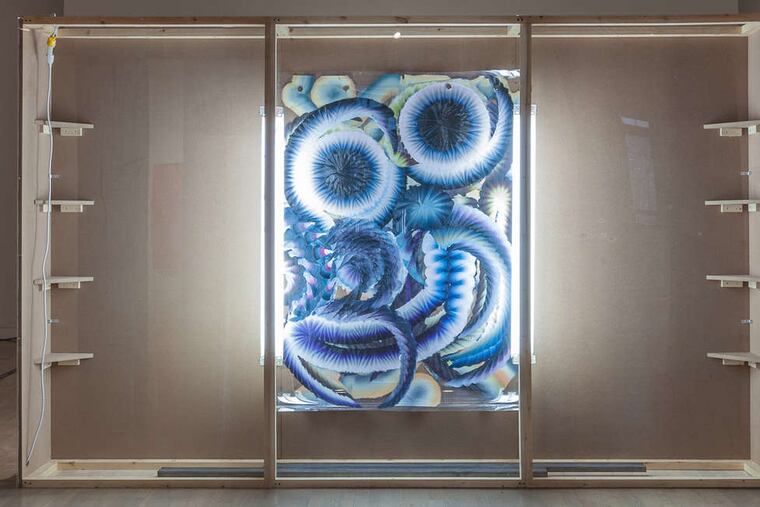
He found it in the dense networks of images in Jutta Koether's paintings; in Lucy Skaer's 16mm color film of artist Leonora Carrington that focuses mainly on her hands (think Tacita Dean, on a much smaller scale); in Nick Mauss' slim, ceramic "paintings" glazed in transparent, drippy veils of blue; and in Viola Yesiltac's painting in fountain-pen ink on a huge orange sheet of seamless paper.
"Catch as Catch Can" also features works by Will Benedict, Tom Burr, Kerstin Brätsch, Michaela Eichwald, Nicole Eisenman, Shahryar Nashat, and Kianja Strobert.