A detective, 11, who can't sleuth straight
When Stephan Pastis made the leap from adult comic strips to children's literature, he knew he would have to make some changes. So he removed the beer cans and smoking.
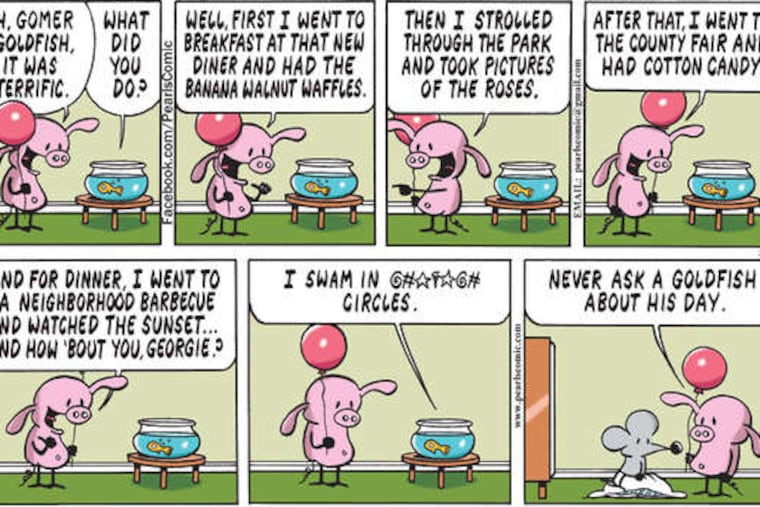
When Stephan Pastis made the leap from adult comic strips to children's literature, he knew he would have to make some changes. So he removed the beer cans and smoking.
It wasn't the first career shift the 45-year-old California native had undergone. After graduating from UCLA law school, he worked as a litigation lawyer before submitting his first comics to syndicates in 1996. Since then, his popular strip Pearls Before Swine has appeared in more than 600 newspapers, including The Inquirer, and spawned a New York Times list bestselling compilation.
In his new book, Timmy Failure: Mistakes Were Made, the author introduces us to the titular Timmy, an 11-year-old wannabe sleuth whose attempts to curb crime are hindered by his huge ego and wild incompetence.
Already at work on the second installment of Timmy and appearing for the first time in the Philadelphia area Thursday, Pastis chatted by phone last week about his first stab at writing a children's novel.
Question: Where did the character of Timmy Failure come from?
Answer: Ever since I was a kid, I read all those kid detective books. Encyclopedia Brown, Hardy Boys, Nancy Drew - they all had really clever young detectives. Much cleverer than me, by the way. So I thought, "What if you worked in a genre like that, but you made the detective totally unable to solve anything?" It just made me laugh. Then I made him sort of arrogant, too, because I like characters that have that blind spot.
Q: So what makes Timmy worth rooting for?
A: Beneath that facade of arrogance is a kid who has almost nobody on his side. That makes him vulnerable. That's the saving grace. If he were that arrogant, and he was popular, that wouldn't be funny.
Q: You've written for adults up until this point. How did you tap into a kid's sense of humor?
A: I always write the same thing. I write to make myself laugh, and apparently when I do that what comes out is something best-suited for an 11-year-old kid. The only changes I had to make from the strip were no beer cans, no smoking.
The one thing a kid will spot immediately is someone who purposefully writes to them as opposed to someone who writes, and you can come along if you like. With Wimpy Kid, Jeff Kinney was not writing that for kids, he was writing it for adults, and I don't think it's an accident that it succeeded like it did.
Q: Did you draw from your own experiences as a kid when you were writing Timmy?
A: I almost never write consciously from my own background because I try to think as little as possible when I write. So, no, because I'm not thinking like that. But I often look back at what I've written and go, "That is straight from my childhood!" This also means I do little to no outlining. The outlining for Timmy Failure would probably fit on three index cards. But that can't be typical. I'm sure there are better ways to write books.
Q: Do the stories develop as you write?
A: For me, the building blocks are the chapters. I just go chapter by chapter. And so the outline is almost like a movie script. At the quarter-way point, this will happen. And at the halfway point, this has to have happened. So as long as I stay within that very skeletonlike outline, I know I'm OK. I just try to write a funny chapter.
Q: Do you have to do a lot of rewrites?
A: That happened a little bit on the second Timmy Failure, because I was 70 pages in and had no outline. Nothing. So then I pulled back because it was a little too free-flowing. So I stopped and gave it a little more of an outline and then I went back to it. But I'm a big believer that your subconscious is much smarter and more creative than your consciousness, and I don't think your consciousness can keep up with the other.
Q: This was your first novel. Were you at all intimidated?
A: The only thing that was hard is when I'm done with a comic strip I can literally hold it at arm's length and see the entirety of the comic strip and see how it flows. When you're writing a novel, there's no such way to see the whole canvas like that. If I went days without writing, to see where I was at and get the flow of it, I would literally start at Page 1 and read the whole thing and then start writing again. But I don't know how else to do it.
Q: You're a veteran of book tours. Any interesting stories from the road?
A: I don't know how this tradition started, but fans bring me beer. That's going to be a very weird combo if it happens at the kids' book signings. Then there are people that have you sign everything - a baseball, a guitar, shirts.
And occasionally there will just be a weird request. I remember one guy on the last tour, after he got a picture with me he said: "Can we take one more, and in this one you just put your hands around my neck and choke me?" And I said, "I don't think so. . . . "
Stephan Pastis will be speaking at 7 p.m. Thursday at Barnes & Noble, 210 Commerce Blvd., Fairless Hills. Information: http://bit.ly/11YtYXQ