Investors scurry for a piece of 'Matilda'
NEW YORK - As the title character of Matilda prepares hair dye to exact revenge on her nasty dad and his pompadour, she sings in a tribute to naughtiness: "Just because you find that life's not fair, it/ Doesn't mean you just have to grin and bear it."
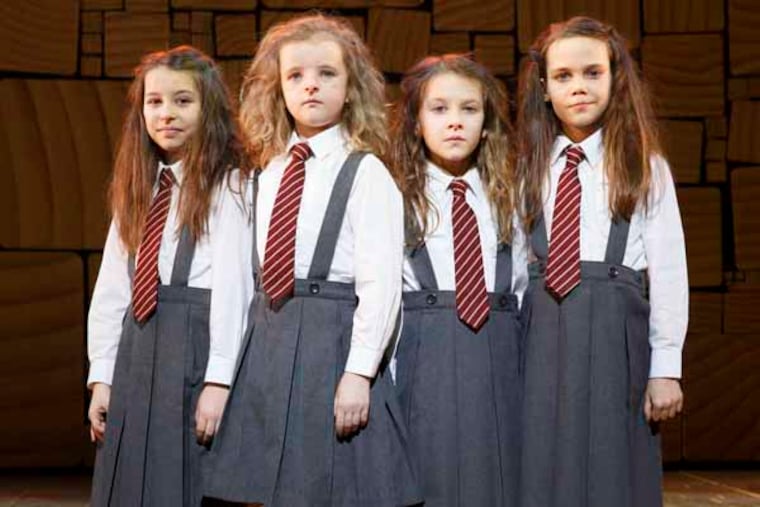
NEW YORK - As the title character of Matilda prepares hair dye to exact revenge on her nasty dad and his pompadour, she sings in a tribute to naughtiness: "Just because you find that life's not fair, it/ Doesn't mean you just have to grin and bear it."
The precocious schoolgirl has the telekinetic ability to manipulate chalk on a distant blackboard. Perhaps more important, she sold more than $12 million worth of tickets ahead of her show's April 11 Broadway opening night.
A horde of investors grinned through unusually tough terms dictated by the lead producer, the Royal Shakespeare Company, for a stake in the musical, now in previews at the Shubert Theatre. It's based on the Roald Dahl story of the same name.
"There were people hanging from tree limbs trying to get into it," said Jerry Frankel, who invested after being wowed by the show in London, where it's played to full houses since late 2011.
Backers are forgoing customary perks and profit-sharing terms for a piece of what seems as close to a sure thing as Broadway offers.
The RSC and its U.S. co-producer, Dodger Theatricals, raised $16 million without dispensing producer credits to its top investors. So, instead of trading above-the-title credit for cash - standard practice, making dozens eligible for a Tony Award if the show wins for best musical - Matilda lists only two producers; key investors are cited in the playbill in small print below the cast and production team.
The investors stand to earn just 34 percent of the show's profits after getting their money back plus 50 percent, according to a partnership agreement. Backers of less-heralded productions usually share profits of 45 percent or more. RSC Executive Director Catherine Mallyon said in an e-mail that "profits generated by our activities are returned to support our charitable purposes to connect people with Shakespeare and live theater."
The show has been in the works since December 2008, when director Matthew Warchus (God of Carnage) approached Tim Minchin, an Australian performer and composer, about writing music and lyrics for an adaptation of the 1988 bestseller. Minchin finished a draft in mid-2009, and it premiered at Stratford-upon-Avon in 2010 with Dennis Kelly's libretto.
The RSC self-produced it on the West End, where it won a record seven Olivier Awards and recouped its $4 million production costs in six months.
For the New York transfer, the RSC chose to partner with Dodger Theatricals, the partnership behind the global blockbuster Jersey Boys.
The Broadway-bound production accepted minimum stakes of $25,000, according to an October filing with the U.S. Securities and Exchange Commission. Its fixed weekly expenses are relatively low at $584,452, plus 7 percent of grosses payable to the landlord, the Shubert Organization, exclusive of other theater expenses.
Weekly ticket sales potential at the 1,427-seat Shubert is about $1.1 million, although sales of "premium" seats starting at $194 may boost that figure considerably.
If the show plays to almost full houses, it can recoup $14.4 million of projected production costs in a little more than a year.
The RSC gets a share of box office or weekly operating profits, and after investors recoup production expenses, it will earn 15 percent of net profits "off the top." The going rate for large nonprofits that develop work for Broadway is about 10 percent.
The RSC also shares with the Dodgers and investors the final pool of profits - net adjusted profits - once authors and the director receive their cut.
Competition for opening-night seats is as heated as the battle for stakes. To make room for RSC board members, supporters "and the like," plus investors and press, talent agents aren't invited. Agents endured a six-month-plus audition process with their clients and see it as a snub, one said.
The RSC and Dodgers wrote: "Unfortunately, the rare and blessed interest and expectation our little show has generated has created collateral damage at a moment like this for everyone."
Confident the moment will pass, producers are already auditioning potential replacements for the four girls in the title role.