On Movies: Art thievery as Olympic stress reliever
Here's what you won't see in Trance, Danny Boyle's flashy, frantic thriller about a missing Francisco Goya masterpiece and the thugs and mugs trying to find it: a flurry of scenes from great art-heist movies like The Thomas Crown Affair (the 1999 remake, that is) and some classics of the genre.
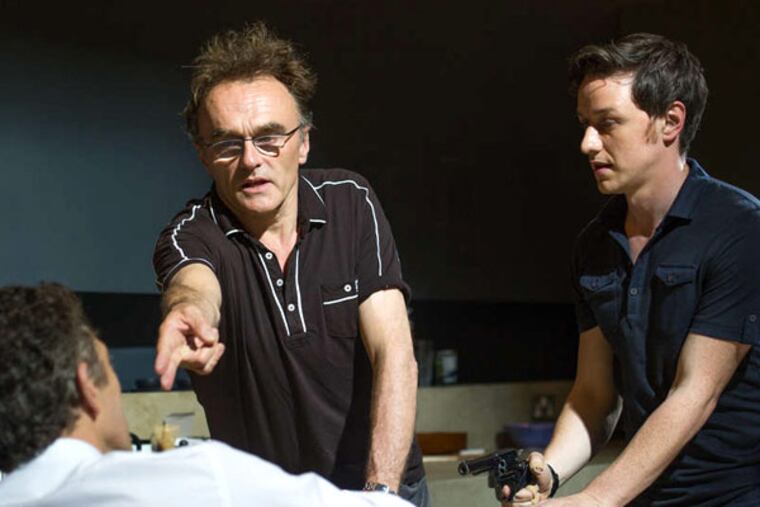
Here's what you won't see in Trance, Danny Boyle's flashy, frantic thriller about a missing Francisco Goya masterpiece and the thugs and mugs trying to find it: a flurry of scenes from great art-heist movies like The Thomas Crown Affair (the 1999 remake, that is) and some classics of the genre.
"We actually had a montage of a lot of movies - you know, all the ones you'd expect - culminating with that scene in Dr. No where Sean Connery sees the stolen painting in Dr. No's lair - and of course it's a Goya painting of the Duke of Wellington!" Boyle says.
"Anyway, we had this lovely, lovely sequence which was part of the fun of the opening of the film . . . . But then our producer priced it - what it would cost us to clear all this footage - and it was like a third of the budget! For a one-minute montage! So we had to cut it all."
Could Boyle put the clips back in for the DVD release, perhaps?
"Same thing," Boyle laments. "I think you pay like 50 bucks less to put it on the DVD.
"Maybe somebody in the editing room will pirate it and put it out there," he says, jokingly (we think).
The tireless Boyle, who won an Oscar for directing (and a best picture Academy Award to go with it) for 2008's Slumdog Millionaire, shot Trance in London in 2011, at the same time he was planning the opening ceremonies of the summer Olympics.
Remember Daniel Craig stepping into Buckingham Palace and escorting Queen Elizabeth to a helicopter so the long-reigning monarch and the MI6 spy could parachute down on Olympic Stadium? Boyle directed Her Majesty.
"She's very sharp, particularly for a woman her age," he says of the 86-year-old queen. "Clearly, she wanted to do it, because obviously you don't get to do a thing like that unless she wants to do it. She wanted a fun afternoon, so that's what we tried to provide."
And then Boyle and his gang ran off to film Rosario Dawson naked, James McAvoy in a torture scene, and nasty people doing nasty things, all in an effort to retrieve the stolen Goya painting, Witches in the Air.
"The Olympics is a major, major commitment," explains Boyle, whose London home is in the same neck of the woods as the stadium. "It's like two years of your life. And so we decided, to keep sane, that while we were planning this very responsible, family-friendly event, we would escape on our days off by shooting Trance.
"It's strange saying this about this film, which is partly about psychosis or madness, but it is actually what kept us sane . . . . It was wonderful to do something dark and twisted and fun on an adult level . . . . You don't know who to trust, who to believe - all that stuff. You can't do any of that in the Olympics."
In Trance, which opened Friday, McAvoy is an art expert with a gambling addiction who goes in with a pack of thieves - led by Vincent Cassel - to lift the valuable Goya from an auction house. Unfortunately, McAvoy's character gets bonked on the head. When he comes to, he can't recall where he's stashed the artwork, and Cassel and his pals are, well, perturbed. So they send McAvoy off to get hypnotized to see if the memory can be coaxed out of him.
Dawson, as the hypnotherapist, does the coaxing. Which, at one point, involves stripping off her clothes. Goya, we learn in the movie, was the first artist to render the female nude with pubic hair - so Dawson's nude scene isn't gratuitous at all. (To wax or not to wax, that is the question.)
The actress researched her role, says Boyle, who was romantically linked with his leading lady for a time - although the gossipists all now report that the relationship is kaput.
"Rosario went off and she did her own work," Boyle says. "She went to hypnotherapists and actually did go under - but none of us got to witness it, unfortunately. I think she thought that was part of the allure - that she'd just tell us about it afterwards."
McAvoy and Cassel, on the other hand, submitted themselves to hypnotherapy, and allowed Boyle to observe.
"Nothing really exciting happened," the director says. "It was very benign . . . . What we found out in our research - and it is mentioned in the film - is that five to 10 percent of the population is extremely suggestible. For that group, hypnotherapy is a powerful tool."
And Boyle? Did he "go under?"
"No, no, no," he says, laughing. "I'm a bit of a control freak, and I don't think I'd be the best person to sit in the chair. Especially if you're sitting in front of the actors - you might reveal something you'd regret."
"Disconnect" man. For Henry Alex Rubin, director of the Oscar-nominated 2005 documentary Murderball, the idea of a fiction feature wasn't something he leapt at.
"People assume that's where you want to end up, but the truth is that documentaries are incredibly exciting and fulfilling," says the New York filmmaker. "The documentary world really feels like my home."
But then Rubin read Andrew Stern's screenplay for Disconnect, in which the lives of a disparate group of people - played by Jason Bateman, Hope Davis, Frank Grillo, Jonah Bobo, Andrea Riseborough, Paula Patton, Alexander Skarsgard, and Max Thieriot - intersect. The common thread is the Internet, and how technology is making us more isolated and alone, not less. The movie opened Friday at the Ritz Five and Rave Motion Pictures/NJ.
Rubin says that when he read Stern's screenplay, he was struck by how relevant, and reportorial, it was. One plotline centered on the Internet sex trade. Another on cyberbullying and the abuse of social media. And another on identity theft.
"What I loved about the script was that it really seemed like three documentaries twisted into one story, one dramatic story.
"They were pulled right out of the headlines . . . . "I thought, OK, I want to tell these stories."