Tune in to DANCE
If there's one thing Ira Glass knows, it's that you can't put a dance performance on the radio. The public radio journalist, who hosts NPR's popular weekly newsmagazine This American Life, was hit with that truth - and the resulting conundrum - two years ago when he fell in love with a performance by New York choreographer Monica Bill Barnes' modern dance ensemble.
If there's one thing Ira Glass knows, it's that you can't put a dance performance on the radio.
The public radio journalist, who hosts NPR's popular weekly newsmagazine This American Life, was hit with that truth - and the resulting conundrum - two years ago when he fell in love with a performance by New York choreographer Monica Bill Barnes' modern dance ensemble.
"I was struck by how the aesthetics of her show matched the tone and feeling of the radio show I do," Glass, 54, said this week in a phone interview. "I thought the audience for the radio show would love these dancers. If only I could put them on the air. But of course you can't put dance on the radio."
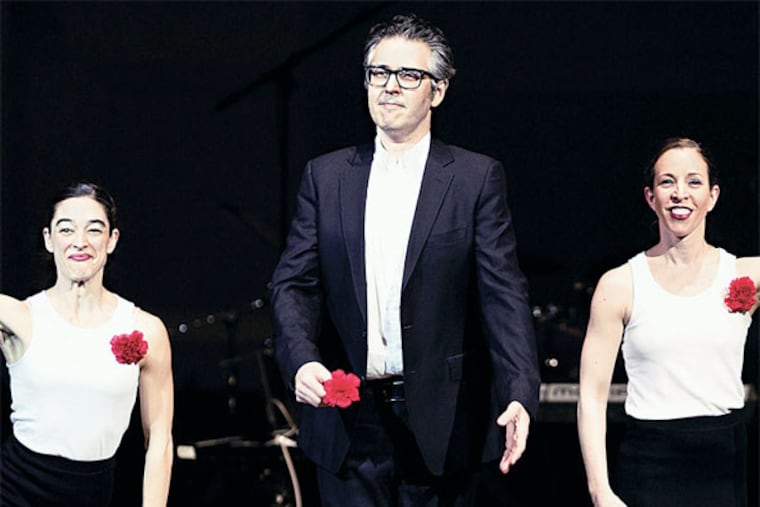
So, instead of bringing Barnes to the airwaves, Glass ended up joining her on stage. Not as a dancer (it would have been a comic sight, Glass acknowledges), but as a writer for a collaborative spoken-word/dance piece called One Radio Host, Two Dancers.
An unlikely blend of two genres, the 90-minute show features narration by Glass and movement by Barnes and fellow dancer Anna Bass. It has its world premiere this weekend at the Annenberg Center's Zellerbach Theater.
The idea for One Radio Host, Two Dancers arose gradually, Glass said.
Glass, whose show draws upwards of 1.8 million listeners a week, said he wanted to expose his audience to Barnes' work.
He showcased her company on a video simulcast of This American Life in May, and introduced them in two public-radio-sponsored performances in New York in the fall.
Eventually, Barnes suggested that Glass embrace the project by being integrated into the show as a raconteur.
It was a crazy idea, she admits.
"Part of what makes Ira's work so successful is that he is not doing visuals," she said this week in a phone interview. "And part of why I think dance is so succesful is that it is not dealing with language.
"So," she added, "we were sort of setting ourselves up for failure."
Undaunted, the duo began building a show around some of Glass' favorite radio stories.
"We went through the archives of This American Life and looked at stories that were about . . . things people would make dances about," Glass said. "We immediately went to all the love stories. The love stories that go wrong; love stories that go swimmingly; love stories that end tragically. Because you can create dance out of that."
Translating story to dance was tricky, though, Barnes said.
"On the one hand, you can be too literal and just act out the story," she said. "On the other hand, you can go too abstract and do your own thing regardless of the story."
Glass and Barnes had a test run in February, when Glass' cousin, composer Philip Glass, invited them to perform as part of his annual Tibet House Benefit Concert at Carnegie Hall.
"Yes, I made my dancing debut at Carnegie Hall," Glass said.
Barnes was worried they would have a spectacular mess on their hands. "I feel we really took a leap of faith," she said, "and we were surprised and incredibly happy that the audience reaction was so enthusiastic."
Barnes and Glass said the bedrock of their collaboration is a shared sensibility.
Glass, whose take on life is wry, said Barnes' dancers have a feel for humor that surprised him.
"I think this show has exactly the same feeling as the radio show, when the radio show is good," he said.
And Barnes said she and her collaborator aim at inspiring empathy in the audience.
"What makes Ira's show so amazing to me is that it makes me feel I'm there inside the story, that I feel a direct empathy with people who are sharing a part of themselves," she said.
"I felt this is what I am trying to do with dance. I am trying to deal with very specific moments in life and share them in a really human way."
So who would be the ideal audience for One Radio Host, Two Dancers, Glass was asked.
"This is the perfect show for anyone who ever thought to themselves, 'God, Ira Glass' show is the most awesome radio show ever, except it's missing modern dance."