The play's the thing - for kids this week
Talking with Philadelphia International Childrens Festival founder Kaki Marshall.
A PLAY about a drowned puppy? At a children's theater festival?
Catherine "Kaki" Marshall took some heat over some of her choices when she organized the first Philadelphia International Children's Festival 29 years ago. She didn't let it stop her from including the Canadian play about a girl who accidentally drowned her pup after leaving him in the bathtub with the water running to answer a phone call.
"A lot of parents thought it was just awful that kids would have to deal with that," Marshall, now 87, recalled. "The kids loved it. You could hear a pin drop."
Marshall thought playwrights should give children more credit when it came to understanding and self-expression. "It's dealing with an issue that is very real in their lives," she said of the play, adding, "Of course there were other pieces that were more cheerful."
The 29th Philadelphia International Children's Festival gets underway today through May 4. The festival's mission - Kaki Marshall's mission - is to bring "affordable performing arts to Philadelphia's youngest audiences," according to a news release. There will be performances like CIRCA's "46 Circus Acts in 45 Minutes" and concerts from kid-friendly bands like Trout Fishing in America, plus a Fun Zone with face painting, jugglers, crafts and other activities.
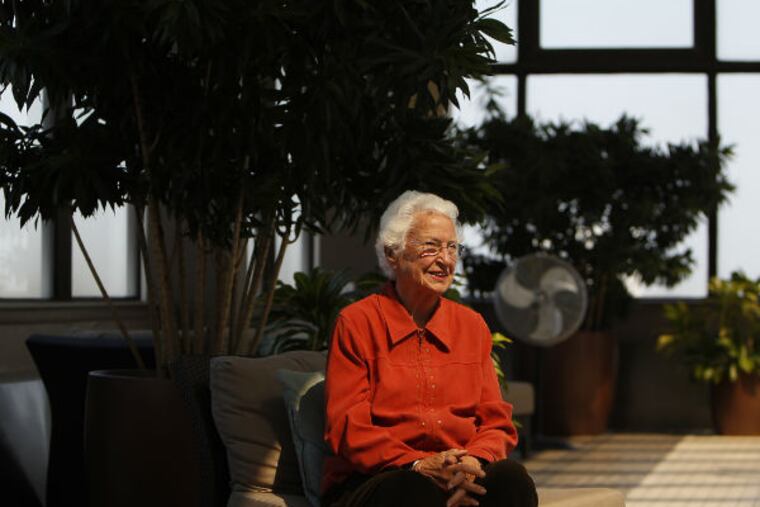
During a recent interview in the sunny, neatly arranged study of her Center City apartment, the silver-haired former University of Pennsylvania professor and mother of six said that she was just a child herself when she became interested in theater.
"I never wanted to perform," she added. "I was always fascinated by putting it all together."
'Challenging theater'
Born and raised in Wawa, Delaware County, Marshall was the middle child of seven. "My younger siblings couldn't say Cathy so they called me Kaki," she recalled with a laugh.
As a young woman, she commuted to the University of Pennsylvania to pursue her undergraduate degree. There was no theater major, so she chose psychology.
After graduating in 1945, she supervised the extracurricular program Penn Players before heading to Columbia University, in New York, for a master's degree in theater.
"I loved Columbia," she said. "The fact that I was in New York and being taught by working actors and directors. . . . You were a part of that professional theater scene while studying."
Following her graduation in 1949, Marshall married her college sweetheart from Penn, lawyer Joe Marshall, and took some time off to raise their family.
In 1976, she returned to Penn, which now had a theater department where she taught courses, some of her own design, including one on theater for children. Practical work for the latter included sending Penn students to nearby public schools to do workshops with the kids.
"One of the things that I learned when we started working with these kids was that they wanted to tell their story," she said. "A lot of their experiences they brought out in the process of performing theater."
When Marshall's husband, who taught law at Temple University, traveled to Europe for work, Kaki went with him. There she discovered that young people's theater was a lot more mature than what was happening back home.
"I realized we were way behind in this country," she said. "We weren't really giving kids challenging theater. They were just getting warmed-over fairy tales."
Marshall's mission
Back in the U.S., Marshall began to collaborate with theater people in Philadelphia who shared her gripes about the state of American children's theater. They worked together to bring companies from across the globe to Philadelphia. By then, she was assistant director at the Annenberg Center of Performing Arts, which gave her the go-ahead to create a weeklong festival in 1985 dedicated to children.
The mission was to expose children to what Marshall felt was a superior kind of theater and then allow them to create theater, as well, through workshops with writing, drawing and improvisational acting.
That mission still stands, almost three decades later.
In an era when children spend more time looking at an LCD screen than interacting with real people, live art takes on even more importance, Marshall believes.
"I don't think it's easy to raise a child in our society," she said. "Theater is a group process. You need writers, designers, actors and directors. You're working, cooperating and negotiating constantly with other people."
Marshall pulled herself up from her seat to reach for a brochure from the Philadelphia International Festival of the Arts, the recent monthlong arts showcase coordinated by the Kimmel Center. She leafed through the thick pamphlet, sighing with relief when she found the desired page.
It was about "The Butterfly Project," a family play about the Holocaust that she went to see because her 13-year-old granddaughter, a student at the Wolf Performing Arts Center, in Wynnewood, was performing.
"In terms of using theater as a teaching tool," Marshall said, sitting back down in her chair, "I think that it reaches a child on an emotional level, so that it's not just intellectually but emotionally they understand an issue."
The wall in front of her displayed family photos through the generations. There were black-and-white images of her father and his siblings, herself and her siblings, as well as images of her own children next to a photo of a young Kaki, wearing the same short haircut she does now - and a ribbon in her hair. Her eyes stare quizzically into the camera.
"The younger that we can start . . . [to] give them art and ways of expressing themselves, I think the better off we'll be," she said.
Marshall stopped working at Annenberg in 1989 (Annenberg Center managing director Michael J. Rose is in charge of the festival now), but continued teaching theater into the 1990s. She was a founding member of InterAct Theatre Company, and has served on various theater boards. She received a Barrymore Lifetime Achievement Award in 2001 from Theatre Alliance of Greater Philadelphia.
In 2011, Marshall was awarded the Penn Creative Spirit Award for her lifelong dedication to the arts. As the festival she founded approaches its fourth decade, Marshall expressed hope that its future would remain true to its legacy and its founding principles.
"We opened up the theater arts to be more meaningful for children," she said. "A culture is as good as its art is."