Rabbi takes to radio to reach aging boomers
If nuns can fly, can a rabbi be a talk-show host? WWDB-AM (860) radio is betting that Richard Address, senior clergy at Cherry Hill's M'Kor Shalom, has the chops to attract a coveted audience: baby boomers.
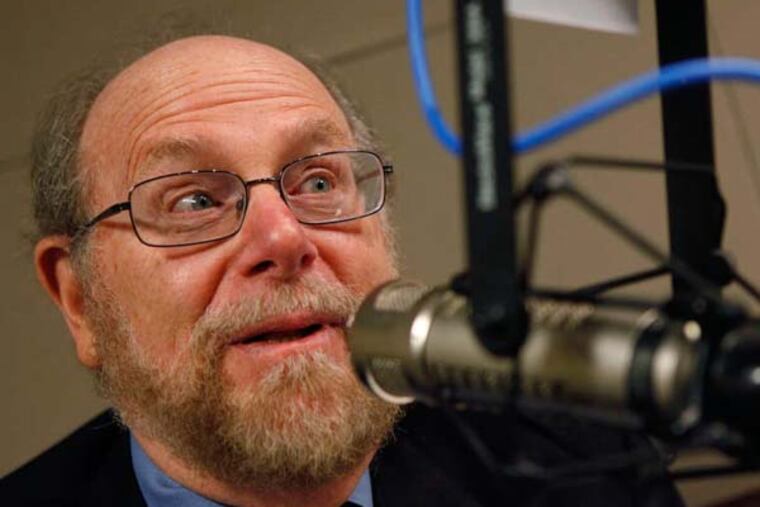
If nuns can fly, can a rabbi be a talk-show host?
WWDB-AM (860) radio is betting that Richard Address, senior clergy at Cherry Hill's M'Kor Shalom, has the chops to attract a coveted audience: baby boomers.
And not just the Jewish ones. (Address goes by Richard on the program.) Boomer Generation Radio, which debuted in February, aims to address the unique concerns of the 76 million Americans born between 1946 and 1964. The first wave is already careening through their mid-60s, joining Medicare, maybe applying for Social Security - all the while caring for their children, possibly looking after grandchildren, and, more often than not, taking care of an elderly parent.
"There's a real need for conversations about what all this means," Address said.
It's a topic Address knows a lot about. At 68, he's facing his own boomer challenges. ("I'm right out of the textbook: between my mom and my children, in a blended family with stepchildren and grandchildren, with mortality a little closer.") He runs the Jewish Sacred Aging website - directed at boomers - and founded the award-winning Sacred Aging Project. Created after studies in 2001 showed that 20 percent of the American Jewish population was older than 65, the project provides programming and resources for congregations to use with this age group.
He also isn't new to broadcasting. In his early days as a rabbi in Los Angeles, he hosted an interfaith radio show, and had a 10-year stint hosting Dialogue, an interfaith discussion format on WCAU-TV in the '80s. But he admitted he is still learning with every show.
"There's no class at the seminary in broadcasting," he admitted. "I have to learn how to work in the moment, multitask to be able to listen to someone respond to a question and at the same time manage the clock and look at the commercial you have to read. That's a challenge. I'm sure there is a list of things I can improve."
In the meantime, Address has his guests - doctors, lawyers, financial experts, spiritual advisers, and the like - share experiences and offer practical advice. On a recent show, psychologist Michael Freidman talked about his three-week vacation in Australia with his grandchildren. ("In my generation, I went to visit my grandparents in Atlantic City working in the back of their store for a penny a box," joked Address.)
Freidman admitted that, for him, being a grandparent trumped parenthood. "I'm at a stage in my life where I'm more spontaneous and relaxed, and frankly, we don't have the same level of responsibility we did when we were parents," he said.
Guest Rabbi Dayle Friedman, an expert in spirituality and aging, discussed ways to help elderly parents feel productive amid physical frailty. "Be curious," she offered. "My dad's in a nursing home . . . and my experience has been so rich in getting to know him in a whole new way by asking him questions about his earlier life. Find ways to honor a person in a nursing home who feels like their life is over by involving them in family events, even if it isn't physically, and honoring their wishes about their care."
Address is planning for future shows to dispel some myths - such as, gym-going boomers are one of the healthiest generations. "I just read a report that says we're not that healthy," Address said.
Other topics to tackle: The so-called "encore phenomenon" - trying to figure out how to transition from full-time to non-full-time work in a meaningful way. "Baby boomers are also redefining and restructuring retirement," Address said. "So, what do you do with that time?"
Guest Sharon Siegel promoted My Turn, an educational program scheduled to launch in the summer at the Katz JCC. "We do a phenomenal job getting this demographic into the JCC for health and wellness programs," she said. "But now we have to get their minds engaged."
Many of her peers are confronting the challenge of having adult children move back home - so-called boomerangs. "How do we deal with a young adult child who is still living under our roof?"
Siegel received several inquiries about My Turn after her appearance, which suggests that people are listening.
Barry Reisman, WWDB account manager, says the program is well-received by listeners and has strong advertising support. The station even has plans to expand the time slot to a full hour on more than one day a week. Reisman calls Address "a host with an excellent radio presence who knows how to ask questions and listen to the answers." Still, it's too early to measure the size of the audience, which can take up to six months.
It doesn't quite matter to WWDB how many people are listening. As a brokered radio show - Address pays for the time and hopes to recoup his expenses through ad sales - WWDB earns revenue regardless.
Address admits he is just beginning to put time into seeking sponsors, but that isn't his priority. He sees the show as an extension of his rabbinate, even though it's geared to the general community.
Of course, clergy broadcasters doing nonsecular programming isn't new - remember Captain Noah? W. Carter Merbreier, an ordained Lutheran minister, created the children's show that aired in Philadelphia from 1967 to 1994.
In fact, more clergy are broadcasting as a way to connect with their communities, whether it's posting on Facebook or tweeting to their congregations, said Address.
"There's a strong but growing cadre of young colleagues who really understand media, social media . . . and computer technology, and they are making that their rabbinate," said Address.
The time also seems right for the show topic: The 7-year-old RLTV network (Retirement Living TV) is geared specifically to boomers, offering features such as AARP Presents Movies for Grownups. A 2012 Scarborough Research study found that 28 percent of boomers tune in to news and talk shows.
Born in 1964, Steven Cohen of Cherry Hill barely qualifies as a boomer, but he listens to Address' broadcast, and he said the show with Siegel was thought-provoking.
"They talked about fully functional older people who may be retired but want to continue to make a difference and add value to the world," he said. "What a great and underutilized workforce."
For now, the format remains a half-hour conversation between the rabbi and his guest. Address hopes to explore adding a call-in feature, and interviewing guests remotely. "I would love to be able to interview people from other areas of the country who have written fascinating books and created movies which speak to our audience," he said.