A body of work
Tukufu Zuberi, host of "The History Detectives" on PBS, shares his collection "Black Bodies in Propaganda: The Art of the War Poster" at the Penn Museum.
Seven years ago, Tukufu Zuberi, a professor of sociology and Africana studies at the University of Pennsylvania, decided to become a collector. The only question was, of what?
He settled on images of the black body - specifically the black body in war - and went about acquiring a trove on his world travels.
Zuberi's efforts have come together in a unique and compelling exhibition of posters portraying blacks in the military, from the Civil War through World War II and the African independence movements of the 1950s and '60s.
"Black Bodies in Propaganda: The Art of the War Poster," which opened last week at Penn's Museum of Archaeology and Anthropology and continues until March, showcases 33 rare works found across the United States, Europe and China by Zuberi, who also hosts the PBS series The History Detectives.
The posters, some violently graphic, were created largely by governments as military propaganda. While many honored the image of the black soldier, some assailed it.
They were "made by nonblack people, asking black people to participate in a war, or glorifying or vilifying their participation in war," Zuberi said in an interview at his campus office.
One poster, titled "Our Colored Heroes," depicts the celebrated black soldier Henry L. Johnson as an Army private in World War I, single-handedly defeating nearly 20 German troops in France with only a knife and a rifle. The color drawing shows a heroic Johnson thrusting a bloody knife into the chest of a German officer during a fierce battle.
"The thing I think you get from these posters," Zuberi said, "is this was one of those unique spaces where, throughout the Jim Crow period, the African American is portrayed in a very powerful place, holding a gun and shooting white people."
Rather than awe, some of the posters aimed to instill fear and hatred of black U.S. troops as ravenous brutes.
One 1942 poster from Italy shows an African American soldier with exaggerated limbs and facial features clutching the ancient statue Venus de Milo , on which is written "$2."
"This poster was put out by the Italian fascist government to motivate the Italian people to fight against U.S. troops," Zuberi said.
"It was saying, 'They're bringing these people over here to fight, and they're going to destroy our culture. And look, they won't even understand a priceless object. They'll be selling it for $2.' "
Zuberi compares the image, and others like it, to D.W. Griffith's 1915 racist epic, The Birth of a Nation, which used white actors in blackface to portray African Americans as aggressive, dim-witted rulers of the post-Civil War South.
In his 11 years on The History Detectives, Zuberi routinely encountered collectors. The show features experts, including auctioneers and specialists in subjects ranging from architecture to sociology, who solve mysteries related to historical artifacts.
Zuberi told them of his interest in collecting - though what, he wasn't sure - and got some advice.
"They said, 'Collect something you will enjoy that will be fun to you and interesting to you. And collect something that is of interest to other people - not everybody - just other people. Make sure you collect it in a way that you preserve the best of the thing that you are collecting,' " he recalled.
"I decided that what I would collect are images of the black body. The first set of images I thought I would focus on were the images of black bodies fighting in wars."
Zuberi's is not the only collection of those themed posters, but, he says, others lack the international scope of his.
"I went to auctions," he said. "I bought them from people all over the world - some from people in China, some in France and Russia."
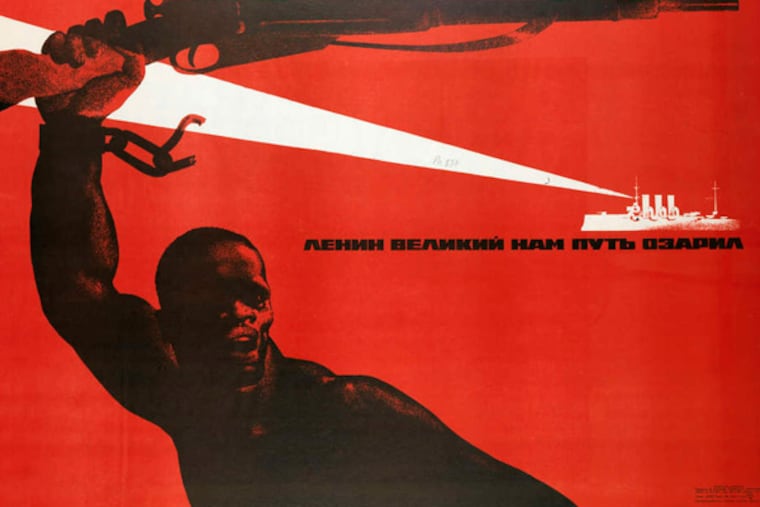
One Russian work, "The Great Lenin Illuminated Our Path," shows an African carrying a rifle. It was meant to convey Russian support for Africans fighting colonialism.
A French poster from 1890, "African Woman Executes African Man," depicts a Dahomey Amazon clutching the severed head of an African man as the Dahomey king looks on.
The exhibition also features computer screens that allow viewers to look closely at specific images within the posters, and get additional information. Each poster comes with a brief analysis written by Zuberi.
He said the posters, whether promoting positive or negative images, are ultimately about propaganda.
"They are trying to motivate people to support a war effort," Zuberi said. "Here you have contrasting images presented, and the black body used in dramatically different ways . . . as an instrument for talking about the war."
Black Bodies in Propaganda
Poster exhibition at the University of Pennsylvania Museum of Archaeology and Anthropology, 3260 South St. Open through March 2, 2014.
Museum admission: $12 for adults; $10 for seniors 65 and older; $8 for children ages 6 to 17 and full-time college students. Free to active-duty service members and their families through the summer. For veterans, a $2 discount.
Hours: Tuesday and Thursday through Sunday, 10 a.m. to 5 p.m.; Wednesdays 10 a.m. to 8 p.m.
EndText