Linguistic maze's triumph, tragedy
If George Smith, the 19th-century Assyriologist, supposedly stripped and ran screaming with excitement through the British Museum upon finally translating the Epic of Gilgamesh, what might happen with a translation exponentially more difficult?
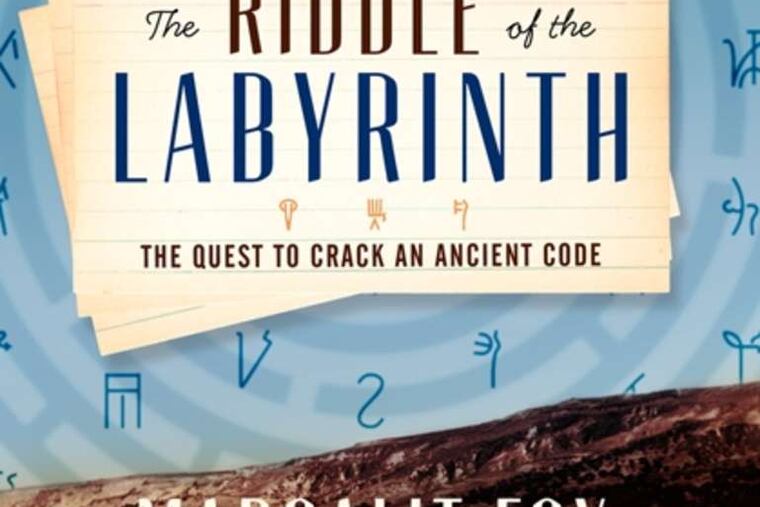
The Riddle of the Labyrinth
The Quest to Crack
an Ancient Code
By Margalit Fox
Ecco Press/HarperCollins.
384 pp. $27.99
nolead ends nolead begins
Reviewed by Richard Di Dio
If George Smith, the 19th-century Assyriologist, supposedly stripped and ran screaming with excitement through the British Museum upon finally translating the Epic of Gilgamesh, what might happen with a translation exponentially more difficult?
What if the project stretches five decades, consuming three independent hunters of long-lost tongues in a maze of linguistic sleuthing, academic intrigue, global conflict, triumph, and tragedy?
Such is the story Margalit Fox brilliantly recounts in The Riddle of the Labyrinth: The Quest to Crack an Ancient Code.
The code is Linear B (named because of its mostly straight-line segments instead of cuneiform squiggles) inscribed on clay tablets unearthed at Knossos, Crete, in 1900. Archaeologist Arthur Evans had discovered the lost palace of Minos and its underground rooms - the Minotaur's Labyrinth. The tablets confirmed Evans' belief that writing must have existed in the Mycenaean world during the Bronze Age of Minos. But who wrote them, and in what language?
Evans spent the next 41 years attempting to decipher "words" made up of alien symbols. Deciphering an unknown script in an unknown language is staggeringly hard. Preconditioned by prevailing theories of people and languages in antiquity, Evans was ultimately unsuccessful. Whatever Linear B was, though, it wasn't Greek: The tablets were made many centuries before Greek writing was thought to appear.
Unknown to Evans, Alice Kober, assistant professor of classics at Brooklyn College, had devoted her life to deciphering the Minoan Scripts.
In almost complete academic isolation, she relied on hand-crunched statistics to seek an internal logic in the symbol patterns themselves, with no consideration of the language represented.
Exhaustively cross-referencing the 200 known Linear B writings, Kober recorded not only how many times each symbol appeared, but also where they appeared, and the probabilities that other characters would appear before and after them. With 78 Linear B symbols, she prepared almost 180,000 separate paper slips, filed in Lucky Strike cigarette boxes, just to begin her linguistic analysis.
Kober extracted information from this "database" by punching holes corresponding to each symbol on the slips in fixed positions.
The common symbol patterns among words were then found by holding stacks of slips up to the light. After 22 years, she was able to determine that Linear B was syllabic rather than alphabetic and that the language was inflected, i.e., that word endings signified the grammatical attributes of the word.
Tragically, Kober died in 1950 at age 43 of cancer, just two years before Michael Ventris, 30, an English architect with no formal training in archaeology or classics, solved the riddle.
For years, Ventris constructed symbol tables not dissimilar from Kober's, unknowingly venturing down the same paths until coming across her published work in 1948. Her arguments and his own intuitive leaps and logic led him to leave the table one night at a dinner party that he and his wife were hosting. He returned some time later, announcing the solution to his startled guests. Incredibly, the tablet language was a very ancient form of Greek, written 600 years before the appearance of the Greek alphabet in a script presumably used by the original Cretans, who spoke a different language.
Unlike Smith, Ventris remained fully clothed. He became world-famous, but the demands on him led to depression and death four years later in a car accident that may have been a suicide.
With very few written samples, no bilingual writings with which to compare it, and no computers, the translation of the Minoan scripts must surely rank as one of the most stunning intellectual achievements of our times.
While The Riddle of the Labyrinth details the crucial roles the three principals played in unlocking Linear B, it is really Alice Kober's story. Until now, her critical contributions to the decipherment were little known. As a woman in a male-dominated academic field, her situation is similar to Rosalind Franklin's originally neglected role in the deciphering of DNA. Kober's untimely death certainly contributed to this omission as well.
Fox's book, then, is more than a well-told story: It corrects a historically unjust account of the person who formed the crucial bridge between discovery of the scripts and their translation.
Fox is a senior writer for the New York Times, with a background in linguistics. Her explanations of writing systems in general, and the Linear B decipherment specifically, are excellent, making a complex subject understandable. These discussions strengthen the important story that Fox tells so well - the uniquely personal quests and contributions of those who spent their lives solving an impossible riddle.
Author Appearance Margalit Fox: "The Riddle of the Labyrinth: The Quest to Crack an Ancient Code"
7:30 p.m. Monday at the Free Library of Philadelphia, 1901 Vine St. Admission: Free.
No tickets required. Information: 215-567-4341 or freelibrary.org/
authorevents.EndText