A decade of gambling pays off for Atlantic City's Borgata
Borgata has redefined how Atlantic City casinos define themselves and their customers.
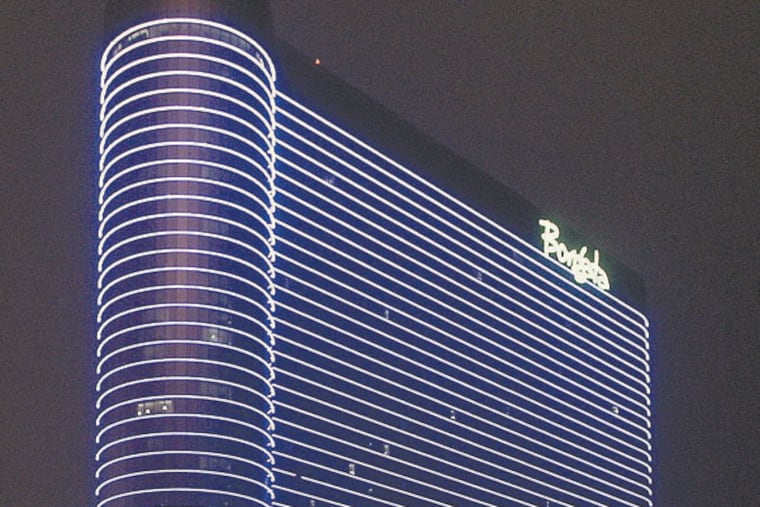
IT CAN be argued there are but three truly crucial dates in the 35-year history of legal gaming in Atlantic City. The first two are Nov. 2, 1976, the day New Jersey voters approved casinos in the fading seaside resort, and May 26, 1978, the day Resorts International, AC's first casino, opened its doors.
It took a quarter-century to reach the third milestone. Just before midnight on July 2, 2003, virtually everything about AC's gaming realm - what it looked like, what it tasted like, what it sounded like and the customers it was marketed to - changed forever as Borgata Hotel Casino & Spa opened.
Atlantic City had been almost exclusively the province of people middle-age and older. Its high-end restaurants had no celebrity-chef connections. The casino hotels were rather generic. During the 1980s, such midmarket chains as Holiday Inn (Trump Plaza), Ramada (Tropicana) and Hilton (Trump's Castle) developed casinos there. With the exception of high-roller suites, style and flair were not the AC casino-hotel blueprint.
Then came Borgata.
This casino catered to people in their 20s and 30s, primarily with entertainment. Sure, dependable casino draws like Paul Anka and Frankie Valli were in the mix. But so were rock and pop icons, from David Bowie and Billy Joel to Prince and Duran Duran - none of whom had booked an AC gig before.
There were superstar disco DJs like Tiesto and Samantha Ronson. And newer waves of comics, like Chris Rock, Dane Cook, Artie Lange and Louis CK.
The pleasure dome, built for $1.1. billion (in turn-of-the-millennium dollars) on the site of what had been a city dump, also became the first local betting parlor to put nightlife in its business plan, with its original disco, MIXX.
Borgata, which on Monday hosted a 10th-anniversary concert starring the Roots and featuring Jill Scott, Slash and comic Aziz Ansari, moved the needle on local casino design, too, offering elegant, marble-lined public spaces and sleek, stylish hotel rooms.
"Borgata definitely introduced a new era in Atlantic City," said casino analyst and consultant Steve Norton, whose Atlantic City experience dates back to his days as the first vice president of marketing at what was then Resorts International (now Resorts Casino Hotel). "I think Borgata made everyone else shine their shoes, in a sense, to upgrade their facilities, if they had the funds."
It's difficult to imagine what Atlantic City's casino scene would look like without Borgata. It's possible such pillars of the local tourism industry as the Pool at Harrah's Resort Atlantic City, the Quarter at Tropicana Atlantic City, House of Blues at Showboat Atlantic City and Revel Casino-Hotel, which was supposed to out-Borgata Borgata, might never have been built.
Courting the 'rejecter'
From the beginning, Borgata was the vision of Bob Boughner, a veteran Boyd Gaming executive who's now the Vegas-based company's executive vice president and chief business development officer.
Boughner targeted what he dubbed the "Atlantic City rejecter" - the potential customer who, for whatever reason, wasn't coming to town. Borgata's current top dog said recently that this customer is still top priority.
"I think the best empirical gauge . . . that we've reached the Atlantic City 'rejecter' is that we have grown market share every single year," said president and chief operating officer Tom Ballance. He oversaw Borgata's construction as Boyd's vice president of development. "And it has happened in both economic environments . . . in the growth years, 2003-2008, and it is happening still, during the years of decline in Atlantic City."
Ballance attributes this success to his gaming hall's insistence on standing out from the pack.
"We have totally differentiated ourselves in the market," he said. "There is a whole different group of people who [are] the base of our business. The Atlantic City 'accepters' from back then were the first people to defect to other gaming jurisdictions. The [people] we appeal to love Borgata."
Formula for success
Continual re-evaluation is key, added Joe Lupo, senior vice president of operations that include entertainment, security, food and beverage and the casino's poker and horse-race wagering.
"I think we really challenged ourselves to continually develop the product and create experiences that were different in Atlantic City," said Lupo. "It's always been an effort to ensure we've stayed connected to our employees and customers."
Both execs agreed that Borgata's track record - it has been the overwhelming revenue champ in Atlantic City almost since its debut - is also the result of executive-level continuity and a surprisingly hands-off ownership strategy.
Borgata "is in Joe's DNA. It's in my DNA," said Ballance. "To have that connection to what the product is all the way through is very valuable."
Then there is Boyd Gaming's operating philosophy. "We almost never have to go outside this building for a decision other than a big capital investment," Ballance said. "Being that nimble and having permission to be that entrepreneurial has absolutely been a key to our success."
Another factor is Boyd's willingness to spend on capital improvements, such as the 2008 opening of the $450 million Water Club, a "boutique" hotel that operates independent of the casino, and last year's $50 million renovation that included freshening up Borgata's hotel rooms.
Red ink and cyber-betting
While there's no debating Borgata is what Eagles boss Jeffrey Lurie might describe as the "gold standard," these days in Atlantic City, "success" is a relative term. As industry observer Norton pointed out, Borgata may be the unchallenged king of the AC jungle, but it's hardly awash in profits.
"If you look at their financials, they are in trouble right now," he said. "They did $900 million in [total] revenue last year [including $613 million in gaming revenue], which was down roughly $50 million from the year before. After they paid $82 million in taxes, they were in the red."
If they're concerned, Ballance and Lupo didn't let on during a recent joint interview. Instead, they talked about past triumphs and the future - which, Ballance acknowledged, will see an emphasis on online gambling.
Though some industry observers have suggested cyber-betting will give people yet another excuse not to visit Atlantic City, Ballance has a different take.
"We've got a pretty significant investment now in online gaming," he said. "That's the new, big product launch we're looking at in the next couple of years.
"One thing we're really good at is, once we know you and we know what you like, we can make you offers and get you to visit us. We view online gaming as another way to get to know . . . people.
"There will be some number of people who will make fewer trips, but now they might be going to Pennsylvania or New York or Maryland. If we can offer something unique online, which is what we intend to do, then we can grow our database and offer them what they like here in the brick-and-mortar world."
@chuckdarrow