The human experience, from an alien
On Vonnadoria, there are no comforting delusions, no religion, no love, hate, passion, or remorse, no names, no husbands or wives, no death. Reason reigns, and every action originates in a logical motive.
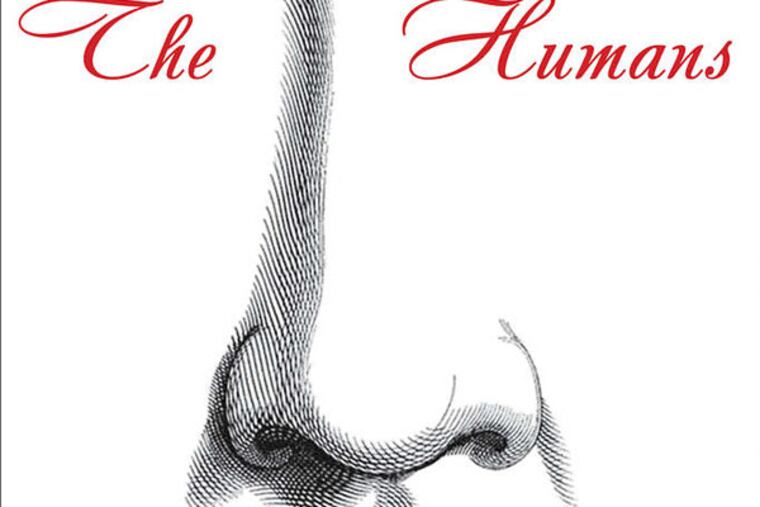
The Humans
A Novel
By Matt Haig
Simon & Schuster. 256 pp. $25.
nolead ends nolead begins
Reviewed by Glenn C. Altschuler
On Vonnadoria, there are no comforting delusions, no religion, no love, hate, passion, or remorse, no names, no husbands or wives, no death. Reason reigns, and every action originates in a logical motive.
Vonnadorians can travel great distances, rearrange their biological ingredients, renew and replenish them. They understand that if the rate of mathematical advancement of Earthlings "exceeds their psychological maturity, then action needs to be taken."
Apparently, it has. As Matt Haig's novel opens, Andrew Martin, a professor of mathematics at Cambridge University in England, has found the key to penetrating "the pattern" in which prime numbers appear, a breakthrough as important as molecular biology and quantum mechanics. An extraterrestrial has killed him and taken on his identity, so that he can find others who know about the discovery and eliminate them as well.
The author of several children's books, including The Dead Fathers Club and The Radleys, Haig uses this conceit to explore the essence of human nature. The Humans is by turns silly, sad, suspenseful and soulful. It is a flawed novel. But Haig manages, somehow, to burrow beneath cliches as he explores the meaning of sentimentality, loyalty, love, and mortality.
Haig struggles with the extraterrestrial's voice, sensibility, and the sophistication of his insights. The Vonnadorian is just learning about emotions, but asks Gulliver, his "son," if beating up the bully who has terrorized him has been "cathartic."
He does not know that humans are expected to wear clothes, but understands that the chief characteristics of teenagers are "weakened resistance to gravity, a vocabulary of grunts, a lack of spatial awareness, copious amounts of masturbation, and an unending appetite for cereal." He has not internalized that married men are not supposed to have sex with other women, but describes "self-referential kissing, kissing about kissing, dramatic and fast and pseudo-intense," and deconstructs that claim that "men are from Mars and women are from Venus." And he uses colloquial expressions like "knuckle-dragger."
Even if they do not really belong in the mouth of the Vonnadorian, Haig's insights are often compelling. A human life, he reminds us, lasts on average about 30,000 days. Enough time for people to be born, make some friends, eat some meals, drink a few thousand glasses of wine, have sex, get married or not, have a child or two, or not, "discover a lump somewhere, feel a bit of regret, wonder where all the time went, know they should have done it differently, realize they would have done it the same, and then they die. Into the great black nothing."
The point of love, he suggests, is to help a person survive and cease searching for the meaning of it all: "To stop looking and start living. The meaning was to hold the hand of someone you cared about and to live inside the present."
Haig acknowledges that sentimentality can be a flaw, a distortion of reality, but claims, nevertheless, that there is "a force behind it as authentic as any other." He judges humans by whether the film Cinema Paradiso moved them. But, on occasion, he can be tough. Even about the precepts he seems to prize. He undercuts sympathy for the Vonnadorian, who is willing to give up his powers, immortality, and ability to return home to save his wife and son, but has also killed a stranger, a colleague, and a friend.
Haig forces the extraterrestrial to confront the proposition that humans "care for each other when the other in question is like them, or lives under their roof, but any difference is a step further away from their empathy. They find it preposterously easy to fall out among themselves."
However, in an ending reminiscent of Woody Allen's list in the movie Manhattan of things that make life worthwhile, Haig returns to his first principles, with the Vonnadorian's elegant and wise advice to Gulliver. "Irony is fine," he tells the son, "but not as fine as feeling." Peanut butter sandwiches do, indeed, go well with white wine. Kissing - and listening to music - stops time. "Don't always try to be cool. The whole universe is cool. It's the warm bits that matter."
Anne Sexton comprehends the mind, and Walt Whitman gets grass, "but Emily Dickinson knows everything." The birth of each human being is the product of so many singular events "as close to impossible as can be. To dismiss the impossible is to dismiss yourself." And, most important, "happiness is not out here. It is in there."