Galleries: Common thread in orange comet and Popeye's drumstick
Curtailed hours and group shows prevail for the rest of the summer, but that doesn't mean that galleries are on autopilot. Actually, the opposite seems to be occurring. The formerly predictable, themeless summer group show increasingly has been replaced by an ambitious curatorial undertaking, here and elsewhere. It's often more experimental than its fall and spring counterparts, too.
Curtailed hours and group shows prevail for the rest of the summer, but that doesn't mean that galleries are on autopilot. Actually, the opposite seems to be occurring. The formerly predictable, themeless summer group show increasingly has been replaced by an ambitious curatorial undertaking, here and elsewhere. It's often more experimental than its fall and spring counterparts, too.
As different as the works of some of Fleisher/Ollman's contemporary artists may appear to be at the gallery's solo shows, they have more in common than you might think. In fact, the works of the 11 artists in "New Wine New Bottle" are so closely aligned aesthetically that you wonder why you didn't detect these obvious commonalities in form, material, color, and subversive humor before.
Is this mere coincidence? They don't initially look remotely alike, but Tristin Lowe's huge glowing, neon-orange comet, suspended from the ceiling, and Nick Paparone's glazed porcelain facsimiles of a Popeye's fried chicken drumstick (part of a larger piece involving a Formica table and a circular rug) are almost exactly the same shape. The empty shape in the center of Mark Mahosky's stripe painting on newsprint (it looks like E.T.'s head in profile), also echoes the drumstick/comet form. You can tell that Alex Baker, the gallery's director, had fun with this show.
A corner of the main gallery that could have been the equivalent of restaurant Siberia instead has become a vortex of energy through the close proximity of Anthony Campuzano, Jennifer Levonian, and Isaac Tin Wei Lin, all of whom use vivid color and words (or, in Lin's case, calligraphy).
Campuzano's bright evocation of a museum poster drawn in the sideways perspective from which he saw it - complete with his notes about the encounter - suggests a new, more personally revealing aspect in his work, as does a drawing incorporating notes from his mother.
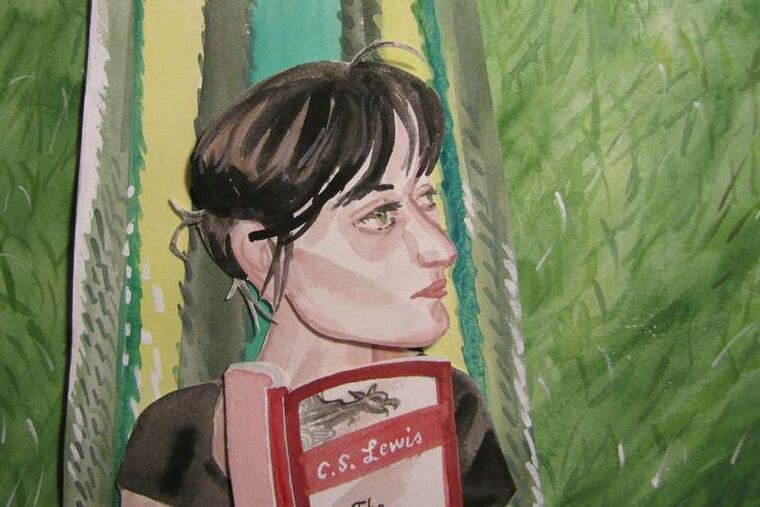
Levonian's cut-paper animation telling the story of a young woman who wins her college's poetry prize and then spends the summer as a supermarket cashier demonstrates her dark humor and perfect pitch for dialogue and image. (I also liked her delicately painted, carved-foam versions of paperbacks).
Lin's colorful graphic paintings of forms that resemble Islamic calligraphy and ink drawings on photographs are the soul of summer, playful and utterly unpretentious.
But Baker's positioning of Paul Swenbeck's glazed porcelain sculptures of strange, primordial forms next to the Dufala Brothers' unsettlingly perfect ball of armored electric cable (complete with socket) provides the most perfect entry into this show. You see, immediately, how a vivid imagination can transform a common everyday material into the memorably unexpected.
"New Wine New Bottle" also features recent gouache paintings by Kate Abercrombie, digital photographs by Dan Murphy, and collages by Chris Corales.
Five small
Gallery Joe's summer show, "Line, Color, Form," gathers works on paper by five gallery artists who explore the fundamentals of abstraction on a surprisingly small scale.
Though executed on a 9-by-18-inch piece of paper, Kristin Holder's oil-stick drawing of two large squares, each a different red pigment and poised slightly off-balance, calls to mind monumental abstract paintings and sculptures from the 1960s. Richard Serra's recent sculptures could also be a touchstone.
The small, emblematic, vaguely erotic-looking objects in Astrid Köppe's drawings are based on things she sees in her everyday life and then reconstructs according to her imagination to capture their essences. They could be a body part, a shell, a telephone cord, or resemble all three. Abstract they may be, but they remind me of Ruth Marten's drawings of hair and the works of several Chicago Imagists.
Lynne Woods Turner and Nicole Phungrasamee Fein, both veterans of several one-person shows at Gallery Joe, use repetitions of patterns or lines in a meditative fashion, Turner creating patterns of geometric forms in graphite and colored pencil on paper, and Fein by layering lines of watercolor onto paper.
Alex Paik makes the most lighthearted contributions to the show - which was organized by gallery associate director Emilie Keim - with airy constructions of painted paper inspired by his training in classical violin.