Celebrating a circle of art, poker, and life
They began by critiquing one another's work. Nothing formal. No highfalutin talk about subverting the discipline or resisting the sculptural.
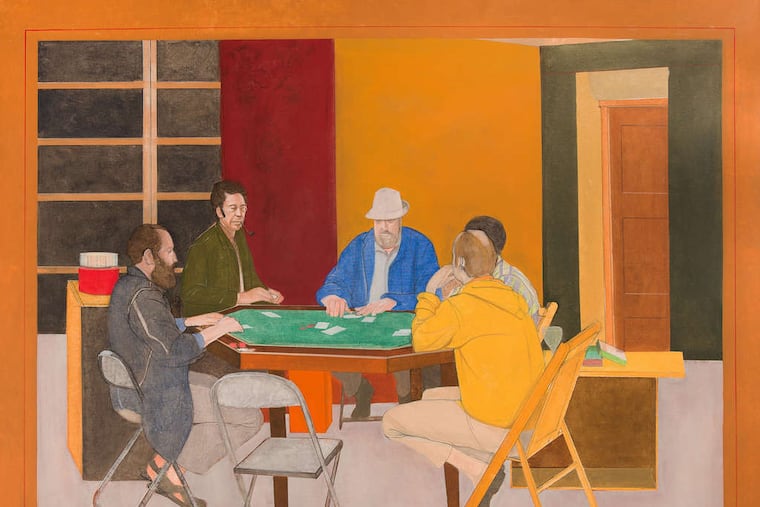
They began by critiquing one another's work.
Nothing formal. No highfalutin talk about subverting the discipline or resisting the sculptural.
So painter Larry Day, joined by painter Jimmy Lueders, sculptor and writer Dennis Leon, ceramicist Armand Mednick, painter David Pease, sculptor Massimo Pierucci, and painter Sidney Goodman gathered in the studio Day shared with Leon on Spring Avenue in Elkins Park and talked about light and shadow, space, stone, clay, brushes, chisels, the Phillies, French cooking, you name it.
All pals, all relatively young (Day was the elder statesman at 40), all making their careers and teaching in the relative backwater of Philadelphia in 1963, they simply enjoyed being together and talking.
They met and yakked and finally Leon said:
"Enough of this! Let's play poker!"
And so they did, beginning what became a monthly ritual that has lasted now through many permutations, departures, and deaths for half a century.
Day celebrated this camaraderie in a monumental 1970 canvas, The Poker Game, which now forms the centerpiece for an exhibition at Woodmere Art Museum, "The Poker Game and Its Circle." The show began Saturday and runs through Oct. 26.
"The concept," said William R. Valerio, Woodmere's director and chief executive, "is to show The Poker Game as a snapshot of art in Philadelphia in 1970. Who are these guys? What did they do?"
What emerges is a portrayal of a rich backwater, indeed, a Philadelphia on the cusp of cultural breakout, a city of artists journeying from abstraction to representation, from local to national reputation, a city of friendships and achievement.
If Woodmere had focused merely on Day and the five artists depicted in his painting (the painter's place is represented by an empty chair at the table), the show would have been rich but not reflective of the game's "circle."
Goodman, for instance, who was Day's student and who died in April, was close to the whole circle - but he did not play poker. Too stressful, Valerio said.
When the game began, the first Sunday of every month, Goodman sat it out.
But an exhibition of work by these artists without their good friend would have misrepresented the group and the emerging power of the city's art world.
Goodman, one of the country's greatest artists, is in the show.
Similarly, all figures in the poker game are male.
"One time, Jimmy invited a lady," said Mednick, 80, the only surviving original player who is still in Philadelphia.
"OK. We were pretty liberal. She cleaned us out. That was the end of ladies."
But an exhibition without artists Mitzi Melnicoff, Ruth Fine, Eileen Goodman, and Doris Staffel, among others, would have been completely lopsided. They were all friends or spouses.
In fact, when Woodmere mounted a show of Staffel's work last year, Mednick attended and began talking with Valerio about the 50th anniversary of the ongoing game. The current show grew from that.
"Women were part of this group of artists, but they weren't part of the poker game," Valerio said.
Fine, who became Day's wife and then curator of special projects in modern art at the National Gallery of Art in Washington, said she didn't play at any games.
But she was surely present at parties. Many parties.
"The '60s were a time of parties," she said. "They were all very close friends."
Virtually everyone taught - there were not enough galleries in the city to support large numbers of artists. Day, who died in 1998, taught at Philadelphia College of Art, now the University of the Arts, for years. So did Goodman.
Leon, who also died in 1998, wrote art criticism for The Inquirer before moving to the West Coast in the early 1970s. Pierucci taught at Philadelphia College of Art before eventually returning to Italy. Pease taught at Tyler School of Art before eventually leaving for Yale University, where he became dean of the School of Art.
Mednick taught at Oak Lane Day School in Blue Bell. Lueders, who died in 1994, taught at the Pennsylvania Academy of the Fine Arts.
Such a constellation of teachers leaves a galaxy of students in its wake.
Richard S. Ranck, who studied at the academy in the 1970s, knew Lueders well. There is no particular stylistic relationship between the way Ranck attacks a canvas and Lueders' more pristine surfaces. Yet there is a closeness there, a shared bond of place and time.
"They were all influential teachers," said Ranck. "Jimmy was very versatile, very versatile. He was very well-read and he was a great cook! I learned about Vidalia onions from him!"
Cooking, art, gossip - all informed the life of The Poker Game.
"It was never about the money," said Mednick. "These guys were about art, about life, about what is important."
Art Exhibition
The Poker Game and Its Circle
Continues through Oct. 26 at the Woodmere Art Museum, 9201 Germantown Ave. Information: 215-247-0476 or www.woodmereartmuseum.org
EndText