Village of Arts and Humanities in Philadelphia is revived
A whine of mowers cuts through the afternoon hum in a small park off a busy North Philadelphia street. Young people talk and laugh on the sidewalk nearby, all about to head off to nearby jobs - on the farm, in the music production studio, on cleanup patrol. Young children dart here and there, campers in the city.
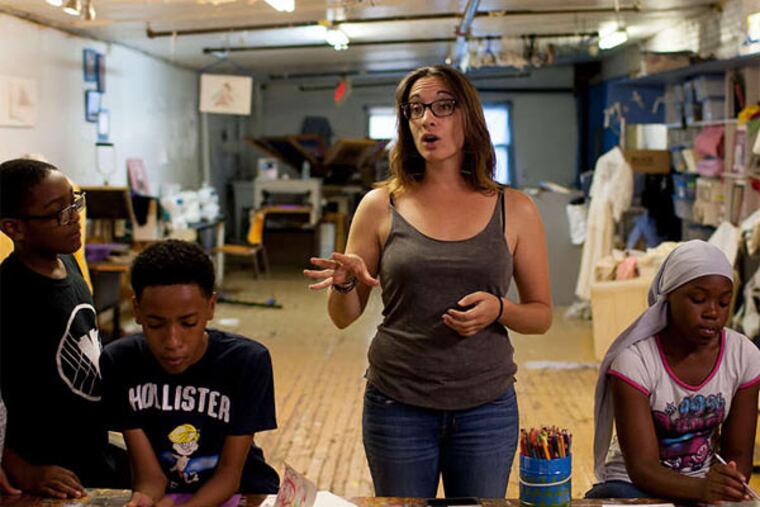
A whine of mowers cuts through the afternoon hum in a small park off a busy North Philadelphia street.
Young people talk and laugh on the sidewalk nearby, all about to head off to nearby jobs - on the farm, in the music production studio, on cleanup patrol. Young children dart here and there, campers in the city.
This is the land of the Village of Arts and Humanities, started more than 25 years ago by charismatic artist Lily Yeh, an archipelago of parks banked by mosaic murals and sculptures stretching south from Lehigh Avenue along Germantown Avenue.
The Village became nationally known during Yeh's time as a model for how the arts can create a place in the midst of indifference and in so doing educate and energize individual lives and a community.
But Yeh left in 2004. Funding began to dry up. Buildings collapsed, taking murals and art with them.
Over the last four years, however, under a young leadership group, the Village has gathered itself up again, and now the Stockton Rush Bartol Foundation has bestowed its George Bartol Arts Education Award on it, recognition of the resurrection taking hold of this unusual place.
"I love it! I love it!" enthused Joy Ross, an energetic 14-year-old working in the Village music production program and helping with the summer camp.
Joy lives in West Philadelphia and will enter the High School for the Creative and Performing Arts in fall. She takes two buses with her mother to reach the Village and its innovative music program.
"I really liked it here," she said. "When I came last year, even though it didn't seem like the most safe neighborhood, I felt safe being in the Village because I felt like everyone is watching over me. Now I definitely do feel safe and I'm really starting to get used to the Village and the environment."
Mikal Watson, also 14, has lived in the neighborhood for two years. He comes to the Village for visual arts and for Philly Earth, a revived environmental program focused on sustainable agriculture.
"More people should come," he said. "People usually think, 'Oh this is a bad neighborhood'; people think, 'Oh, the kids there are too rambunctious.' Well, that's not true. The neighborhood may not look its best, but we're trying our best to make it look better, trying to turn stuff that looks plain and make it more welcoming."
Mikal, who will enter Central High School next school year, is learning the ins and outs of farming. But he and Joy also are learning what it takes to turn their interests into businesses.
The music production program teaches not only technical aspects of recording and producing but also the finances, marketing, distributing, selling.
The same is true of Philly Earth. Kids grow corn, tomatoes, squash, peppers, and other produce on a large space - made available by an earlier building collapse - and they sell their wares. Every week.
"The way we've set it up, we have a series of businesses," said Aviva Kapust, who became the Village's executive director this year and has been overseeing its programs since 2009.
"One is Cred magazine, which has been very successful. The others are photography, music production, fashion, and Philly Earth. Each of those businesses has two components - advanced arts training or environmental training, and then the business component where they learn all the skills they need to actually provide services or a product.
"As Joy was explaining, for music production, they will be launching in September. They will put out fliers, brochures, whatever they see as the most effective way to market themselves. They'll be putting out their services of 'students recording students.' "
The merging of art and business programming is what attracted the Bartol Foundation.
"This idea of connecting their art skills to the 21st century and working and running businesses and having clients, doing a budget, selling or raising money - it's a really inventive way of engaging kids," said Beth Feldman Brandt, Bartol executive director.
The Village is also engaged in rehabbing a building on North Alder Street that will be used for a regular artist in residence. In fact, the current artist in residence, Pedro Ospina, already is working with Village and community help to rehab the house using completely recycled materials - a "building sculpture," Kapust calls it.
All these programs are part of the Village's rejuvenation, which began with the arrival of Kapust and Elizabeth Grimaldi, the executive director who left last year to run the Fleisher Art Memorial.
It is a different focus from the days of Lily Yeh, but weekly participation by teens and young children is back up, hovering around 500. The budget has climbed to $800,000, an increase of about 60 percent in a few years. The lion's share comes from grants, with a bit from government sources and program revenue.
Partnerships are proliferating, and so is an effort to engage directly in straightforward community economic development. The Village has a contract to maintain the Germantown commercial corridor, for instance.
"We knew we had to focus a little bit on the direction we're [now] going in," said El Sawyer, Village operations director and film instructor. "We're a good conduit [into the community] for a lot of other organizations. The past couple years, we've partnered with some smaller organizations and some huge organizations, in fact 20 or 30 other organizations."
But Kapust, 35, says all this is happening with renewed focus on the Village's origins and physical legacy. Murals and mosaics that have decayed or collapsed are being repaired or remade. Parks are being reclaimed. Yeh has returned three times recently to work out what murals and projects can be restored or re-created.
Roots are important, Kapust says.
"With all of this entrepreneurship and development, my core, and the Village's core, is a sense of history and heritage and a belief in the people who built the space that we're in," she said.
"Art at the Village was always intended to be a vehicle for change. . . . That's what this is about."