Fencing catching on with area youths
When 12-year-old Trystan Nash felt misunderstood by the other kids at school, her mother realized the Oreland tween's aggression needed some channeling.
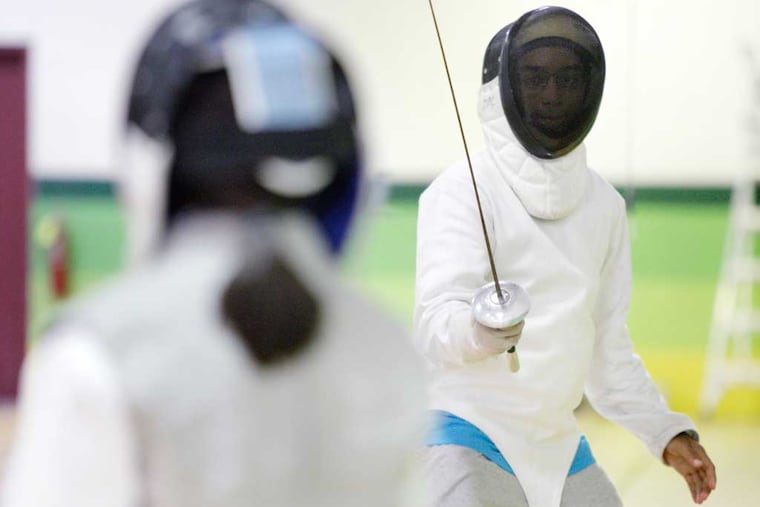
When 12-year-old Trystan Nash felt misunderstood by the other kids at school, her mother realized the Oreland tween's aggression needed some channeling.
"She drew a picture that was a little bit on the violent side - it involved a blade," recalled Sara Nash.
Perhaps fencing might be a way to handle those blades productively?
Trystan discovered the sport was, indeed, her passion. In just a year, she became an advanced fencer who takes two-hour lessons three days a week.
She's not the only one.
Fencing, a full-contact martial art that involves fighting with swords - foil, sabre, and épée - has caught on nationwide, most notably among kids younger than 14, and especially in the Philadelphia division. In the past year, the number of total competitive memberships in Philadelphia, Delaware, Chester, Montgomery, Bucks and New Castle Counties have increased 19 percent (compared to 8 percent nationally,) and USA Fencing memberships have soared 96 percent locally (compared to 66 percent nationally).
There's no blockbuster swashbuckler spiking interest, but movies including Pirates of the Caribbean, Three Musketeers, and Zorro have romanticized the sword. Bradley Baker, a board member of USA Fencing, says there's a self-fulfilling prophecy that's fueling the recent surge in interest.
"More kids are getting into it, so we have more tournaments, and more tournaments means there's more opportunity to fence, so we're retaining people better," he said.
In the Philadelphia area, there are several new clubs, including the nearly year-old Delaware Valley Fencers Club. Owner and head coach Kate Thomas had worked at The Fencing Academy of Philadelphia, which, despite offering numerous locations, was often "a bit too far away for families with tight schedules."
She started with a dozen students in West Conshohocken and now has almost 70.
Fencing, an individual sport often described as a physical chess, offers multiple benefits, devotees say.
"It's a great way for kids to learn skills about self-control, strategic thinking," Thomas said. "Kids of all different types can have fun with fencing and find success in it."
Kids as young as 6 start with plastic swords and slowly develop self-reliance - a sports attribute gaining popularity among parents. Individual sports often emphasize being the best athlete you can be, as opposed to being the best athlete among your peers.
Nash has noticed a marked change in her daughter since she took up the sport.
"She's more confident, and her posture has even changed," Nash said. "It's given her a self-assuredness that she didn't have before."
Mark L. Masters started his first fencing program in 1989 with 20 students. Today, his Fencing Academy of Philadelphia teaches more than 300 students, operating out of facilities in University City and Germantown, which he will soon vacate for a larger space. An additional 200 youths are enrolled in Masters' after-school programs in Devon and Bryn Mawr - double the number from three years ago - and his staff now includes six assistant coaches.
"I've seen an increase in kids who are not conventional learners where the conventional team sports don't fit," Masters explained. "In fencing, you don't have to be the fastest or the strongest, you have to be the smartest. Every kid has to be taught how to do it - there are no naturals. You can take clumsy kids and make them athletes."
Fencing is the only sport that covers each of the American College of Sports Medicine's recent recommendations on the quantity and quality of exercise adults should get, Masters said. For instance, it advises a workout should be cardiovascular, involve anaerobic and aerobic endurance, enhance flexibility, and develop upper and lower body strength. Fencing also has a fine-motor skill component.
On the collegiate level, a $22 million upgrade to University of Pennsylvania's 80-year-old Hutchinson Gymnasium will include a larger, air-conditioned facility dedicated to fencing this fall. Head coach Andy Ma is encouraged that his men's team may improve on last year's sixth-place finish among 40 teams in the NCAA tournament. The team also earned a gold medal in men's saber for the first time since 1983.
"Penn will attract more elite fencers with a program that's more efficient and professional," said Ma, who fenced on the Chinese National Team before coming to the United States 20 years ago and opening The Fencing Academy of South Jersey in Cherry Hill in 1994. He opened a second facility, Mr. Ma USA, in Hillsborough, N.J., in 2006.
Though Ivy League schools like Penn don't offer athletic scholarships, many colleges do - another reason for students to join fencing.
Although the sport is attracting more young fencers, Thomas wants to grow her club's adult market, too. They're less likely to start a new sport, but once they do, they tend to stick with it longer, she said.
Alexander Kocsy, 73, has been fencing much of his life, recently competing in the veterans division of the national competition in Columbus, Ohio.
"It's a lifetime sport that's a good workout both mentally and physically, and it really appeals to my psyche," the Strafford resident said.
Besides competitions geared specifically for certain age groups, age doesn't matter in fencing. A 70-year-old often can compete against a teenager.
Competitive fencing, which has been featured at every modern Olympics since 1896, is becoming much more diverse, Baker said.
"Historically, fencing at the world level has been dominated by Europeans. Over the past decade, there has been a dramatic shift" to include other countries, including the United States.
The United States medaled in each of the last three Summer Games. In Beijing in 2008, U.S. athletes earned an unprecedented six medals - the second-highest among the participating countries.
Trystan Nash may never go to the Olympics - she's not a fan of competitions. But, she knows fencing calms her when stressed.
"And when I feel calm, I feel more in control."