Artist-spouses locked in career combat
At the end of the brilliant, beautiful Cutie and the Boxer, Japanese artists Ushio and Noriko Shinohara stand face to face on the New York City riverfront, punching each other in slo-mo with boxing gloves slathered in paint.
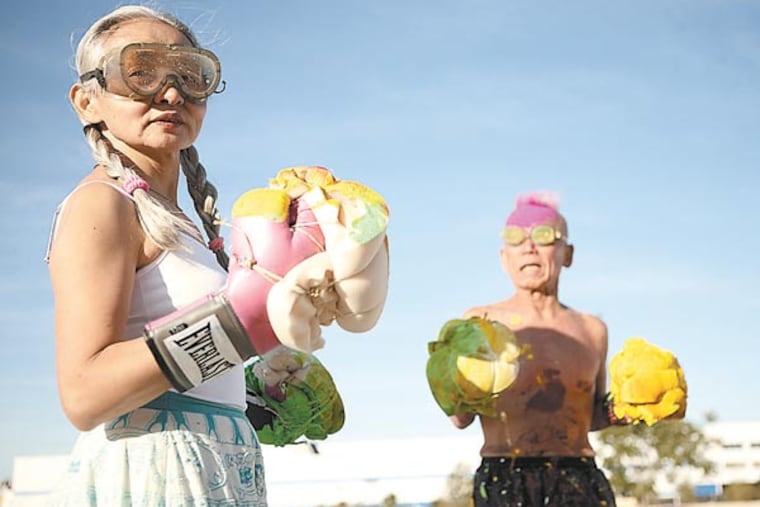
At the end of the brilliant, beautiful Cutie and the Boxer, Japanese artists Ushio and Noriko Shinohara stand face to face on the New York City riverfront, punching each other in slo-mo with boxing gloves slathered in paint.
The gloves are Everlast - a wonderfully apt visual pun for a man and woman who have been together for more than 40 years, through good times and bad, drunken rages, ego trips, shivering poverty, and sacrifice.
And mostly, the sacrifice has been Noriko's. Impossibly graceful, with watchful eyes and a gentle smile, she came from rural Japan to New York City when she was 19, in the late 1960s, and soon met up with Ushio, a Tokyo ex-pat who would later fall in with the Basquiat and Warhol crowd - and who was more than 20 years her senior. His excited, graffiti-inspired art covered wide canvases and gigantic cardboard sculptures. His signature work: "boxing" paintings, which Ushio, wearing fighter's gloves, would make by pummeling a canvas with blots and splashes of paint. We see Ushio's process as the documentary begins: a fit, sinewy octogenarian now, leaping, shuffling, upper-cutting - a pugilist, not a pointillist, for sure.
Cutie and the Boxer, directed with invention and insight by Zachary Heinzerling, explores the raw, messy loft space where Ushio and Noriko live and work. And quite pointedly, the film explores the toll that art - art with a capital A - can take on a relationship. Is it possible to be a devoted lover, an empathetic partner, and still be devoted to your life's work, your creations? For Noriko, who wears her gray hair in braids and pigtails, her own art - comic book-inspired, ink brush drawings with Picasso-like flourishes - took a backseat to Ushio's.
It isn't until a new SoHo gallery show, documented in the film, that Noriko's talent begins to be recognized. Even Ushio - self-centered, a reformed alcoholic, a wildman in his youth - seems to be taken aback by the poignancy, poetry, and confessional humor of his wife's work.
In the catalog for their new show, it is suggested that Ushio and Noriko are like another famous artist couple: Jackson Pollock and Lee Krasner. Ushio scoffs at the analogy. The camera doesn't pan on Noriko right then, but when it does later - and when she talks about her life with Ushio, and her regrets, and the struggles raising their son (an artist and a drinker), she emerges into the light.
And then she gets to sock Ushio in the kisser a couple of times, and get purple paint all over him.
Cutie and the Boxer **** (Out of four)
Directed by Zachary Heinzerling. With Noriko Shinohara and Ushio Shinohara. In English and
Japanese with subtitles. Distributed by Radius-TWC.
Running time: 1 hour, 28 mins.
Parent's guide: R (adult themes)
Playing at: Ritz BourseEndText