Art: Jason Rhoades' art demands your attention
Be prepared to be overwhelmed by Jason Rhoades. Be further prepared to be baffled, disgusted, delighted, amused, outraged, bored, and captivated by the exhibition devoted to his career at the Institute of Contemporary Art.
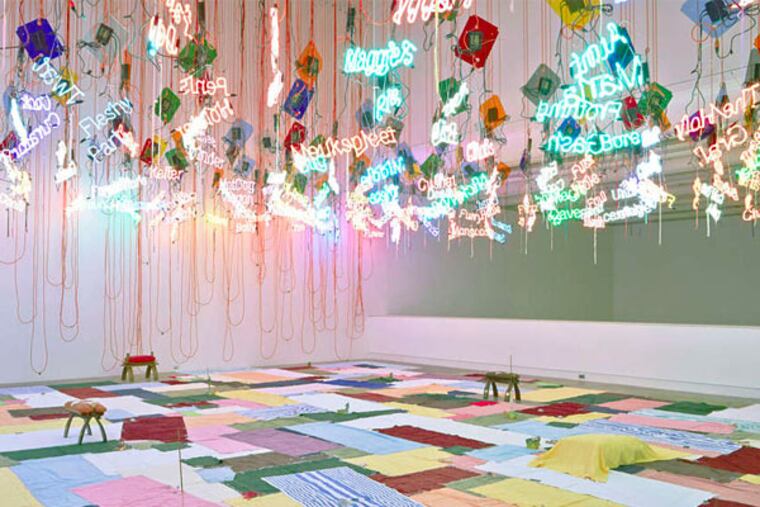
Be prepared to be overwhelmed by Jason Rhoades. Be further prepared to be baffled, disgusted, delighted, amused, outraged, bored, and captivated by the exhibition devoted to his career at the Institute of Contemporary Art.
This first major U.S. museum show for the California native consists of four multimedia installations, plus a few single pieces, that create total immersion in the artist's consciousness, and probably his subconsciousness as well.
Rhoades wanted his art to "shut you down; it should make you give up something." The ICA show certainly stops you in your tracks with a cascade of visceral and conceptual energy. As for giving up something, that could range from insistence on good taste to a belief that, as far as art is concerned, you've seen everything.
We speak of Rhoades in the past tense because he died in 2006 at age 41 from heart disease and an accidental drug overdose.
By then, he had become well known in Europe, but less so in the United States, perhaps because his art, which can be characterized broadly as sculptural installation, is as difficult to classify as it is to tame or grasp intellectually.
Curated by Ingrid Schaffner, the exhibition occupies the entire ICA space. Each installation presents a specific pathway into the artist's thinking.
Two of these are autobiographical and two societal; combined, they express an astonishing ambition to project the history of human development through the artist's own experience, impulses, and obsessions.
For instance, the installation My Madinah: In pursuit of my ermitage . . . is an elaborate homage to, and obvious fixation on, pudenda. Dozens of slang terms for female genitalia, converted to colorful neon signs, hang from the ceiling of the second-floor gallery.
The message is subtle; the considerable material appeal of the piece initially masks its subject - taboos and how people deal with them. Rhoades comes down squarely on the fence between being repulsed and intrigued.
The same is true for an element in the more heterogeneous installation called The Creation Myth, in which a number of logs propped against the walls are papered with deftly edited pornographic photos.
One can read these effusions in two ways - that as a typical male Rhoades was sex-obsessed and felt compelled to express his fixation publicly, or that, satirically and philosophically, he's promoting sexual compulsion as the essential meaning of life.
These installations, especially the earlier ones, might appear to be randomly improvisational, yet on close examination, it's clear that they have been carefully plotted.
The clumps of shredded paper on the fringes of The Creation Myth and the general messiness allude to the "scatter-art" movement. Many of the utilitarian components are emphatically Home-Depot-ish, but the architecture is deliberate and logical in its own way.
The Creation Myth, the most complicated of the four pieces, and the other first-floor installation, Garage Renovation New York (CHERRY Makita), represent one aspect of Rhoades' attempt to express a holistic philosophy of life as sculpture, one intensely masculine in spirit.
For instance, the centerpiece of Garage is a massive eight-cylinder automobile engine, accessorized by various tools and related symbols of men's work. Creation Myth also contains a plethora of such objects, from plastic construction buckets converted to lights to wheelbarrows and circular saws.
The two upstairs installations, made later in the artist's career, are more unitary. The sculpture called Sutter's Mill, made of polished tubular aluminum scaffolding and incorporating a mean-looking serrated blade, is the smallest, most refined work, as if when Rhoades made it (in 2000) he was creatively downshifting to a slower gear.
The upstairs pieces are more soothing, more conventionally appealing as forms or environments. The downstairs pieces generate more emotional tension and more hubris, even arrogance, in terms of what the artist thinks he can achieve.
They're also more challenging as puzzles. The core of Creation Myth reveals itself to be a two-tiered structure made of folding tables. In the hollow center, functioning as the "brain" of a hypothetical body, Rhoades placed a desk chair and a large television set.
A sinuous red plastic "esophagus" trails off sinuously to a bulbous "stomach," while nearby, a smoke-puffing "volcano" symbolizes the inevitable climax of mental and physical digestion.
If the meaning of life isn't more life, Rhoades seems to be saying, then it's waste matter.
Rhoades was an artist very much full of himself, which isn't necessarily a bad thing. The painter who signed his pictures simply "Vincent" was driven by a similar personality, and retrospectively, we admire him for it.
Rhoades was neither a towering intellect nor an aesthetic innovator, but he did create work that demands engagement on more than a superficial level and for more than momentary diversion. It should be seen.
Jason Rhoades: Four Roads
Continues at the Institute of Contemporary Art, 36th and Sansom Streets, through Dec. 29.
Hours: 11 a.m. to 8 p.m. Wednesdays, 11 a.m. to 6 p.m. Thursdays and Fridays, and 11 a.m. to 5 p.m. Saturdays and Sundays. Free admission.
Information: 215-898-7108 or www.icaphila.org
gmail.com
"Art" by Edward J. Sozanski and "Galleries" by Edith Newhall appear in alternate weeks.