Newlywed Legend is 'Made to Love'
Piano-playing soul man John Legend has just released Love in the Future, his first recording since Wake Up!, the 2010 cover song collaboration with Philadelphia hip-hop band the Roots.
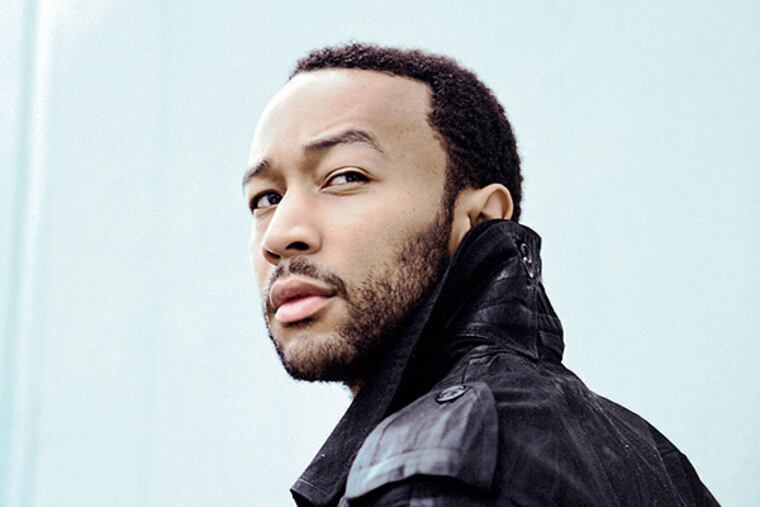
Piano-playing soul man John Legend has just released Love in the Future, his first recording since Wake Up!, the 2010 cover song collaboration with Philadelphia hip-hop band the Roots.
These are busy days for the 34-year-old University of Pennsylvania alumnus, Class of 1999, who grew up as John Stephens in Springfield, Ohio. In addition to letting loose Love in the Future, which was artfully produced with the assistance of old friend Kanye West, the singer married swimsuit model Chrissy Teigen in September in Lake Como in Italy.
That's where the video was shot for his current single "All of Me," an adoring ballad that's sure to be first-dance-as-a-couple music at weddings for years. While on his way to rehearsal last week for his "Made to Love" tour - which brings him to Ovation Hall at Revel casino in Atlantic City on Friday - Legend talked on the phone about "Love," Kanye, and his formative years in Philadelphia.
Dan DeLuca: When you wrote the song "Love in the Future," did you know you had an album title?
John Legend: I write that song in Toronto with Martin McKinney and Ali Shaheed Muhammad from A Tribe Called Quest. The lyrics made sense with where I am in my life, and as a theme for my album. I had a bunch of other songs, but they all kind of fit that theme.
I looked at it as a personal statement because I was about to get married. And I also was thinking of what the place of soul music in the future is. This form of music that is thought of as traditionalist and classic, but being reinterpreted in a modern age. We wanted to think of it in terms of keeping soul music alive, but also moving it forward. That's what Kanye and I and Dave Tozer tried to do with this album.
DD: Kanye is deeply involved in this record, more so than any since your first, Get Lifted in 2004. Aren't you guys a little too busy these days to be spending all this time hanging out making music?
JL: That's why it took so long. I'd meet him in Paris or London or Hawaii, and try to get some work in. And then we worked in New York as well.
DD: Your album is so melodic, and Kanye's Yeezus, which came out around the same time, is anti-melodic.
JL: It's funny, because we were literally making our albums at the same time. It shows that there are two sides to him.
DD: He's assaulting the listener on his own album, and then making sounds that are really inviting on yours.
JL: Yeah, and he really encouraged me to make a soulful album full of love. He was about to become a father when we started making the album. I think he was getting that fatherly, nurturing side out in my project. And none of it on Yeezus, apparently. [Laughs].
DD: Your last album, Wake Up!, with the Roots, was a collection of politically pointed songs for Obama's America. Was that the socially conscious John Legend, and this is the romantic John Legend?
JL: That's an effective summation. The socially conscious part doesn't go away. I'm still thinking about politics, talking about it, tweeting about it. But I did decide to make an album that was dedicated to love and celebrating love.
DD: You recorded an angry song called "Who Did That to You" for Quentin Tarantino's Django Unchained that's about revenge and race. That song kicks a little. . . .
JL: It does. It's just a darker, more urgent song than a lot of other songs on the this album. That pops up in the show.
There's another film I'm involved in called 12 Years a Slave. I just executive produced the soundtrack to it. I do two songs on it, and it's got Gary Clark Jr., Alicia Keys, Laura Mvula, the Alabama Shakes.
It's really beautiful and I'm really proud of the work everybody did, and the film is just stunning. It's incredible.
DD: What's your feeling about the state of the music business? It's turned upside down over the course of your career.
JL: It's not as lucrative to be a musician anymore. I'm fine, but the issue is for people down the line, like record company employees getting fired. If you're a star, you can tour and do all sorts of other things to make money, but for those who don't tour, like writers and producers, it's getting harder and harder for them, because there's just less money in the pot. The value of recorded music has gone down dramatically. It's evaporated in a lot of ways. I don't know how you reverse it, because people are used to getting things for free, or streaming it. I don't know how you go back.
DD: When you went to Penn, you worked as a choir director, and you got a degree in English with a concentration in African American literature. What about those years in Philadelphia prepared you best for a career as a pop star?
JL: I was there for a great time for Philadelphia music. A lot of great things were happening. I used to go to Black Lily [at the since burned-down Five Spot in Old City], and I would see Jaguar [Wright] and Bilal and Musiq Soulchild and the Roots and Jill Scott. Erykah Badu would come up a lot, and D'Angelo and Common. A lot of people would be coming to Philly to work with Questlove and James Poyser. I didn't become friends with those guys at that time. I was just a nobody college student. But for me being in Philly at that time? It was very inspiring.
215-854-5628
@delucadan