Armstrong gets lanced in new documentary
Documentary filmmaker Alex Gibney takes a hard look at disgraced cyclist Lance Armstrong in "The Armstrong Lie."
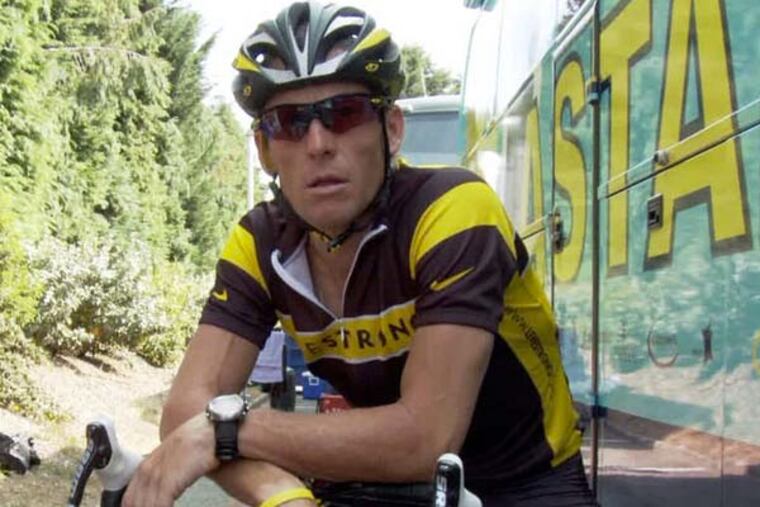
WHEN ALEX GIBNEY started to follow Lance Armstrong around to document his pro-cycling comeback in 2009, he noticed something strange.
Cycling insiders with cameras and microphones, looking askance at him, promising to make the "real" Lance Armstrong documentary.
Gibney, a respected and decorated documentary filmmaker, was naturally confused. If they were making the real documentary, what, he wondered, was he making?
You get the complicated answer in "The Armstrong Lie," Gibney's examination of the disgraced cyclist, whose hypercompetitive personality has many facets.
One is a kind of pathological arrogance - it led Armstrong to believe he could recruit a fellow like Gibney, who'd taken on Enron, the U.S. military and pedophile priests, and spin him into a purveyor of the ongoing Armstrong myth.
At that point, of course, Armstrong had yet to officially be exposed as a drug cheat, and he'd been able to successfully maintain a thin but effective shell of deniability. Long enough to win several Tour de France titles and to retire unscathed as the beloved head of the Livestrong empire.
Gibney shows us how Armstrong brought to denial the same staggering competitive focus he brought to cycling and doping. He used his power and money and sheer will to destroy accusers. He used those same resources to be the best doper in a sport dominated by drugs - there is an informative look here at the science of doping, at how drugs are used in complex combination to improve muscle efficiency.
Armstrong perfected a doping process that had long been part of the cycling world - hired, in fact, the best doper in the business at the time. Gibney is almost too scrupulous in laying out the facts of Armstrong's drug use, revisiting races and rivalries in numbing detail. (Although the movie, curiously, avoids the issue of whether Armstrong's prodigious use of body-altering drugs and hormones might have contributed to his cancer.)
This fact-scouring resolves the who-what-when-where of Armstrong's doping, but avoids a big and overhanging question: Why did so many want to believe Armstrong? Why would anyone believe Armstrong to be the clean, seven-time champ of one of the most notoriously dirty sports in the world?
It's about more than Armstrong's cancer battle. This willful suspension of disbelief extends to all sports, to home-run hitters and 40-something power pitchers.
Sports have the Shadowlike power to cloud our minds and judgment. And this says as much about us as it does about Armstrong.
Online: ph.ly/Movies