Original 'Star-Spangled Banner' and manuscript in tandem display
The original, handwritten manuscript of "The Star-Spangled Banner" and the flag that inspired the lyrics will be displayed together at the Smithsonian in Washington, the first time the historic pieces are believed to have been shown side by side.
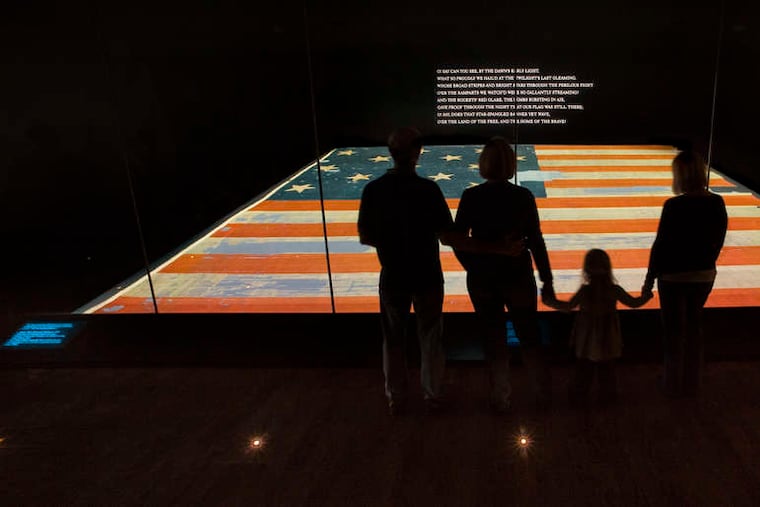
WASHINGTON - The original, handwritten manuscript of "The Star-Spangled Banner" and the flag that inspired the lyrics will be displayed together at the Smithsonian in Washington, the first time the historic pieces are believed to have been shown side by side.
The manuscript is ordinarily on display at the Maryland Historical Society in Baltimore, and the flag has been at the Smithsonian since the early 1900s. They will be displayed together from Flag Day, June 14, through July 6. The three-week display is the start of celebrations marking 200 years since the song was written on Sept. 14, 1814.
Bonnie Lilienfeld, a Smithsonian curator working on the manuscript display in Washington, said she hoped the exhibit would help people think more about where the lyrics came from. Having the two objects together provides an "aha moment," said Jennifer Jones, the curator who oversees the flag.
"It's meant to be emotional. It's meant to be reflective," she said.
Francis Scott Key was a 35-year-old lawyer and amateur poet when he wrote the words during the War of 1812. Key watched as the British bombarded Baltimore's Fort McHenry for more than 24 hours. When he saw the fort's flag flying on the morning after the bombardment, a sign that U.S. troops had withstood the enemy, he was inspired to write a poem originally called "Defense of Fort McHenry." Set to music and renamed, it became the country's national anthem in 1931.
Key's original manuscript, written with quill and ink, has two surprises for visitors who know the song. First, Key's poem runs to four stanzas, though the first is the only one traditionally sung. And Key wrote, "Oh say can you see through the dawn's early light," but crossed out through and wrote by.
Americans may be more familiar with the flag, which gets millions of visitors a year at the Smithsonian's National Museum of American History. It has been at the Smithsonian for more than a century, since it was given to the institution by the family of Maj. George Armistead. Armistead was the commander of Fort McHenry and the man who commissioned the banner with 15 stripes and 15 stars, representing the number of states in the Union at the time.
Except for a period during World War II, when it was housed in Virginia for safekeeping, the flag hasn't traveled outside Washington since going to the Smithsonian.
Key's manuscript has traveled only slightly more often since being bought for the historical society in the 1950s. In 2011, it was taken, in an armored vehicle with a police escort, to the state capital in Annapolis and to Fort McHenry. In 2013, the museum took the manuscript to Mount Olivet Cemetery in Frederick, Md., where Key is buried.
Burt Kummerow, president of the Maryland Historical Society, said he hoped this summer's exhibit would be a chance for people to study the lyrics. He compared the song to a church hymn, something that has become so familiar that what Key was trying to say can get lost. And he called putting the manuscript and flag together a "very, very special moment."
"It isn't going to happen again anytime soon," he said.