"The Disappearing Quarterback": An appeal beyond only football fanatics
'I really don't think of this as a football play." The statement sounds strange coming from Mike Boryla, a former pro-bowler who led the Eagles' offense from 1974-76 and titled his work The Disappearing Quarterback.
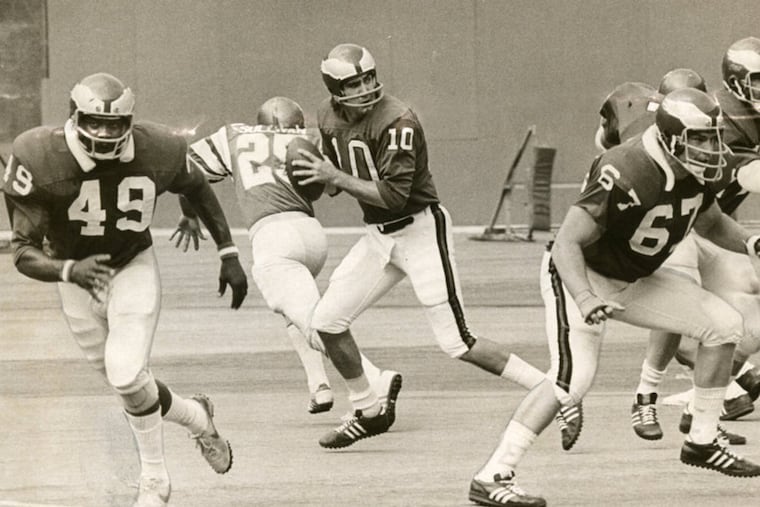
'I really don't think of this as a football play."
The statement sounds strange coming from Mike Boryla, a former pro-bowler who led the Eagles' offense from 1974-76 and titled his work The Disappearing Quarterback.
However, according to Stanford standout Boryla, football serves only as a backdrop for his 75-minute work, which opens in its world premiere this weekend at Plays & Players Theatre.
That backdrop includes stories, game recaps, and humorous episodes off the field culled from two decades in the sport, from third grade through high school, college and the NFL, until 1978, when the Eagles traded Boryla to the Tampa Bay Buccaneers. Boryla played one game for the Bucs before disappearing into retirement.
Boryla's use of football, as he tells it, is twofold. He wants to explore the "duality of the pro-football experience" on behalf of his former teammates. That duality consists of the fun and humor playing with "some of the funniest guys I've ever met," and the tragedy that the sport has inflicted so much misery, including a number of friends "already dead from football-related injuries."
In this latter regard, Boryla's play deals head-on with repeated concussions, a medical, legal, and ethical concern still contested in the media and in a class-action lawsuit filed in federal court in Pennsylvania by more than 3,000 former players and presided over in Philadelphia. Boryla suffered three concussions while in the NFL; his play opens with his recovering from one of his blackouts, which he said would last up to 15 minutes and during one of which he led a 10-play drive that he doesn't remember at all.
Each concussion would leave Boryla "sobbing uncontrollably on the sidelines," which he says frightened teammates and kept his coaches from letting him practice for a week. Although still an imposing figure at 6-foot-2, Boryla freely admits, "I would never play pro football today." In Boryla's playing days, the most fearsome defensive lineman in the league was the 6-foot-4, 245-pound Alan Page (now an associate justice of the Minnesota Supreme Court). Today, a quarterback has to face the blows of linemen like 6-foot-4, 340-pound Terrence Cody of the Baltimore Ravens.
It's this window into the human side of football that Boryla believes will appeal to all theatergoers, and not just Philadelphia sports lovers. While the die-hard Eagles fan will no doubt enjoy hearing about hotel room pregame rituals that involved eating glass and about the in-huddle humor (Boryla says there's nothing salacious in the play), Boryla's target audience also consists of "married women between 45 and 65, who love theater but know absolutely nothing about pro football." He believes they will identify with and enjoy the play's journey and theme, a classic tale of how a "young man survives and keeps his humanity while negotiating through reality."
Director Daniel Student agrees that Boryla's theme has appeal. Plays & Players built the arc of its current season around works dealing with brothers and sisters, and The Disappearing Quarterback deals with "the extended brotherhood" of professional football players and how one young person "gets through his path by finding people to get through that path with."
This brotherhood is the second reason Boryla used football as a backdrop. "I could've made it about a guy that joined a shrimp boat crew and how he survives that rough and tumble world" (much like the Wilma Theater's 2013 production Under the Whaleback). Instead, Boryla sought to honor the men he played alongside and then left behind. He hopes his work encourages them to "tell their story" and to let audiences hear a history of humor and heartbreak that they might not have originally found worth hearing.
THEATER
The Disappearing Quarterback
Premieres at 7 p.m. Thursday at Plays & Players Theatre, 1714 Delancey Place. Through Feb. 2. Tickets: $25-$30.
Information: 866-811-4111 or www.playsandplayers.org
EndText