Classical music review: Faust and Melnikov meet Beethoven et al.on their own terms
What a difference when chamber music is played with absolutely no extraneous sound. Violinist Isabelle Faust and pianist Alexander Melnikov have considerable big-concert-hall careers. For Monday's Philadelphia Chamber Music Society concert at the Kimmel Center, however, they left that part of their musical lives behind and met small-scale works from the Beethoven, Weber, and Schubert repertoires.
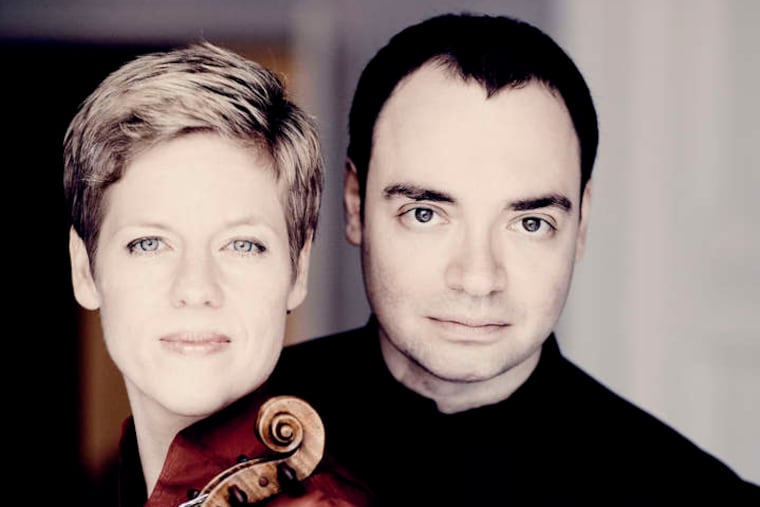
What a difference when chamber music is played with absolutely no extraneous sound.
Violinist Isabelle Faust and pianist Alexander Melnikov have considerable big-concert-hall careers. For Monday's Philadelphia Chamber Music Society concert at the Kimmel Center, however, they left that part of their musical lives behind and met small-scale works from the Beethoven, Weber, and Schubert repertoires - so much on their own terms (even more than in their prestigious recordings for Harmonia Mundi) that the results eschewed conventional thrills and entered this surprisingly distant musical world as few do.
The program might have been titled Music on the Verge of Professionalism, with much of it hailing from the turn of the 18th into the 19th centuries, when composers moved away from writing chamber music for domestic use and toward concert works as we now know them. Selections were on both sides of that line. Two lightweight Weber violin sonatas from his Op. 10 were conservative and undemanding, with the odd outburst suggesting Biedermeier tantrums.
Beethoven was represented by his earlyish Violin Sonata in E flat (Op. 12, No. 3) and late-ish Violin Sonata in G (Op. 96), the former work played with a clearer sense of its humbler origins than one usually hears from modern performers. The latter is Beethoven's most forward-looking piece in this medium; this performance suggested how strange this deeply personal music had to have been when first heard.
In getting to the true nature of this era, Faust and Melnikov kept the sound envelope small, yet revealed the world of experience that could be found in such narrow boundaries. Put simply, big-concert playing can act as a smokescreen for the music's details. Every moment had a jewellike coherence, often with a sense of strong emotion under wraps.
I still don't understand what those silly Weber pieces were doing there, except to make Beethoven look even greater in comparison. And nothing the players could do could minimize the windiness of Schubert's Fantasy in C Major. In the extensive, third-movement variations on the song "Sei mir gegrusst," you sensed the performers would have been happy to stick with the song rather than its loopy reiterations.
The encore, John Cage's early-period Nocturne (1947), might have seemed incongruous if the piece hadn't been perfectly in step with the quieter character of the concert. The more one knows Cage, the more soft-spoken he is, with gentle Debussy-style chords in the piano, and wistful, long-breathed writing in the violin.