Flamenco opera
Take a MacArthur "Genius Grant" recipient as your composer, add a Tony Award-winning playwright who has collaborated with the likes of Philip Glass and Elton John, and what do you get?
Take a MacArthur "Genius Grant" recipient as your composer, add a Tony Award-winning playwright who has collaborated with the likes of Philip Glass and Elton John, and what do you get?
In a word: Ainadamar.
A Grammy Award-winning opera by Osvaldo Golijov, with a libretto by David Henry Hwang, Ainadamar premiered in 2003 at Tanglewood and later was lauded by the Los Angeles Times as "one of the most moving and meaningful operas of our time." On Friday, Opera Philadelphia's production - unusual, in many ways - will open at the Academy of Music and run through Feb. 16.
In a series of flashbacks, Ainadamar (pronounced "eye-nah-dah-MAHR") evokes the controversial life and tragic death of the celebrated Spanish poet and playwright Federico García Lorca. The Granada native was assassinated for his political and personal affiliations - populist, antifascist, and gay - by Franco's troops in 1936, reportedly at a large natural spring. Hence, the title, an Arabic word meaning "fountain of tears."
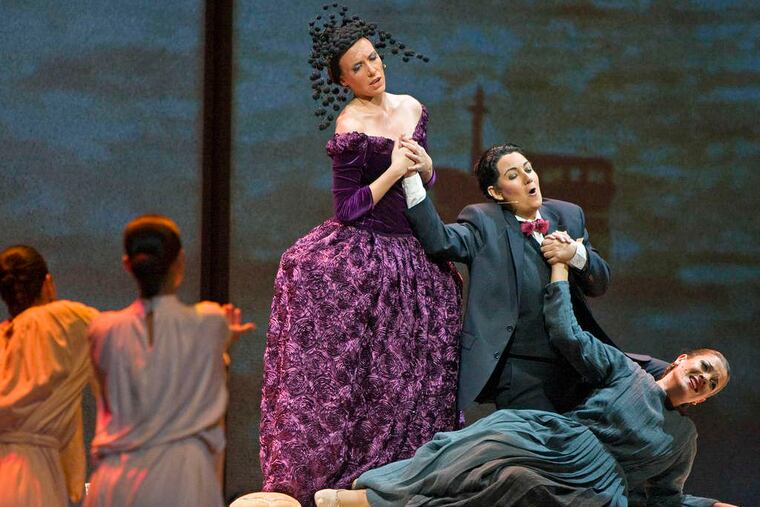
Ainadamar explores its subject from the viewpoint of Margarita Xirgu, a Spanish actress who was García Lorca's friend, political compatriot, and artistic muse. Xirgu recalls how she got to know the writer, and how she, while in exile in Latin America during the Franco years, helped keep his art alive by performing in his plays.
In this innovative production, the all-female chorus joins the orchestra and conductor Corrado Rovaris in the pit. The stage is free for the other singers and, more significant, the Antonio Gades Dance Company.
Operas with Spanish themes (e.g. Carmen) often include a bit of dancing. But the Gades troupe, one of Spain's most important and inventive flamenco companies since its founding 50 years ago, is an integral part of this opera. Gades died in 2004; the group's artistic director, Stella Arauzo, who choreographed Ainadamar, was Gades' principal dancer and carries on his artistic legacy.
Gades was a pioneer in using the movement vocabulary of flamenco, mixed with modern and other dance forms, to tell stories. And García Lorca was a flamenco aficionado, so this art form is entirely appropriate. Golijov demonstrates his respect for this tradition by highlighting both flamenco dance and flamenco singing, by the masterful Alfredo Tejada.
Last week, I had the opportunity to observe a rehearsal for Ainadamar, and spoke with Arauzo and assistant choreographer Antonio Hidalgo. Both artists stressed the special character of the Gades dancers, who are trained to act with their faces and bodies. As a result, Arauzo said, "They're not simply dancing; they're doing theater, participating in the overall production."
Hidalgo added, "Gades' technique breaks down the barriers between opera and dance. You don't have singers standing there, stiffly, making music, and then interludes with other people dancing."
Moreover, the principal singers in Ainadamar move well. That is not always the case, even with very fine opera singers.
And these singers are very fine. The role of Margarita Xirgu is sung by Catalan soprano María Hinojosa Montenegro. Spanish mezzo-soprano Marina Pardo plays García Lorca in a "trouser" role - a woman portraying a male character. The third vocal lead, Nuria, a protegee of Xirgu's, is young American soprano Sarah Shafer.
Trouser roles appear in works by Mozart, Haydn, Wagner, and many other historical composers. But they are rare in contemporary opera. During a rehearsal break, I asked Shafer about this. "Performing with a female García Lorca," she said, "doesn't seem odd at all." She noted the similarity between the final, exquisite vocal trio in Ainadamar and the one at the end of Strauss' Der Rosenkavalier - also sung by three women, one playing a male character.
Shafer is a local gal. At 25, she could easily pass for 15, with a sweet face, enormous eyes, and a rehearsal outfit featuring lavender socks patterned with fluffy yellow chicks. But Shafer is an accomplished artist. Born and raised in State College, she earned her bachelor's degree from the Curtis Institute of Music, where she is completing her master's while adding to an already impressive resumé. Since her professional operatic debut in 2012, Shafer has appeared in operas in the United Kingdom, San Francisco, Memphis, and Philadelphia.
In a stroke of coincidence, she sang in the chorus for the Curtis Opera Theatre's 2008 production of Ainadamar. But "this is better," she asserted. Referring to Nuria, she added, "It's a great role, yet not so big that it's scary."
During rehearsal, Shafer showed no sign of fear, singing confidently alongside her older, more seasoned European counterparts.
"This is some of the most magical music I've ever heard," Shafer said of both Tejada's flamenco singing and Golijov's flamenco-inflected composition. "Even in our [operatic] parts, it's stylized; the music needs a lot of control and nuance, rather than just projecting to the far ends of the house."
Shafer said she was looking forward to trying out the wireless headset mikes that the principal singers will wear. Rick Jacobsohn's sound design uses these, along with recorded tracks for certain effects - sounds of water that morph into horses' hoofbeats, a fusillade of rifle shots - to complement video projections by Julián de Tavira.
OPERA / DANCE
Ainadamar
Friday and Feb. 14, 8 p.m.; Feb. 12, 7:30 p.m.; Sunday and Feb. 16, 2:30 p.m. Academy of Music,
240 S. Broad St.
Running time: 80 min.,
no intermission.
Spanish with English subtitles.
Tickets: $10-$232
Information: 215-893-3600
EndText