Uggams, overlooked part of black history, coming to Bucks playhouse
She may be a singer, but Leslie Uggams is mostly unsung as a TV pioneer.
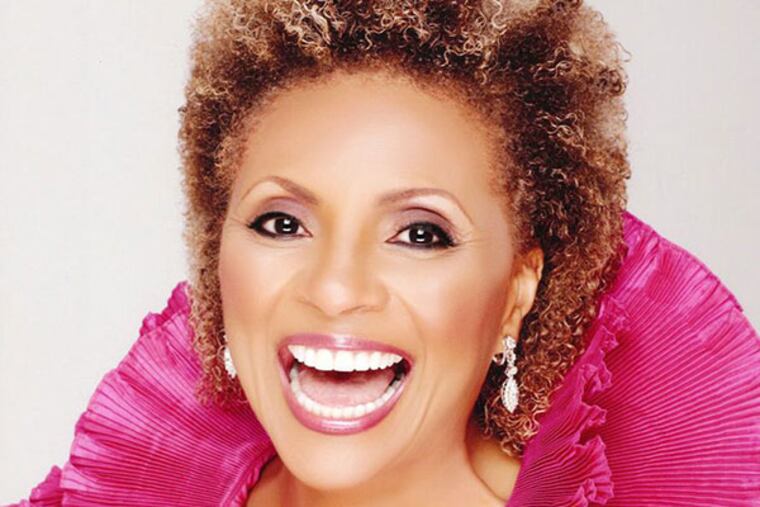
IF LESLIE Uggams feels that she's been underappreciated as a show-business pioneer, she is too gracious and humble to make a big deal about it.
"I have no control over that," said the 70-year-old singer-actress, who Saturday presents "An Evening with Leslie Uggams" at the Bucks County Playhouse, in New Hope. "I've done what I've done in my career to push things forward. It's really up to others to do their research and find out what I've done."
What Uggams did was considerable and significant, although she's not necessarily thought of in the same way as such groundbreakers as Bill Cosby ("I Spy") and Diahann Carroll ("Julia"), who made television history by being the first African-American man to star in a network drama, in 1965, and the first African-American woman to portray a leading character who wasn't a maid or similar stereotype, in 1968.
In 1961, the then-17-year-old Uggams was hired by record-company exec Mitch Miller to be a regular part of his weekly "Sing Along with Mitch" musicale on NBC-TV.
Although Sam Cooke and Nat King Cole had beaten her to the variety-show punch with their mid-'50s self-titled programs, Uggams was the first black woman to star successfully in that format. (Hazel Scott had a short-lived show in the early 1950s.) Not surprisingly, her presence on "Sing Along with Mitch" wasn't universally acclaimed.
Her participation, she recalled during a recent phone call to her Manhattan home, "met with a lot of resistance from the South. [Stations there] blacked out the show because I was on it."
Miller, who likewise is undersung for his role in mainstreaming African-Americans in the media, could have acquiesced and 86'ed Uggams - a move that likely would have caused few ripples in 1961.
But he stood firm.
"The sponsors, the network, everybody kept going to Mitch and saying either, 'Can she not be on the show anymore?' or 'Can we isolate her . . . and cut her out for the South?' " said Uggams.
"And Mitch kept saying, 'No, no, no! She's part of the show and she's staying on the show.' He really laid it on the line. He had tried for four years to sell [the series] to a network; for him to do that for me was really quite amazing."
Fearing viewer backlash in the South, sponsors did boycott the show - a situation that Uggams admitted she wasn't aware of as it was happening. Nor, she said, did she know at the time that some Southern NBC affiliates refused to air the program. But she certainly understood that not everyone was thrilled to see her on their televisions.
"We had death threats," she said. "At one point, the FBI was hanging around Mitch and me. It was very scary. I wasn't used to that. My parents weren't happy about it, either. But you can't live your life in fear. I just went about what I was supposed to do.
"My thought was, I ain't gonna die, so I don't care what they say. I just kept doing what I was doing."
Ultimately, Miller and Uggams got the last laugh. "We became such a smash hit; everybody was talking about the show," she noted. "So the [Southern network affiliates] said, 'Never mind. We've changed our minds.' Our greatest fan mail came from the South, which was really interesting."
Amazingly, "Sing Along with Mitch" wasn't Uggams' first go-round with precedent-shattering television. Her TV debut was in 1950 when, at age 6, she portrayed the niece of Philadelphian Ethel Waters on ABC's "Beulah," the first sitcom to star an African-American.
And she was a key part of another broadcast milestone: In 1977, she played the slave named Kizzy in the iconic ABC miniseries, "Roots."
For those not doing the math, that means that Uggams has been in the public eye and ear in seven different decades. Which, she suggested with a laugh, gives her plenty of material for the kind of one-woman show she has planned for Bucks County Playhouse.
"There's so much stuff I can do," she said, "I could be out there for three weeks!"