'Peabody' a funny expansion of the original
"Mr. Peabody and Sherman" turns the Jay Ward original into a funny, even moving story of a dog and his boy.
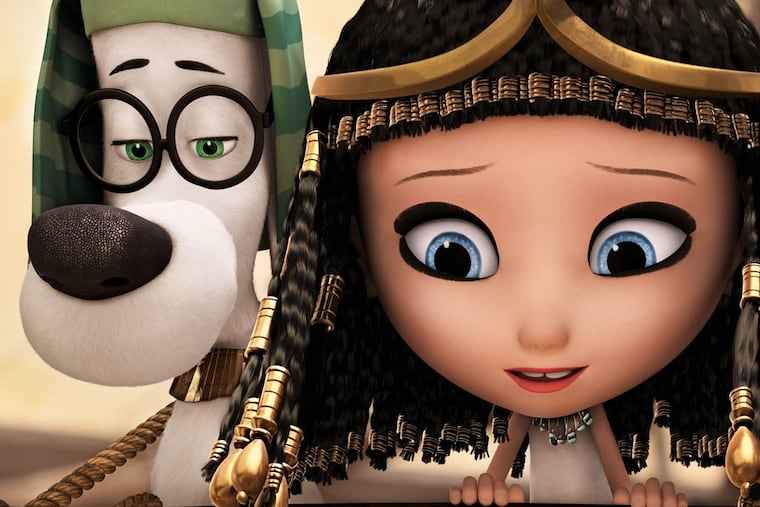
IN THE COSMOS of brainy cartoon dogs, Mr. Peabody remains unsurpassed.
No less a pop-culture connoisseur than Seth MacFarlane acknowledged this in "Family Guy," when Peabody-inspired Brian took a time machine back to visit Christopher Columbus.
Now the time has come for the tributes and references to give way to the real thing - a 3-D animated feature "Mr. Peabody and Sherman," adapted from the beloved '60s Jay Ward animated short about a time-traveling pedagogical dog and his adopted boy Sherman.
The movie totally gets Peabody, the kicky smarts that made the original a standout, and though it backs off a bit from the free-wheeling, absurdist anarchy of the TV show, it does so in the interest of a more full-bodied movie experience.
The dog/owner premise of the original gives way to a surrogate father/son drama, and maybe a subtle message about "mixed" families. Peabody is voiced by Ty Burrell of "Modern Family," who imitates the character's erudite diction while adding a paternal, emotional edge the movie is looking for.
Peabody is the genius/industrialist/inventor who adopts a boy (here from the cradle), raises him as his son, tutors him with a time machine (the WABAC) that enables them to see "history" firsthand.
Sherman thus becomes a bit of a know-it-all in elementary school, where he runs afoul of queen bee Penny, leading to a dispute that leaves Peabody's custody of the boy in doubt.
Peabody patches things up by inviting the girl to his Tony Stark-ish pad (the movie's design is funny and clever), where the three end up in the WABAC, visiting King Tut and Da Vinci, wreaking all manner of historical, comical havoc.
Cartoons that celebrate intellect are rare in the American canon of animation. In researching animated dogs, I was shocked, for instance, to find out that Scooby-Doo had a cousin named Scooby-Dum, somehow less intelligent that Scooby himself.
It's probably for this reason that Peabody has languished, unadapted, as every baby-boomer cartoon this side of Johnny Quest made it to the big screen.
But maybe the wait was a good thing. Peabody lingered long enough for the project to fall into the eager hands of Peabody-nut and "Lion King" director Rob Minkoff, who spent more than a decade bringing it to the screen.
His affection for the show, his care in bringing it to the big screen, are evident in every frame.
Online: ph.ly/Movies