If WWII had never happened
C.J. Sansom's alternative-history thriller Dominion takes place in Britain in 1952, but it's not a post-World War II novel. That's because World War II has never happened. Dominion's ingenious premise is a doozy: In 1940, Neville Chamberlain was succeeded as prime minister by Lord Halifax rather than Winston Churchill. Rather than continue to fight on at all costs against Nazi Germany, Britain signed a peace treaty with Hitler after suffering crushing defeats in Norway and Dunkirk in 1940.
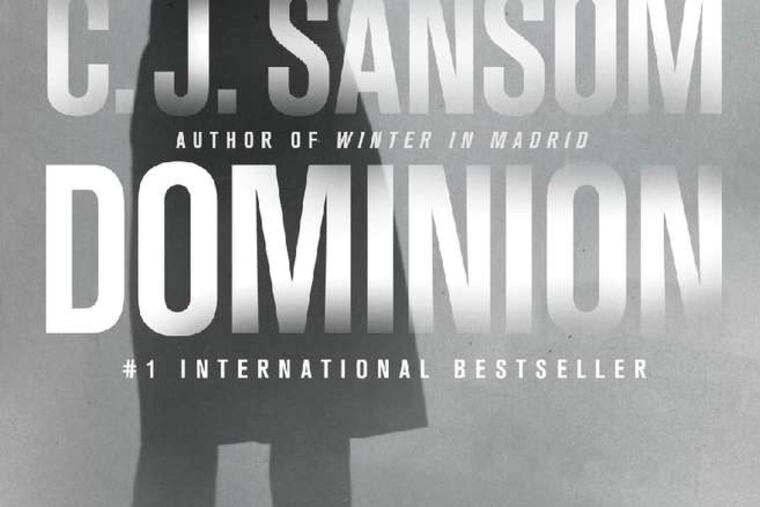
Dominion
By C.J. Sansom
Mulholland Books. 629 pp. $28
nolead ends nolead begins
Reviewed by Dan DeLuca
C.J. Sansom's alternative-history thriller Dominion takes place in Britain in 1952, but it's not a post-World War II novel.
That's because World War II has never happened. Dominion's ingenious premise is a doozy: In 1940, Neville Chamberlain was succeeded as prime minister by Lord Halifax rather than Winston Churchill. Rather than continue to fight on at all costs against Nazi Germany, Britain signed a peace treaty with Hitler after suffering crushing defeats in Norway and Dunkirk in 1940.
London is spared the Blitz, and America reaches a nonaggression accord with Japan, so Pearl Harbor never happens and the United States doesn't enter the war.
Instead, in 1952, Germany is preoccupied with an unending war with the Soviet Union, even as the country gains ever more power over all aspects of society in England. Jews are forced to wear yellow stars and fascist leader Oswald Mosley is a powerful force in the cabinet of Lord Beaverbrook, the press baron and Nazi sympathizer who now serves as prime minister.
Hitler is still alive - though suffering from advanced Parkinson's disease. Swastikas, like the one on the armband of a London bobby shown on Dominion's cover, are a not uncommon sight in not so merry old England. The Gestapo plans to move the Jewish population into detention camps on the Isle of Wight. In America, with Dwight D. Eisenhower an unknown who didn't get the chance to lead the D-Day invasion, Adlai Stevenson has just been elected president.
And what of Churchill, the bulldog-faced leader who, in real life, possessed the iron will to inspire the Brits to stand up to the Nazis? He's in hiding, leading the Resistance, his cigar-smoking face splashed on Wanted: Dead or Alive posters throughout the United Kingdom.
Against that backdrop, Dominion builds human drama, focusing on wholly fictional characters. They're caught up in fast-paced action that involves cloak-and-dagger spying, Resistance combatants hiding out in safe houses, and a precious cargo that could allow the Germans to obtain the not-yet-developed atomic bomb.
The story unfolds around David Fitzgerald, a civil servant in the Dominions office, in charge of relations with territories in the British Empire, still largely intact with Mohandas K. Gandhi having died in prison and India not yet independent. After sharing his concern about creeping fascism with his Cambridge classmate Geoff Drax, he's recruited to join the Resistance.
To protect his pacifist wife Sarah, he doesn't tell her of his deepening involvement, which leads to assignations in a Soho flat that, naturally, require him to work in close contact with a beautiful Bratislavan coconspirator named Natalia, who is also an expert markswoman.
The book turns on the predicament of David, detached and disengaged by nature but compelled by a moral imperative that arises out of a secret of his own: His late mother was Jewish. He decides he can't stand idly by as the Brits succumb to notions of racial purity pushed by the Germans (who regard the British as fellow Aryans). But as his commitment strengthens, the more danger he creates for those around him.
Dominion belongs in the company of other what-if World War II-era histories. Robert Harris' bestseller Fatherland imagines a world in which Germany won the war and Joseph P. Kennedy becomes U.S. president. In Philip Roth's literary The Plot Against America, appeaser Charles Lindbergh defeats Franklin D. Roosevelt in the 1940 American presidential race and a wave of anti-Semitism is unleashed in the U.S.
Sansom, a former lawyer who is the author of the Shardlake series of mystery novels set in 16th-century England during the reign of Henry VIII, is a skilled storyteller. He occasionally slows the story down for serious discussion (and a little too much speechifying) about race and nationalism and empire, before kicking back into action gear.
He has mixed success when it comes to fleshing out his characters in an espionage saga with multiple moving parts. Most of his bad guys are one-dimensional - as are some of the good guys, like the lonely and unstable scientist with a secret.
But the author does quite well with Gunther Hoth, an experienced hunter of Jews and fluent English speaker who's called in from Berlin. He's married to his job, recently divorced, and with a brother a casualty of the Russian front, left only with the Reich.
Hoth knows there's trouble ahead with the Fuhrer ailing and Joseph Goebbels and Heinrich Himmler both looking to succeed him, and Sansom renders Hoth nearly sympathetic, until he starts musing on mass sterilization, or tortures a prisoner in a particularly horrifying way. That's when moral indignation really kicks in, as you page-turn your way toward the end, rooting for the evil Nazi to get what he deserves.
215-854-5628
@delucadan