David Allen Sibley at Free Library: A passion for painting birds
It was a day in 1980 when the kid walked into the Cape May Bird Observatory. He'd left Cornell and wanted a job as the person who leads the Cape May Point hawk count during the fall migration.
It was a day in 1980 when the kid walked into the Cape May Bird Observatory. He'd left Cornell and wanted a job as the person who leads the Cape May Point hawk count during the fall migration.
While he was at it, the kid asked if the center's director, legendary birder Pete Dunne, wanted to see his field sketches.
As Dunne recalls, they filled five loose-leaf binders. And even then, they were "just magnificent."
The kid was David Allen Sibley.
By now, Sibley's depictions of birds are known to pretty much every birder in the nation because they fill his field guides.
When The Sibley Guide to Birds came out in 2000, it was hailed as a birding game-changer, perhaps eclipsing even the venerated guides by Roger Tory Peterson. "His first guide was catalytic," Dunne said. "Nobody had laid out birds in such a systematic fashion."
Peterson was all about plumage - wing bars and tail spots, Donne said. Sibley was all about shape.
By now, birders have bought more than 1.5 million copies of the guide and its Eastern and Western splits. That figure is surely growing because on March 11, Alfred A. Knopf released the second edition.
To introduce the new edition, Sibley, 52, of Concord, Mass., has embarked on a multicity book tour that this week includes Philadelphia. He'll speak Sunday at 2 p.m. at the Free Library.
He said he'll talk about the new edition and, more broadly, about what makes bird-watching so great.
The new guide has more of everything. The illustrations were enlarged by 15 to 20 percent. There are 600 more than before, about 7,000 total, and more than 100 rare species have been added. Range maps were improved. He's added more text and 80 pages.
And, yes, a few corrections. As an author, he said in the foreword, mistakes are frustrating. "But as a birder it is invigorating. Our understanding of birds and nature is always advancing."
One of the most immediately noticeable changes: the cover itself. The red-tailed hawk has been replaced with a Magnolia warbler, which will pass through this region on its northward migration later this spring.
Sibley says the warbler is one of his "spark birds" - a term birders use to describe a specific bird that ignited their interest.
Sibley was just in third grade at the time, and his father, a well-known ornithologist, was director of the Point Reyes Bird Observatory in California. Sibley came home from school just after a Magnolia warbler had been trapped and banded and was ready to be released. "I got to look at it up close, hold it in my hand," he recalled. "Then we released it and it flew off into the woods and disappeared. It was a magical moment."
According to a 2011 U.S. Fish and Wildlife Service survey, of all the wildlife in the nation, birds have the biggest following. More than 46.7 million people watch birds, either at home or on trips. They spend billions of dollars on equipment, travel and, yes, field guides. (Sibley's second edition costs $40.)
For Sibley, it's many things - an excuse to get outdoors and connect with the nature world, for one. Birds are constantly changing and moving around. For many, it can be challenging to identify them, to even just find them, so you have to learn a lot about them.
Sibley has birded since he was 7. He'd been drawing even before that, even - almost as soon as he could hold a pencil.
Now, he paints in a technique called gouache, a variation of watercolor that allows the artist to add detail by layering colors.
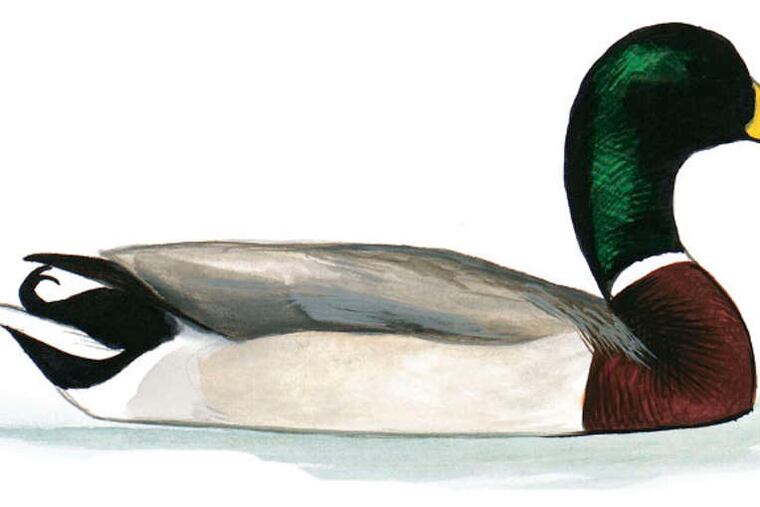
Painting a bird allows him to simplify the image, he said. He can choose the pose - almost all his birds are in profile, facing right - and excise the fuss, the background, the shadows.
A photograph, on the other hand, is "recording every detail of that scene without giving any extra importance or emphasis to any one thing."
Still, photographic field guides have their place, and an important one at that, many birders say.
The ideal situation is to have both, said Doug Wechsler, who directs the VIREO collection of more than 95,000 bird photographs at the Academy of Natural Sciences of Drexel University. Although, he adds, given the weight of some of these books - the new Sibley is nearly three pounds - "maybe not in the field."
"It's easier in a photograph to capture the essence of the bird, but harder to get all the field marks," Wechsler said.
For much of the time he was working on the first edition, Sibley lived in Cape May, the birding mecca where he did, indeed, get the job of hawk counter that year.
He described it as being a "critical part of the research and study," given not only the wealth of birds that live there or migrate through, but also the expert birders who migrated there as well.
In 1984, he joined several other birders to compete in the first World Series of Birding, an annual event in which teams race to spot the most species in New Jersey in 24 hours.
They won, recording 201 species.
Dunne also was on the team, as was another bird illustrator who later said of Sibley, "He certainly has a marvelous sense of shape, doesn't he?"
It was Roger Tory Peterson.