'Noah': A story with a very interesing ark
Russell Crowe is Noah in a visually spectacular, provocative, wildly embellished version of the Genesis story.
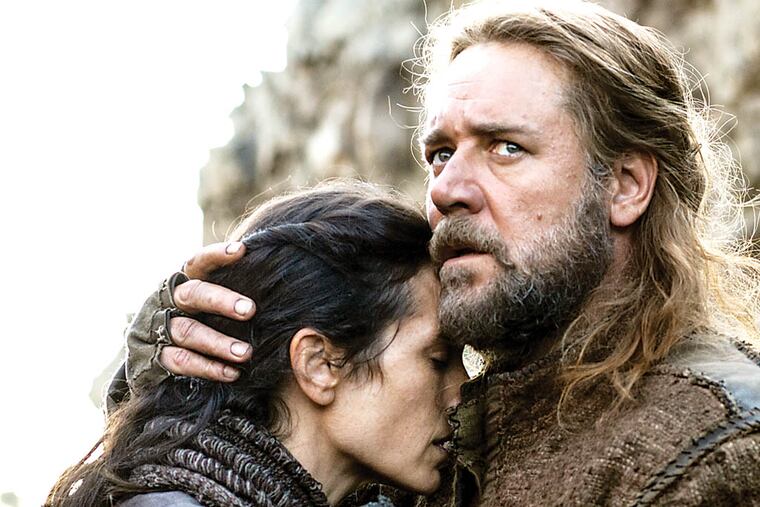
"NOAH" director Darren Aronofsky has called his new epic "the least biblical film ever made" and, having seen it, I can tell you that he's full of beans.
True, the movie is not woodenly faithful to the traditional story, but it's certainly biblical, padding the brief story of Noah (three dozen paragraphs in Genesis) with borrowings from later passages: from the Old Testament, the story of Abraham and Isaac; from the New Testament, miraculous pregnancies, paraphrasing of questions asked by Jesus of God, ideas from Revelations.
Too bad fundamentalists have predecided that they aren't going to Aronofsky's provocative new movie, because the more you know about the Bible, the more you'll get out of the director's crazy mash-up.
Remember the Nephilim? I sure didn't, until I reread Noah's story and found a reference to this bygone race of mystery men. Scholars describe them as "fallen angels" or "watchers," depending on translations, and Aronofsky has clearly considered the scholarship.
He turns these so-named Watchers into stone giants (very Peter Jackson) who assist Noah (Russell Crowe) in building the ark, a vessel that does indeed find itself full of animals to be saved from the pending flood.
Yes, this is Aronofsky's eccentric interpretation, but it's intended to engage and entertain (the stone watchers help construct and defend the ark, which makes a weird kind of sense), not to offend. Remember, one popular "interpretation" of the story of Noah and his son Ham (Logan Lerman) was used for centuries to justify slavery.
That's offensive.
Aronofsky's Genesis rewrite feels like the work of a dramatist, not a condescending atheist. For instance, he turns Noah from a passive follower of directions to a man of action, taking up spear and sword to fend off the armies of the wayward and wicked (led by Ray Winstone).
It's an interesting performance by Crowe, who plays Noah as a man sure of his faith but not at all enthusiastic by his grim task. Noah does his duty but suspects that much of what is meant to be cleansed by the flood is present in his family, and in himself.
These themes surface in Noah's fraught relationships with his wife (Jennifer Connelly) and sons, who have obvious questions about how mankind is to be reconstituted when, and if, they all survive.
Here again, Aronofsky fills in the blanks, giving Shem (Douglas Booth) a wife (Emma Watson), the key figure in a wildly embellished plot that, if nothing else, keeps life aboard-ship rather lively.
The result is a movie that does not revere the text, but is respectful of its ideas. Its themes, in fact, could fairly be described as pro-life. Human and otherwise.
Rumors that the movie has an environmental agenda turn out to be true. But so, some would argue, does the Bible. Revelations 11:18: "God will destroy those that destroy the earth."
Again, readers can find different meaning in that phrase. The Bible endures because it invites, rather than discourages, the search for meaning of which "Noah," in its own nutty way, is a part.
And some of Aronofsky's most pointed provocations are made toward atheists. When Winstone's character turns one of Noah's animals into a meal, he's told that the animals are precious, that there are only two of every kind. His response: "Well, there's only one of me," a line that seems aimed at modern moral philosophies constructed around self-interest.
And the movie's most interesting visual sequence suggests that creationists and evolutionists are arguing over different versions of the same story.
Aronofsky looks for points of agreement. He settles on the idea that life, whatever its origins, is miraculous, and that if man is to protect the gift he's inherited, he must act.