Nézet-Séguin's Schumann cycle stirs debate
Is it backlash or breakthrough? Maybe both with Yannick Nézet-Séguin's new Schumann symphony set on Deutsche Grammophon that recently hit the market: It's both adored and dismissed, though not for any uniform reasons.
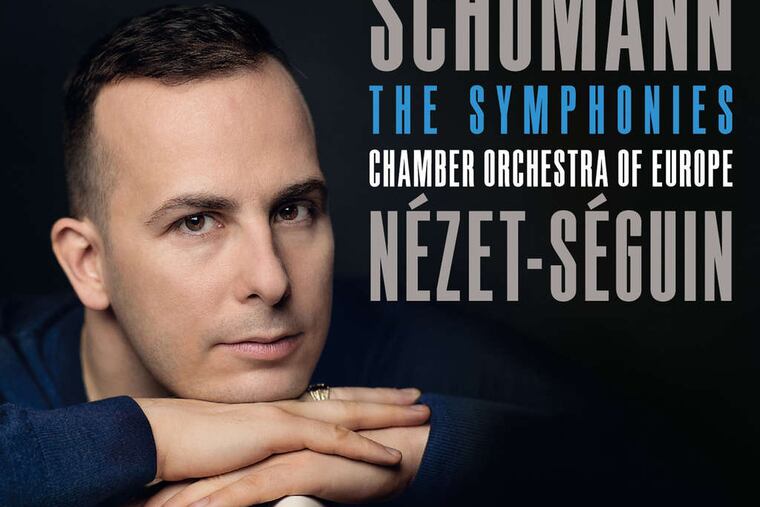
Is it backlash or breakthrough? Maybe both with Yannick Nézet-Séguin's new Schumann symphony set on Deutsche Grammophon that recently hit the market: It's both adored and dismissed, though not for any uniform reasons.
Rather than recording the symphonies over time with one of his home orchestras (Rotterdam or Philadelphia), Nézet-Séguin opted for the Chamber Orchestra of Europe (COE) during an intensive series of concerts at Paris' Cité de la Musique, plus a patch session.
The reaction in England (where the set has been out longer) included a pan from Andrew Clements: "Nézet-Séguin seems to have little to offer in the way of interpretive insights. Tempi are often pushed to extremes . . . ."
In Gramophone magazine, the set landed in the prestigious "Editor's Choice" section, with an extremely laudatory review from David Thresher: "Schumann lite this may be, but it now becomes a heavyweight contender in a far-from-uncrowded corner of the market."
Other reactions are similarly polarized, the only consistent point of reference being Nézet-Séguin's decision to use a chamber orchestra. Some simply don't like the smaller sound envelope. For others, the absence of a thicker orchestra sound lifts a curtain that can keep one's ears at a distance from the symphonies. Close-ups can be a revelation.
Some of Nézet-Séguin's best performances have been with COE. His choice (according to the conductor's podcast) was made to capture the quicksilver changes in the music that perhaps reflect the composer's mental illness. Nobody likes to think about that part of Schumann's life (it was nasty at the end); even the Swedish Chamber Orchestra's small-scale recordings under Thomas Dausgaard maintain Germanic dignity.
The symphonies themselves are a moving target, full of questionable orchestration decisions and repetition of themes that may not hold up under repeated exposure. Perhaps nobody since Wolfgang Sawallisch, in his classic set with the Dresden Staatskapelle, achieved so much small-orchestra detail amid big-orchestra sound. Perhaps only Leonard Bernstein has let the music off its leash as much as Nézet-Séguin, who isn't kidding when he says he hears bipolarity in this music. Clements is right to say tempos are extreme. The question is, do they speak to you?
Having first heard these performances on their initial broadcast on French radio, I didn't really feel what Nézet-Séguin was after; the Deutsche Grammophon recordings gave the sound more immediacy. I'm fine with the smaller chamber orchestra sound - the better to track Schumann's thematic development and interplay of references, especially in the revised version of Symphony No. 4 - but was initially underwhelmed by the usually commanding opening moments of the Symphony No. 1 ("Spring"). Soon, though, the performance builds into an unusually cogent organism that leads the ear straight into the heart of the symphony.
Elsewhere, the fast music is indeed fast, but veers between ecstatically breathless and mind-racing mania. Slow music feels like the calm after the storm, a relief that makes the music's sweetness even sweeter.
Some of the music's smaller gestures have a shape of their own that stands outside the overall tempo, which may raise eyebrows. It's almost balletic, especially next to the more straitlaced smaller-orchestra recordings of John Eliot Gardiner, and hugely effective.
Thresher singles out the dark, hypnotic "Cologne Cathedral" movement in the Symphony No. 3 as an instance where Nézet-Séguin achieves gravity without a big-orchestra sound. To me, it's the one disappointment.
The real test came when, after hearing this recording, I returned to classics by George Szell and Carl Schuricht, only to find their sound ungainly and their tempos lumbering. Only Sawallisch and young Bernstein were left standing. But the saying "It's just one opinion," is so applicable here. Listeners have a more personal relationship with Schumann than with, say, Brahms. And that's a great thing.