Land of the Lenape
History books have been kind to Philadelphia - the city William Penn hewed with its rational lines and ordered grid system; the city that gave birth to the Declaration of Independence.
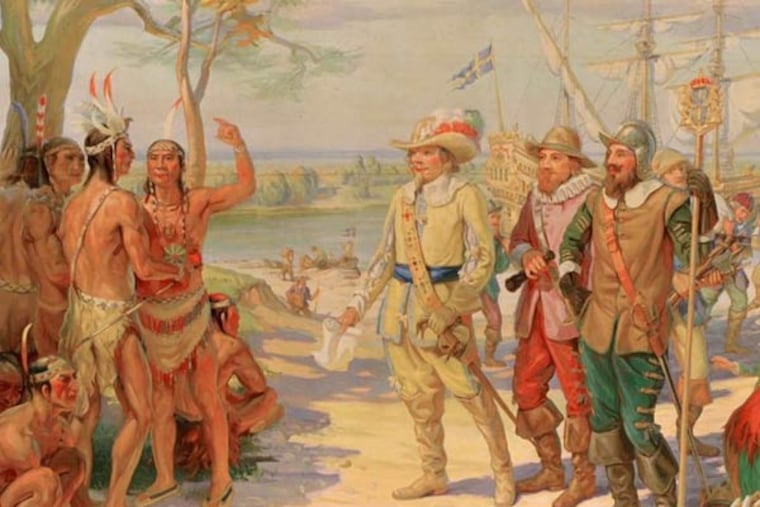
History books have been kind to Philadelphia - the city William Penn hewed with its rational lines and ordered grid system; the city that gave birth to the Declaration of Independence.
Yet historians have all but ignored the rich culture our area enjoyed before Europeans claimed it for their own.
So argues "A Lost World," the sixth episode of the documentary series Philadelphia: The Great Experiment, which tells the story of the Lenape, who called the Delaware Valley home for 13,000 years before Penn made landfall.
It airs Thursday at 7:30 p.m. on 6ABC (WPVI-TV) and also can be viewed online at www.historyofphilly.com.
"You know, it's so interesting, when you read the 300-year history of Philadelphia - there is this big book - in the first page there is a sentence that pretty much says nothing really happened here until William Penn founded Philadelphia," said episode cowriter and director Andrew Ferrett. He was referring to an 842-page opus, Philadelphia: A 300-Year History, published in 1982, which opens with the line, "If ever one man created a city, William Penn founded Philadelphia."
Added Ferrett, "Well, we've just made 25 minutes on what happened before that."
Ferrett, members of his crew, and series creator Sam Katz assembled on Monday to watch a final cut of the episode in the editing suite at the offices of Katz's History Making Productions at 12th and Callowhill Streets.
Featuring interviews with local scholars and Lenape community leaders, the episode covers the 60-year period from 1620 to Penn's arrival in 1680, when the Lenape had their first contacts with European explorers. First came the Dutch and later the Swedes, both groups in search of land they could claim for their own and resources they could strip and send home.
Eventually came the English Quakers who helped Penn found his utopian city.
Spanning the Mid-Atlantic region, the land occupied by the Lenape, or the Lenni Lenape as they called themselves, was called Lenapehoking, a voice-over explains at the top of the episode over shots of the Delaware River.
"At the center is the river, the pulsing Lenapewihittuck."
We learn that the Lenape generally eschewed warfare, believed in individual freedom, and were organized and governed under a matriarchal structure. Women were the primary authorities and were empowered to divorce if they wished.
And we're told that three-quarters of the tribe was wiped out by European diseases, including influenza.
While the Dutch and Swedes had conflicts with the Lenape, Penn and his followers tried to maintain a line of communication with them, to treat them with respect, say on-camera experts.
It's all very fascinating material.
"This was history that was largely left out of books by all the major historians of the area," Katz said.
"There is a story about our origins that comes from one side of the [Atlantic] ocean, and that's the story of the Quakers and the religious persecution they were fleeing. But there is a story on the other side of the water, about the Lenape and their persecution at the hands of Europeans before Penn arrives."
Katz said that because of its placement in a prime broadcast block on 6ABC, Philadelphia: The Great Experiment reaches an audience that generally does not watch historical documentaries. He hopes by telling the story of the Lenape, the show will inspire viewers to look afresh at the region's history: "We associate the story of Native Americans with cowboys and the West. 'What happened to them wasn't done by us,' we say. But the entire eastern coast . . . was populated by Indians, all of whom suffered a similar fate."
Added the politician turned historian and filmmaker, "I think we have a responsibility not to do what our ancestors in the community have always done by ignoring it, by skipping it over."
TELEVISION
Philadelphia: The Great Experiment
7:30 p.m. Thursday on 6ABC or at www.historyofphilly.com.EndText
215-854-2736