'The Dance of Reality': Childhood amid Chilean unrest
After an absence of 24 years, Alejandro Jodorowsky has haunted theater screens twice in as many months, first as the subject of the remarkable documentary Jodorowsky's Dune, a chronicle of his failed attempt in the 1970s to make a big-budget adaptation of Frank Herbert's Dune.
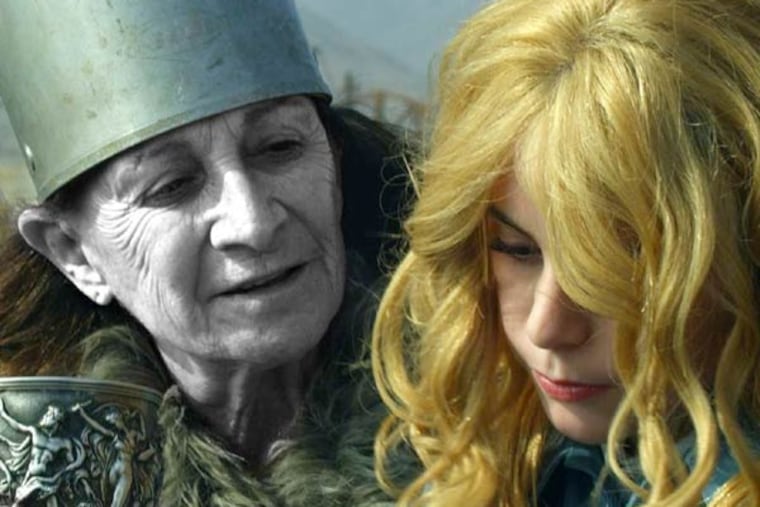
After an absence of 24 years, Alejandro Jodorowsky has haunted theater screens twice in as many months, first as the subject of the remarkable documentary Jodorowsky's Dune, a chronicle of his failed attempt in the 1970s to make a big-budget adaptation of Frank Herbert's Dune.
The 85-year-old Chilean-born auteur returns this week with his latest directorial attempt, The Dance of Reality, an intensely personal, deeply felt, if at times solipsistic autobiographical work about his childhood in Tocopilla, a seaside town at the edge of the Chilean desert.
Opening a few years after the 1929 Wall Street crash that crippled the Chilean economy (the filmmaker was born that year), The Dance of Reality chronicles the complex, ambivalent relationship between the prepubescent Alejandro (Jeremias Herskovits) and his father, Jaime Jodorowsky Groismann (played by the director's son, Brontis Jodorowsky), a Ukrainian-born Jewish merchant and would-be Stalinist revolutionary.
A sensitive child who is uniquely open to religion, poetry, and art, Alejandro is coddled by his mother, Sara (Pamela Flores) - who communicates in the film entirely through operatic song. The boy is branded a coward and sissy by his sadistic father, who decides to toughen him up for the trials and tribulations of manhood with a regime of mental and physical abuse.
The action occurs against the shadow of Chilean neo-fascism and the rise of army strongman Carlos Ibáñez del Campo (Bastián Bodenhöfer), who became president in 1927.
While the focus remains on the young child, the second half of this long film (130 minutes) follows the personal journey of his father, who abandons his communism after becoming enthralled with Ibáñez, and later throws off the yoke of politics altogether.
Jodorowsky's work often resides in the ether of spirituality, but he has always been fascinated with the political and social context that gives rise to art. Here, he does a nice job of showing how those forces shaped his own sensibility.
For the most part, the film moves with the force of dream logic, putting at play symbols and images that have saturated his greatest work, including El Topo and The Holy Mountain.
The Dance of Reality will divide viewers. Some will brand it the maestro's crowing masterpiece. (While he's certainly sprightly for his age, it's possible this film will be Jodorowsky's last.)
Others will deride the film as a cheap, self-indulgent, wholly unremarkable morality tale that takes its surrealistic pretensions far too seriously. Especially troubling are the many cameos Jodorowsky makes throughout the action to directly address the viewer.
Yet, despite its many flaws, this is a major work that deserves attention.
215-854-2736
The Dance of Reality *** (out of four stars)
Directed by Alejandro Jodorowsky. With Jeremias Herskovits, Brontis Jodorowsky, Pamela Flores, Alejandro Jodorowsky. Distributed by ABKCO Films.
Running time: 2 hours, 10 mins.
Parent's guide: No MPAA rating (profanity, nudity, disturbing images, violence).
Playing at: Ritz Bourse.