Rittenhouse Square's 'Billy' marks 100 years as a rallying point
In a shady corner of Rittenhouse Square, as summer eased into fall, Eli Green was racing around the curved benches that encircle Billy, the bronze goat that guards the corner of the park.
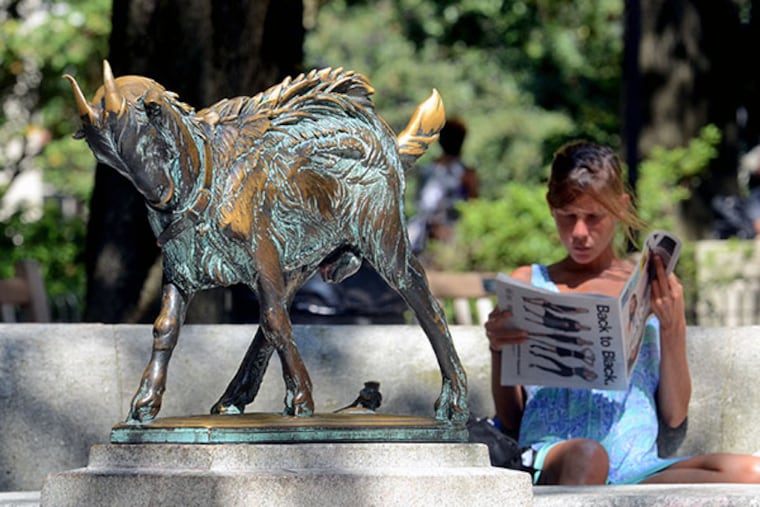
In a shady corner of Rittenhouse Square, as summer eased into fall, Eli Green was racing around the curved benches that encircle Billy, the bronze goat that guards the corner of the park.
His mother, Jackie Green, stopped him short with a question: "Eli, how old do you think the goat is?"
Without a pause, Eli answered gleefully: "3½!"
"He's 100!" Green said.
But Eli was resolute: "No! He's 3½ like me."
Kid logic aside, Billy, cast by Philadelphia sculptor Albert Laessle in 1914, does indeed turn 100 this year. The goat is notable not just for its age, but for its enduring appeal to children - our answer to Central Park's Alice in Wonderland. For much of the last century, he has served as a rallying point for generations of young families, arguably more so than any other artwork in the city.
"Over the late '20s, '30s, '40s and '50s, for children and people living around the square, it became a go-to thing," said Nancy Heinzen, a longtime board member of Friends of Rittenhouse Square. "I think it's more of an icon of the square than any other single thing."
Though the sculpture is the product of a bygone era of public art - long before urbanists were talking about "creative place-making" - it helps accomplish something artists and planners still aspire to today.
"It's successful artistically, architecturally, and as a site plan," said Susan Miller Davis, a public art consultant and a former director of public art for the Philadelphia Redevelopment Authority. "The goat is a perfect scale for that little space. It's a real scale, kid-scale. . . . It creates a whole little community within the square that's a safe place."
Things weren't always so idyllic at this corner of Rittenhouse Square. Though part of William Penn's original city plan, by the turn of the 20th century, the park had become an eyesore with a trash pit and dying trees, Heinzen notes in The Perfect Square, her 2009 history of the park and neighborhood.
In 1913, French architect Paul Cret was selected to draft a new plan for the square. He designed the system of walkways that loop around the park and converge at a raised central terrace. Cret envisioned children sailing boats in the park's reflecting pool. The goat - thought to be modeled on a family pet of Laessle's - didn't figure in Cret's plan at all.
According to Heinzen, it was Eli Kirk Price II, a preeminent Philadelphia civic leader and a trustee of the Fairmount Park Art Association, who first took a fancy to the sculpture, after spotting it at a show at the Pennsylvania Academy of Fine Arts in 1914.
Price proposed that the association purchase the statue - but he was overruled by others who felt Billy lacked the necessary grandeur for a public space. They sent Laessle a rejection and a $25 honorarium.
Price, though, wasn't ready to give up the goat. A few years later, an anonymous donor - presumed to be Price himself - purchased the sculpture and donated it to the city.
By 1920, was installed. But early reviews weren't exactly raves, Heinzen noted. The Public Ledger called it "vulgar," an "insult to the intelligence of art lovers."
Yet, in just a few years, the goat became a favorite of local children, who loved to climb on it and relished the myth, recounted by a park guard, that after midnight Billy left his post to graze on the square.
Since then, the goat's horns, tail and tufts of hair have been polished to a high shine by thousands of tiny hands.
Price's grandson, Philip Price Jr., who lives in Chestnut Hill, said his grandfather was a private man, who never revealed the price of the sculpture or sought recognition for donating it.
"At least three generations of children have enjoyed that statue greatly. I give credit to my grandfather," he said. "It was due to his persistence and willingness to bide his time."
Yale University sociologist Elijah Anderson, who has studied the civic life of Rittenhouse Square, noted the goat's magnetism, as well as its calming effect on the greater space.
"I see people come together and surround it," he said. "It's almost like a pilgrimage."
In his 2012 study of race and civility in Philadelphia, The Cosmopolitan Canopy, he wrote: "From the point of social control, the presence of mothers and small children may deter public aggression and encourage civility in the square. A sense of safety and protection . . . is inspired by the ongoing social activity of public mothering."
Cathy McCoy of Northeast Philadelphia, who was trailing her 20-month-old grandson around the statue, put it more simply: "It's better here than at the playground. With the slides, it's one or two times, and he's done. But here, he finds so many interesting things."
There's the parade of passersby, free saxophone concerts, and at least a few other kids at any given time.
"It's like a constant playgroup," said Green, who's been making the trip since Eli was born. "You know that there's going to be children for your kid to play with. It's shaded, and it always seems 10 degrees cooler than it is out in the rest of the world."
Miraculously, they all seem to get along at the goat, she said. "There's always more than one kid, so I think they assume it's a shared space, and no one takes ownership."
That's what, in Anderson's view, cosmopolitan civility is all about.
215-854-5053
@samanthamelamed