A disturbing parable of war's cruel lessons
Hungarian auteur János Szász (Woyzeck) isn't exactly known for creating light entertainment. His 2007 entry, Opium: Diary of a Madwoman, was set in a mental asylum and tackled drug addiction and madness.
Hungarian auteur János Szász (Woyzeck) isn't exactly known for creating light entertainment. His 2007 entry, Opium: Diary of a Madwoman, was set in a mental asylum and tackled drug addiction and madness.
Opium is mere child's play compared to the director's most extreme film to date, The Notebook (A nagy füzet), a bleak, despairing testament to the cruelty of war, and how it mangles and defaces everyone it touches.
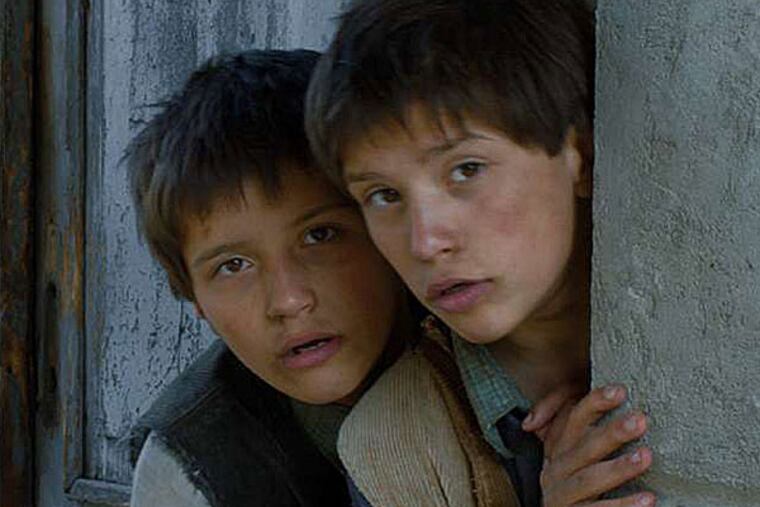
While it's presented as a parable - dispensing with character and place names - The Notebook is a very thinly disguised story about the Nazi occupation of Hungary that focuses on the fate of a pair of 13-year-old twin boys (real-life twins László Gyémánt and András Gyémánt) who are evacuated to the countryside when the capital comes under attack.
Children of a well-off bourgeois family, the twins are clearly well-loved by parents who encourage them to read, study, and appreciate culture. But when their father (Ulrich Matthes) goes off to fight, their mother (Gyöngyvér Bognár) takes them to their maternal grandmother's farm. For reasons we never figure out, the otherwise doting mom dumps her sons and takes off.
An isolated, almost barren plot of land that's interminably bleak, the farm is run with an iron hand by the widowed old lady (Piroska Molnár), who makes no bones about telling one and all how much she loathes her daughter and son-in-law. A cruel, avaricious miser who may have killed her husband for his money, Gran forces the boys to sleep outside until they do enough work to justify a place in her home.
The boys soon learn that the world of adults is a world of hatred, malice, and lust. The church deacon (Péter Andorai) is an oversexed thief; his maid (Diána Kiss) a lustful creature who uses sex to manipulate men; the policeman (Lajos Kovács) beats the kids for no reason, while the Nazi SS officer (Ulrich Thomsen) who takes over one of the grandmother's buildings is a preening effete and potential pederast.
To survive, the boys embark on a shocking, rigorous program of Pavlovian self-conditioning. In a section of the film titled "Training the Body," they take turns beating one another until they become insensate to pain.
Their strange agenda becomes even more unsettling in its second phase, "Training the Soul." To overcome emotional pain, the boys destroy every sign of love in their lives, burning all family photos and their mother's letters.
They try to transcend natural human feelings of pity and compassion by systematically torturing and killing animals.
Eventually, the twins hope, they will become indifferent to all the bonds of caring, sentiment, and desire that link us to the world.
Szász is unsparing in his denunciations: He portrays 1940s Hungary as a place rife with prejudice, hatred, and anti-Semitism. In one scene, the townsfolk come out to jeer and laugh as Jews are rounded up and marched onto a train bound for a nearby concentration camp.
The Notebook is heavy-handed, to say the least. But its stark photography, crisp acting, and startling denouement make for compelling viewing.
The Notebook *** (out of four stars)
Directed by János Szász. With László Gyémánt, András Gyémánt, Piroska Molnár, Ulrich Thomsen, Ulrich Matthes. Distributed by Sony Pictures Classics. With subtitles.
Running time: 1 hour, 40 mins.
Parent's guide: R (disturbing violent and sexual content including rape, profanity).
Playing at: Ritz at the Bourse.
EndText
215-854-2736