After 30 years, '60 Minutes'
NOT LONG AGO, Bill Whitaker got the call he'd almost stopped hoping for: After nearly 30 years at CBS News, the Media native and Penncrest High grad was being asked to join the granddaddy of all news magazines, "60 Minutes" as its newest full-time correspondent. His first story is expected to air next Sunday.
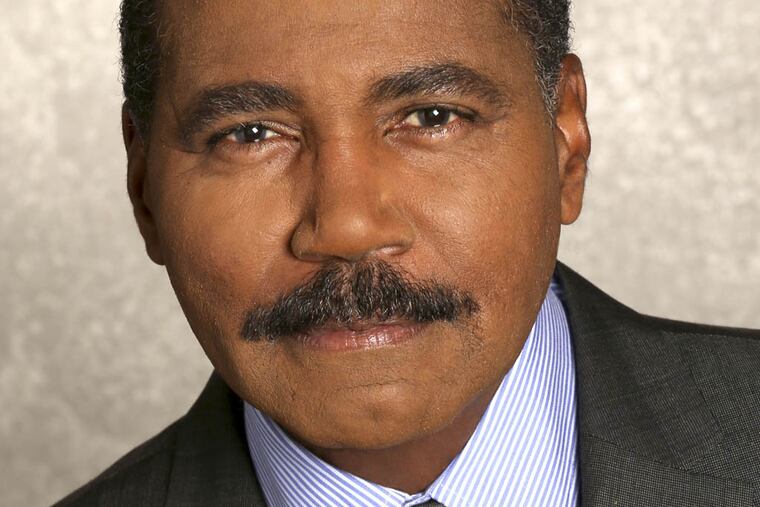
NOT LONG AGO, Bill Whitaker got the call he'd almost stopped hoping for: After nearly 30 years at CBS News, the Media native and Penncrest High grad was being asked to join the granddaddy of all news magazines, "60 Minutes," as its newest full-time correspondent. His first story is expected to air next Sunday.
Whitaker spoke with Ellen Gray early this month about the perks and pressures of his new job, the kitchen he and his wife left behind and the mustache he'll never surrender.
Q) There's a long history of "60 Minutes" correspondents having a long history at "60 Minutes." Is this your profession's equivalent of the Supreme Court?
Yeah, this is about as good as it gets. I'm still pinching myself.
Q) Was this your goal all along? Or is this something people occasionally get tapped for but that you could never be sure would happen?
The latter. It's been a wonderful 30 years. I started off in Atlanta and then I got to go to Japan. Covered all of Asia for four years and then went to Los Angeles and was there for 21 years. I guess, truly, I sort of thought that this ship had sailed. And when I did get the call - "We'd like you to come to New York, we have something to discuss with you" - I thought, "Well, this is either going to be really good or really bad." And it was really good.
Q) What happened next?
I sort of walked away pinching myself and called my wife and said, "Guess what, honey?" We had just renovated our kitchen in Los Angeles and she had the kitchen of her dreams.
Q) How, so far, has working for "60 Minutes" been different? Are there more resources? More time? Or is the workload even greater than before?
It's all that you just said. The resources are greater, the amount of time that you have to work on a story is greater, but the pressure is greater. You have all the resources you need, you have all the time that you need, you must produce an excellent story. There's no excuse.
Q) You would've been in high school when "60 Minutes" began, in 1968. Where you even aware of the show then?
Yes. I grew up in a household that paid great attention to the news. My father used to come home from work and take a shower and make us kids be quiet so he could sit down and watch the evening news - this was his ritual before dinner. So we all got into the habit early of watching the news. He passed away in '65, but ["60 Minutes"] was must-see TV for the family.
Q) When did you decide you wanted to be in TV news?
Well, my cousins will tell you that I used to play reporter when we were growing up, that I would pick up a stick and stand and say, "This is Bill Whitaker, reporting from" wherever. I don't have those memories, but I have heard it from enough of them that I believe I did.
Q) What was your first job in the business?
I was working at [public station] KQED, in San Francisco, and the executive producer of the evening news just got up one day and threw papers into the air and said, "I'm outta here." He literally just walked out, and the news director came out and said, "Can anybody do this?" And I said, "I can," and I sat down in the chair and went from tape runner to producing the evening news broadcast.
I must tell you, it didn't all go so smoothly. But, yeah, I pulled that out and I did it for a year before I got picked up by WBTV, in Charlotte [N.C.], to be a reporter.
Q) It's hard to believe you'll be only the second African-American to be a fulltime correspondent at "60 Minutes," after another Philadelphian, Ed Bradley. Was he a particular inspiration for you coming up? Or did you just assume that by 2014, I wouldn't even be asking this question?
A little of both. But you know, Ed Bradley and Mike Wallace and Harry Reasoner, all of these guys were inspirations for me.
Q) So, the mustache. It seems to be a signature look. Did you ever encounter resistance from consultant-conscious TV news directors about it?
I have had this as long as I can remember. No one ever asked me to cut it, [but] there was a CBS News vice president a few years back who called my bureau chief to ask would it be possible.
One time I did cut it. It was on vacation and I cut it off and my wife, my children, my cousins who were visiting, all stood up and said, "Don't ever do that again. You don't look like you without the mustache." I had told [the bureau chief] this story and she told this vice president, "I don't think you want to see him without it."
Q) Now that you're back on the East Coast, did you at least get an apartment with a great kitchen?
We got an apartment with a great kitchen and a great view. We found a place in Harlem, right on the north edge of Central Park. My parents met in Harlem, back in the '30s, so this is like going full circle.
My father was a waiter at the Cotton Club. And my mother was a secretary, for James Van Der Zee, a black photographer. She used to go to the Cotton Club to pick up my father and would sit in the kitchen, playing cards with Ella Fitzgerald.