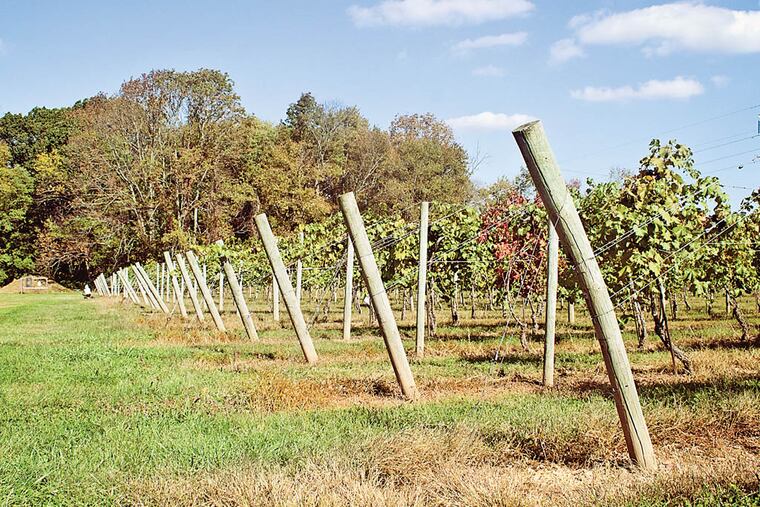
JERRY AND KATHY FOREST planted their first grapes in 1966, in what was then ultra-rural Buckingham in Bucks County. They had only meant to make wine for family and friends, but then the Pennsylvania Farm Winery Act of 1968 came along and by 1970, Buckingham Valley Vineyards & Winery - a dream since Jerry's college days at Penn - produced its first bottles.
This weekend, the Forests will join with eight other Bucks County wineries for Harvest Weekend, and a couple dozen other wineries from the Lehigh Valley down through the Brandywine Valley and east to Cape May County will also be holding special mid-October events. They are all members of regional wine trails - countryside drives between nearby wineries, the better for sampling a variety of wines from what owners believe is an up-and-coming area for good reds and whites.
"We are working to overcome the skepticism, one tasting at a time," said Kathy Matson, the tasting-room manager at Galen Glen Winery, which is celebrating its 19th year making wines in the no-stoplight town of Andreas, northwest of Allentown. "Our winemaker has won prestigious awards, as have many in the region, and hopefully, as time goes on and people come visit, they will realize we have high-quality wines all over Pennsylvania and New Jersey."
Galen Glen is one of nine wineries on the Lehigh Valley Wine Trail, which next weekend celebrates a grape that thrives up that way during its annual Chambourcin Weekend.
Down the Shore, Jersey vintners gather for the Cape May Wine Festival this weekend, and five of the Cape May Wine Trail's six wineries are open for tastings (hours vary). And tonight in Chester County, the Black Walnut Winery - a mainstay on that region's Brandywine Valley Wine Trail - has its second annual Fire and Wine Festival and bonfire, benefiting local fire departments. (All six of the of the trail's wineries are open their usual weekend hours for tastings and/or tours).
Skeptics might say that these are all beautiful fall weekend driving areas, but wine? C'mon, go to Napa and Sonoma for that. But Denise Gardner, a Penn State University extension oenologist - wine expert, that is - said there is nothing that makes California any better for wines than our area.
"We forget that before the 1970s, people looked at wines from California and said, 'We're not going to buy that stuff.' It was all European wines then," Gardner said.
"People here have to get over the stigma, and there really shouldn't be one because we grow grapes and make wines just as good as those from the West Coast." Most of the bottles of good wines she has found are in the relatively affordable $15-to-$20 range.
Kevin Celli, the winemaker at Willow Creek Winery and Farm in Cape May, said that New Jersey resembles Europe as a winemaking region more than it does California. He grows 13 types of grapes on the 50-acre farm, all with parentage from Spain, Portugal, Italy and France.
"California is a different microclimate, but here in Cape May, being on the outer peninsula by water, we are like Bordeaux or Tuscany or Portugal and the Basque region of Spain," Celli said. "My merlot grape, my honor-roll student, he has no idea he is sitting in New Jersey. He thinks he is in France."
Washington's troops quaffed here?
When Tom Carroll Jr. was a little kid in the 1980s, he was eating pizza with his parents, Tom Sr. and Christine, in their 150-year-old house in Washington Crossing, and said, "You know, this place would make a good winery."
"Who knew where that came out of?" said Christine Carroll, but in 2000, the family started planting grapes on the fallow farmland, and by 2003, opened Crossing Vineyards and Winery, now on the Bucks County Wine Trail. Christine said the family's research shows that some of Washington's men mustered on their land before crossing the Delaware that cold December night. "I'm betting claret may have been in their supply bags," she said.
Mike Conti, manager of operations at New Hope Winery, a few miles from the Carrolls, admitted that not every popular grape does well in our area.
"Pinot noir is tough. We just don't even have it," Conti said. "It works better in different soil and it also has to do with the temperature degree days. Pinot grapes like hotter suns and cooler evenings, and we don't have that variance here. It's not 95 in the daytime and 50 at night like it might be in California.
"But I would say our job in this area is to grow varietals that will produce quality wines, and I think most of the people growing here know that. We want this area to thrive."
Most of the wineries on the wine trails have full-time owners, some who serve as winemakers and others who hire trained experts to do that job. Some buy grapes and others grow their own either on adjacent properties or somewhat nearby. The Brandywine Valley Wine Trail wineries have said they will buy only Pennsylvania grapes to make their wines as an advocacy of promoting the area.
Most tastings cost between $5 and $10, with the fee often going toward the purchase of a bottle. Those who have vineyards on site also often have tours, either guided or self-guided, for a small fee. Many make money on the side holding events - weddings or tasting parties, for instance. At New Hope Winery, there is a showroom in one of the older buildings and there are somewhat big-name concerts on occasion. (Folksinger Tom Chapin will be there Sunday at 6 p.m. - tickets are $30).
In Chesco, partners in wine
For Lance and Valerie Castle and Jack and Carol Kuhn, Black Walnut Winery in Chester County is a mutual part-time venture, each of them holding day jobs.
Lance Castle, by the week a hospital administrator, started making wine in his basement, and then took courses in winemaking and viniculture at the University of California at Davis and Virginia Tech.
"I started with 500 pounds, which seemed enormous to my wife, and got so passionate I would make 2 tons worth of grapes into wine a year," Castle said.
By 2007, he had persuaded his wife and the Kuhns to buy a 10,000-square-foot, 200-year-old barn in Sadsburyville and start renovating it into a winery. Eighteen months later, in the summer of 2009, they had red wines ready to go and opened the doors. They buy grapes from various vineyards in the area and, though they do make white wines, specialize in reds like merlot, cabernet sauvignon and syrah.
"I kidded them when we opened that I wanted to be a red house," Castle said. "But white wines are easier to make around here, and I love it too much to not do everything we can."
Sometimes, though, the local winemakers like to have a little fun and experiment. Three years ago, the Carrolls at Crossing Vineyards were having a little trouble with their port-wine harvest. They added a little chocolate and cherry essence to it and made a winter special - Chocolate Cherry Truffle.
"It became so wildly popular that we now sell futures. People order it before we even make it," Christine Carroll said.
More grapy goodness
Galen Glen in the Lehigh Valley produces an ice wine. The vineyard keeps some of its Vidal blanc grapes on the vine through the winter, allowing them to freeze. According to German and Canadian standards, where ice wine is harvested, it has to be 17 degrees Fahrenheit or lower to make the wine.
"It is like pressing a frozen raisin," said Galen Glen's Matson, who said the vineyard couldn't make any from 2009 to 2012 because it never got cold enough. "The juice is extremely concentrated and sweet. It is a dessert wine for special occasions."
The Chambourcin being celebrated next weekend on the Lehigh Valley trail is a hearty red-wine grape whose juice is pink. It's resistant to fungus, which growers like.
"Chambourcin is produced by all the wineries in that area," said Penn State's Gardner. "It can be made both in a dry style or sweet and fruity, so it is versatile. It's another thing that goes into making our area distinctive."
The winemakers from Cape May to Allentown say they are trying to cooperate with each other, hoping to boost the visibility of wines coming from the area. Thus, the wine trails and special events have grown and there is now an attempt by marketers and tourism agencies to call Pennsylvania, Delaware, New Jersey and Maryland the "Vintage Atlantic Wine Region" - hopefully like Napa or Bordeaux, eventually becoming an appellation known for its signature wines.
"For the wine connoisseur, there are really choices out there," Gardner said. "Most of these wineries are small, making only about 10,000 cases a year. If you are that connoisseur and find something you like, then you can have your own little secret."