A fresh perspective on Terry Gross
Any discussion of popular and influential Philadelphians in the media has to include Terry Gross. For 39 years, the 63-year-old Brooklyn native has presided over "Fresh Air," the weekday afternoon talk-and-commentary show anchored by Gross' chats with A-listers from the arts, show business, journalism, business and politics.
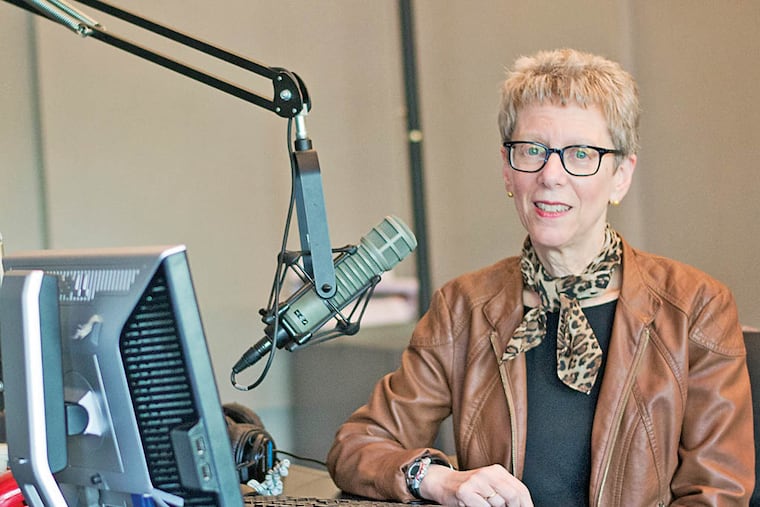
ANY DISCUSSION of popular and influential Philadelphians in the media has to include Terry Gross.
For 39 years, the 63-year-old Brooklyn native has presided over "Fresh Air," the weekday afternoon talk-and-commentary show (3 p.m.; repeats at 7 p.m.) anchored by Gross' chats with A-listers from the arts, show business, journalism, business and politics.
Produced at its Independence Mall studios by WHYY (90.9-FM) - it was WUHY when Gross began - the hourlong program has been syndicated by National Public Radio for 27 years. Today, according to npr.org, "Fresh Air" is broadcast on 566 stations. It can also be heard online and via a variety of apps.
Gross - who lives in Center City with her husband, writer Francis Davis - is not your typical celebrity inquisitor, serving up publicist-suggested softballs for her guests to knock out of the park. While most of her subjects have a book, film, album or TV show to hype, her intense preparation enables her to probe well beyond the particulars of an au courant commercial project. And it's why the interviews - mostly 30- to 40-minutes long - often cover the entire arc of a subject's life and career.
Her avoidance of "if-you-were-a-tree"-style questions is one reason she regularly lands guests who tend to shy away from the media (among them, singer-songwriter Elvis Costello and composer Stephen Sondheim). And the seriousness of her interviews, combined with her formidable audience, has provided her the opportunity to speak with an eclectic roster of notables, from Quentin Tarantino and Hillary Clinton to Louis C.K. and Jay Z.
Sunday, Gross is making a rare public appearance, at Glenside's Keswick Theatre. "Off Air With Fresh Air's Terry Gross" will feature Gross' reminiscences of her favorite interviews and an audience Q&A.
What better time, then, to turn the tables and get her to answer questions instead of asking them:
Q: Were you an inquisitive child?
A: I was probably always somewhat confused, and needing to ask questions.
Q: How did you get to Philly?
A: Through Buffalo [N.Y.]. I went to college [SUNY Buffalo, now the University at Buffalo]. After getting a B.A. in English and getting fired from teaching and discovering public radio, I went back for my master's degree in education with a major in communications. I had started working at the college station. Then I got hired [in 1975] to do "Fresh Air."
Q: Why were you fired?
A: I was fired after six weeks in 1972. I was teaching English in Buffalo's toughest inner-city junior high. I was 21 years old, and [less than] 5 feet tall - a very unconvincing authority figure. I had a hard time just getting the students out of the hallways and into the classroom, and when I did get them there, I couldn't get them to quiet down. I was too ineffective to actually teach them anything.
Part of the problem was that I was from a middle-class background, and needed some anarchy in my life. My students were mostly poor, and from violent neighborhoods. They needed structure and safety and I didn't know how to provide either.
It was only after I was fired that I managed to find my way to public radio, where I immediately felt I'd found the place that was right for me.
Q: What were your preconceived notions about Philadelphia, especially as a New Yorker?
A: I really didn't have any. I knew two things about Philadelphia: The Liberty Bell was here, and I knew "American Bandstand" had been done here originally.
Of course, WUHY's studios were in the building where Dick Clark originally did "Bandstand."
Q: Your preparation borders on the superhuman. What's the process?
A: I read as much as I can by and about a person, or see as many of their movies or listen to as many of their records as possible.
I go through every page [of a book], I dog-ear every page that has something I want to remember or refer to during the interview. I mark everything on that page I want to remember.
Then I go through the book a second time and [go back to] every page that's dog-eared and type notes based on everything that's underlined. Those notes become my memory bank, since I have an imperfect memory.
I use those notes to jog my memory, and then I try to synthesize everything that I've learned and try to figure out, 'What's the interview about and where am I going?' "
Q: Because of the show, you have to be immersed not only in pop culture, but politics and world affairs as well. Can you disconnect at times, and how do you disconnect?
A: There's not a lot of time to shut it off, because weekdays I'm working until it's time to go to sleep. Weekends, I try to go to a movie or concert.
Q: Isn't that kind of a busman's holiday?
A: It's a nice one, though. I like movies. That's why I can get passionate about movies, because I actually really care about them. If it's a movie where I'm not taking a lot of notes, I can totally lose myself in it.
Q: What historical figures would you like to interview?
A: If I could bring people back . . . and interview them, I would do a series of shows with the great American songwriters. They'd be at the piano talking about and performing their songs: the Gershwins, Cole Porter, Harold Arlen, Irving Berlin, Duke Ellington . . .
Q: In the July issue of Philadelphia magazine, writer Sandy Hingston described you as "The Church Lady of Public Radio" and accused you of "elitist snobbery." Do you care to respond?
A: [Hingston] obviously wanted to be provocative. Fine.
Q: What will you be doing at the Keswick?
A: I'm going to give a talk . . . that is largely going to be about interviewing. I play clips of interviews that didn't quite work out as I expected they would, and were often kind of car crashes.
And [the late Inquirer editorial cartoonist, who most recently had been working at WHYY] Tony Auth, about a year-and-a-half ago, did illustrations for my talk, and I'm going to use them - little animations and illustrations. Then I'll talk about what happens behind the scenes at the show . . . talk a little about myself and how I got into this. I talk a little about my personal life, which I never do on the show. And then we'll take questions from the audience.