Remembering a poet who didn't go quietly
Dylan Thomas' poetry can look baffling on the page, long rolling hills of words winding their way downward. But read them aloud - or better yet, hear Thomas read them - and the images and ideas, sounds and characters, sights and smells they evoke come alive.
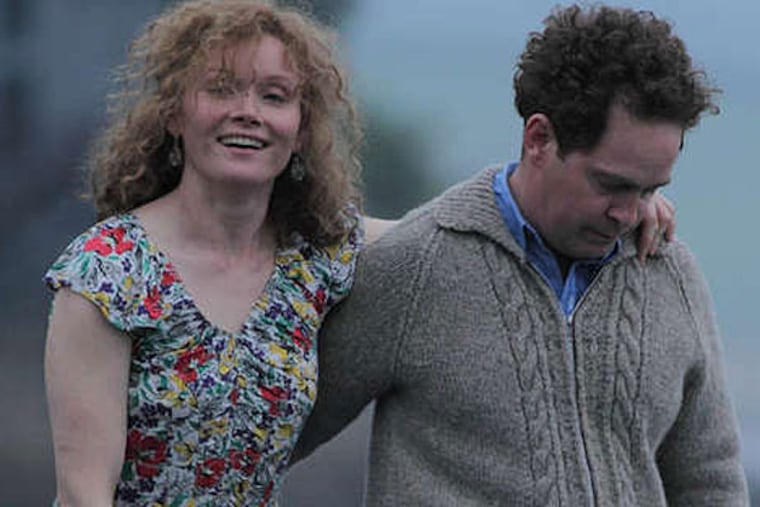
Dylan Thomas' poetry can look baffling on the page, long rolling hills of words winding their way downward.
But read them aloud - or better yet, hear Thomas read them - and the images and ideas, sounds and characters, sights and smells they evoke come alive.
That's one of the reasons Tom Hollander, who plays the Welsh poet in BBC America's biopic A Poet in New York, spent days listening to every existing recording of Thomas reading his verse.
"The voice was incredibly important for me," Hollander said. "Especially since, oddly enough, there is no [film] footage of him, so I couldn't study the way he moved."
Commissioned to mark the 100th anniversary of Thomas' birth (Oct. 27, 1914), A Poet in New York will premiere at 8 p.m. Wednesday on the cable channel.
With a script by acclaimed screenwriter and fellow Welshman Andrew Davies (A Very Peculiar Practice, Sense and Sensibility), A Poet in New York is set in fall 1953 during the final weeks of Thomas' life when he flew to New York to make some money with a reading tour and to complete recording his last major work, the play for voices Under Milk Wood.
Davies, 78, said A Poet in New York is a deeply personal project.
"[Thomas] was my inspiration to become a writer when I was a kid," he said.
"I grew up in south Wales, as he did, and I was struck by his poetry and even more when I realized I came from the same sort of background as he did, because no one in my family had been a writer or had any aspirations toward it."
Given the occasion, isn't it odd to focus on the end of the poet's life and not his early life?
"It seemed like a good jumping-off point, a place from where we could then talk about several stages of his life by means of flashbacks," Davies said.
Hollander portrays Thomas as a perpetually drunk, almost helpless man-child who relied heavily on his American friends to ply him with drink and pills so he could get through the day.
Before leaving Wales, he had quarreled with wife Caitlin (Essie Davis), who was concerned because their family - the couple had three children - was in constant financial crisis.
In New York, he was alternately manic, taciturn and depressed, inflicting his moods on his two closest associates, his lover Liz Reitell (Phoebe Fox) and his sometime editor and agent John Malcolm Brinnin (Ewen Bremner).
His alcoholism and poor diet were contributing factors to his death from pneumonia on Nov. 9, 1953.
Hollander, 47, said Thomas liked to play up his role as a "roistering, drunken and doomed poet," as the poet put it himself.
Yet he wasn't always play-acting, Hollander said. Thomas was in a deep crisis. He considered himself a failure as a man, husband, and father. And most of all as a poet.
It's not hard to understand why: Thomas wrote nearly all his most famous poems when he was still in his teens: including "Do not go gentle into that good night," "And death shall have no dominion," and "Fern Hill." Two decades later, he felt he was floundering.
He covered up his despair by playing on his boyish charm to dazzle fans.
"He was cherubic, funny, charming, and naughty," Hollander said. "He was quite good at being a boy and he found it harder to be an adult."
At the same time, Thomas was deeply conscious of his failings and knew he was using alcohol and the trappings of fame to hide from himself.
"He was self-indulgent, but he also beat himself up and hated himself," Hollander said. "He was highly, deeply conscious of his flaws, and that makes him such a tragic figure."
TELEVISION
A Poet in New York
Premieres 8 p.m. Wednesday on BBC America.
EndText