'The Homesman': Hard traveling in the Old West
It's a curious cargo in the wooden wagon, pulled by a pair of mules named Grace and Redemption, moving east across the Nebraska plains. In Tommy Lee Jones' odd and affecting western The Homesman, three women who have lost their minds are being transported to an Iowa church - a rugged journey of many weeks across land occupied by Indians and thieves.
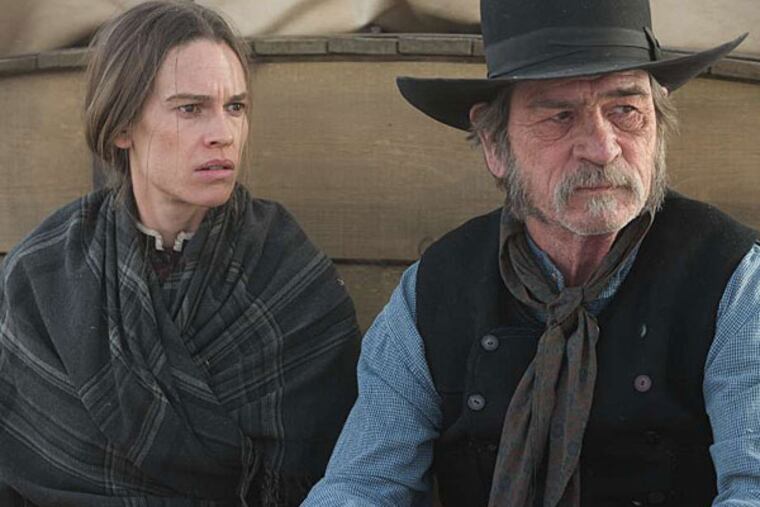
It's a curious cargo in the wooden wagon, pulled by a pair of mules named Grace and Redemption, moving east across the Nebraska plains. In Tommy Lee Jones' odd and affecting western The Homesman, three women who have lost their minds are being transported to an Iowa church - a rugged journey of many weeks across land occupied by Indians and thieves.
The driver is another woman: Mary Bee Cuddy (Hilary Swank), a spinster farmer, who has volunteered to take the women from Loup, the little town where she and they live, because no one else seems up for the job. Accompanying her is a grizzled stranger who calls himself George. He is ornery, canny, a drifter, a claim jumper - but Mary Bee can't handle the women, the mules, and the wagon by herself, and so a wary partnership is forged.
The Homesman, then, is a road movie - an 1850s road movie, when there weren't any roads to speak of and when Nebraska wasn't even a state - but one where two people, different in almost every way, learn something about themselves and each other as the wintry scenery passes them by.
Jones, who a decade ago directed and starred in the very fine modern-day western The Three Burials of Melquiades Estrada, has learned a lot about filmmaking over his years as an actor. The Homesman moves at a slow but steady pace, and despite its title, the focus for much of the time is on Swank's Mary Bee, proud and strong, desperate to be married. Early on, she invites a neighboring homesteader (Evan Jones) over for fried chicken and peach pie. "Why not marry?" she asks across the kitchen table. They could pool resources, provide each other with company.
"Because you are too bossy and too plum darn plain," he answers back.
Swank's Mary Bee has heard as much before; she winces, then sets about cleaning, setting things right.
A few years ago, another director, Kelly Reichardt, tried her hand at a wagon-train western full of strong women facing daunting challenges. It was called Meek's Cutoff and it didn't really work; it was poky, the characters weren't there. The Homesman is all about its characters: Mary Bee, with her bonnets and her tamped-down hurt, George Briggs with his squinting caginess, his face creased with years of hardship and bum luck.
As for their freight, Grace Gummer, Miranda Otto, and Sonja Richter play the women who have gone insane, staring blankly into the middle distance, or wailing pitiably, or rocking violently to and fro. Their stories of woe - dead children, dead loved ones, rape, abuse - are told in intermittent flashbacks, the only element to Jones' film that doesn't feel wholly right. The haze of memory and trauma does not fit snugly with the necessity of clear exposition.
Swank is just exceptionally good - the intelligence, integrity, and inner pain all there in her eyes, her every subtle gesture. And Jones lines up an impressive roster of supporting players: John Lithgow, Meryl Streep, Tim Blake Nelson, and James Spader.
At a certain point, The Homesman will take you by surprise. By the end, a ferry ride across the Missouri River, it will take your heart.
The Homesman *** (Out of four stars)
Directed by Tommy Lee Jones. With Jones, Hilary Swank, John Lithgow, Miranda Otto, Meryl Streep. Distributed by Roadside Attractions.
Running time: 2 hours.
Parent's guide: R (violence, profanity, sex, adult themes).
Playing at: Ritz Five.EndText
215-854-5629
@Steven_Rea