Athenaeum preserves the past while looking forward with architectural competition
It might seem a perverse exercise to some, but one of Philadelphia's most venerable institutions, the Athenaeum, has sponsored an architectural competition - Looking Forward: Reimagining the Athenaeum of Philadelphia - seeking designs for a new building.
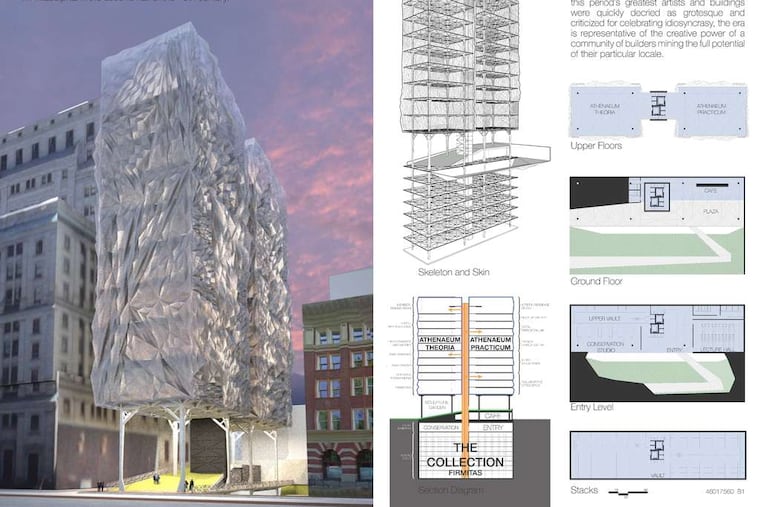
It might seem a perverse exercise to some, but one of Philadelphia's most venerable institutions, the Athenaeum, has sponsored an architectural competition - Looking Forward: Reimagining the Athenaeum of Philadelphia - seeking designs for a new building.
Not to worry.
The bookish Athenaeum, situated in a splendid National Historic Landmark Italianate brownstone on Washington Square at 219 S. Sixth Street, is not really looking for a new home.
It is not going anywhere. It is not going to be torn down and replaced by the crinkly competition winner from Philadelphia's Stanev Potts Architects.
In fact, it is simply attempting to trumpet what it is right now - a library with books and photographs, documents, drawings, plans, and vast archives held on- and off-site - all the scholarly trappings that go with being a premier research center, largely associated with architecture and construction.
But wait. The Athenaeum is more than just a spectacular, quiet building with stately and comfortable reading and research rooms, a resplendent columned stairwell, airy ceilings rising 25 feet - all designed by Philadelphia architect John Notman in 1845. It is more than a museum of the decorative and design arts filled with exquisite pieces such as Joseph N. Du Barry's Federal bookcase (1800), Isaiah Lukens' 14-foot tall-case clock (1840), and an 1867 globe by Thomas Malby & Son, London, centerpiece of the great reading room.
So why a competition to come up with something else?
"We thought it was a good way to think of not just what a wonderful building this is, but what it is we do and what we do for the community," said Bruce Laverty, the Athenaeum's curator of architecture and co-manager of the competition.
The point is that the place was and is devoted to the dissemination of useful knowledge as widely as possible, he said. "The competition is not saying we're dissatisfied with what we have. It functions for us, although we've pushed it almost as far as its limits can go."
In fact, Notman himself designed the building as part of a competition, winning out over the likes of such giants as William Strickland, Thomas Ustick Walter, John Haviland, and Napoleon LeBrun. Notman was told to "build something cheap" and "something that would pay for itself forever."
Out went his fanciful Egyptian Revival reveries, out went marble cladding and columns. In came far less expensive brownstone, and the nation's first Italianate manse.
Also, Notman's design allowed for retail and office rentals, which supplemented income obtained from Athenaeum member subscriptions. The library, founded in 1814, was and remains a subscription library, one of the last of its kind. That means all are welcome to use the space to read and browse, but to borrow books one must subscribe ($200 annually).
Lots of lawyers originally had offices at the Athenaeum. And in 1870, the American Institute of Architects made its first home on the building's third floor, which is when the Athenaeum seriously moved into becoming a repository for the study of architecture. It now houses 200,000 drawings, 300,000 photographs, and thousands of books and pamphlets.
That seems pretty basic. So what kinds of ideas did the competition elicit?
"The jury wanted the students and professionals to be thinking about the future," said Laverty. "How the world will change. How libraries and library technology will change. How architecture will change."
The call produced 88 submissions from professionals all over the world, including five from Philadelphia architects. There were also 42 student entries, 30 from Catholic University in Washington, D.C., where a competition entry was an assignment. No students from Philadelphia submitted proposals.
Many entries emphasized the relationship of the site to green Washington Square. Some addressed environmental issues (though no design featured a dock in anticipation of rising sea levels).
The most common element envisioned for the future, a highlight of almost every proposal, involved heightened digitization of libraries in a digital world. The winning entry, for instance, assumes that "with life becoming increasingly virtual, interest in physical artifacts, archived drawings, and preserved narratives flourishes." In this digitized world "the Athenaeum flourishes" largely through its mandate to disseminate knowledge and information as widely as possible.
Maybe. Or maybe the opposite.
In any event, the fact that digitization already has been a major focus of the Athenaeum for decades makes this forecast hardly a surprise. The library has been digitizing since the 1980s. In 2000, it launched the online American Architects and Buildings database, now easily the largest freely accessible resource for architecture and building design, with new photos and data contributed by numerous institutions from around the country. (It can be accessed from the Athenaeum's website: www.philaathenaeum.org.)
The top three professional winners of the competition will be at the Athenaeum on Saturday at 3 p.m. for a presentation. Wednesday at noon, competition co-managers Laverty and Michael Seneca will give a talk on the exhibition. And on Feb. 4, Laverty will deliver a lecture comparing the 19th-century competition to design the Athenaeum's current building with the current conceptual competition.
The exhibition closes Feb. 14.
215-854-5594 @SPSalisbury