'Song of the Sea': A moving and magical Irish tale
Given the extraordinary, cacophonous barrage of media images and sounds assaulting us every day, it's all too easy to forget the power that true art possesses to awaken us to ourselves.
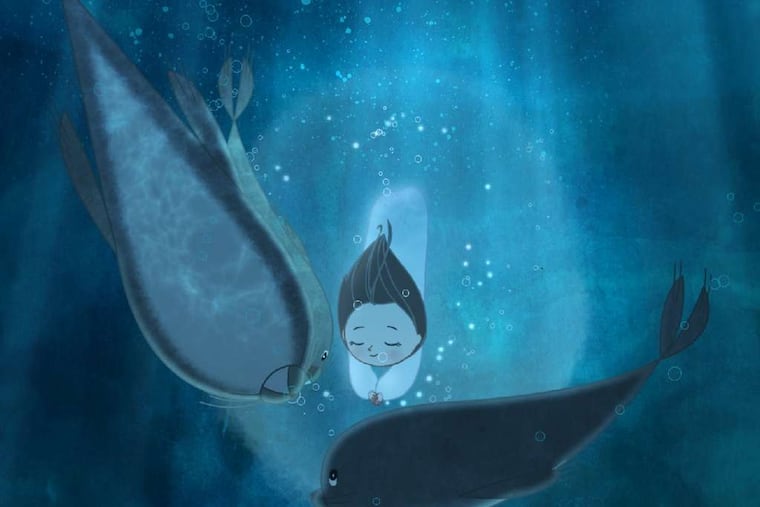
Given the extraordinary, cacophonous barrage of media images and sounds assaulting us every day, it's all too easy to forget the power that true art possesses to awaken us to ourselves.
That's why it can be so jarring when we're confronted with the real thing, as we are with the animated family film Song of the Sea, a transcendent work from Ireland's Cartoon Saloon studio that's almost wasted on kids.
Deeply rooted in traditional Irish mythology and folklore, Song of the Sea is carved - one thinks of wood engravings and illuminated manuscripts - with a rich, dynamic visual style and a sophisticated symbolic language that will elicit aesthetic and emotional shivers. Its story delights at every turn and is propelled by a body of songs that's simply breathtaking.
Though it helps to know the myths and folktales that inform Song of the Sea, the story is so vital and so fundamental in its handling of grounding human emotions such as parental and filial love that it will sing to viewers who haven't the slightest familiarity with the source material.
The film opens in the modest house of a lighthouse keeper named Conor (voiced by Brendan Gleeson). His wife, Bronagh (Lisa Hannigan), an elegant singer with long waves of black hair, is about to give birth to their child. Her eldest boy, Ben (David Rawle), still a toddler, curls up with the family's shaggy dog and fantasizes about the games he'll play with his little sibling.
Suddenly, Bronagh rushes out into the night.
We skip ahead six years to find that, while she had a healthy baby - a soulful little girl named Saoirse (Lucy O'Connell) - Bronagh was lost during the delivery.
Ben is a bundle of anger and anxiety. He has refused to acknowledge his sister. Saoirse, who has yet to utter her first word, seems too dependent on her dad, who spends his days fussing over her, and his nights staring blankly across the sea. He virtually ignores Ben, who feels slighted by the whole world.
Simple, direct, uncompromising, Song of the Sea has the most heartrending first act of any tragedy in Irish letters. It ends with Ben's obnoxious worrywart of a grandmother (Fionnula Flanagan) taking the children away from the sea, away from their dad, away from their beloved dog to raise them on her own in the big, strange city.
Yet, the film has a deeper current, a secret fantastical world under the sea that, at turns, is dark, foreboding, deadly, and yet has the potential to be transformed into a salvific place of creation.
Saoirse is the only one who sees this plane, and she eventually opens it up for Ben and her father. She's a magical creature like her mother, a selkie, a mythical being that can take on the form of a seal or a human and is blessed with song. Her voice can redress evil acts and restore balance to a community rent by tragedy.
The latter part of the film follows Saoirse and Ben as they are plunged into this hinterworld in search of the key that will awaken Saoirse's ability to sing.
Song of the Sea is a work of rare sublimity that reveals how the human world is maintained, refreshed, even re-created through stories.
Allow it to wash over you, and it will take you places you never dreamed a movie could reach.
Song of the Sea **** (out of four stars)
Directed by Tomm Moore. With voices by Brendan Gleeson, Fionnula Flanagan, David Rawle, Lisa Hannigan, Lucy O'Connell. Distributed by GKids.
Running time: 1 hour, 33 mins.
Parent's guide: PG (mild peril, some mild profanity, pipe smoking).
Playing at: Ritz Bourse.
EndText
215-854-2736