Genghis Khan: The Great Civilizer?
This is what most of us know about Genghis Khan and his Mongolian horsemen: "They killed women, men, children, ripped open the bodies of the pregnant and slaughtered the unborn," in the words of 13th-century Arab chronicler Ali ibn al-Athir.
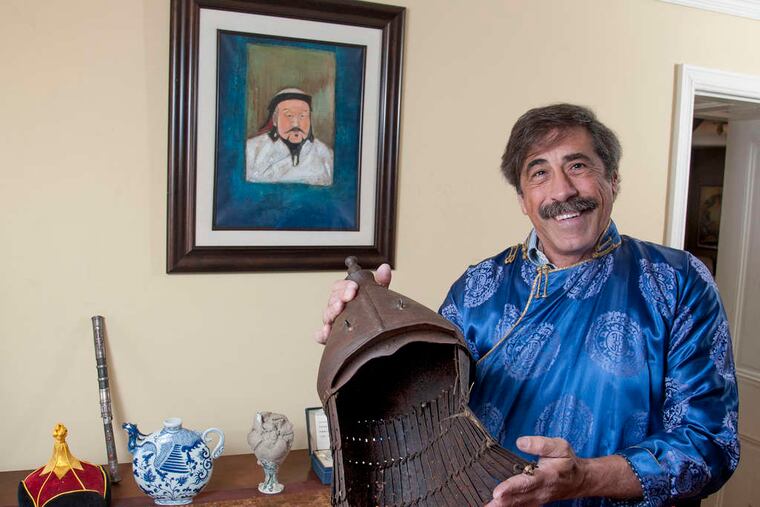
This is what most of us know about Genghis Khan and his Mongolian horsemen: "They killed women, men, children, ripped open the bodies of the pregnant and slaughtered the unborn," in the words of 13th-century Arab chronicler Ali ibn al-Athir.
That's about it when comes to "Mongol hordes."
But for Don Lessem of Media, an exhibitor and self-described "dino guy," there's a lot more than infanticide and slaughter to Genghis Khan (ca. 1162-1227), founder of what became the largest land-based empire in history, stretching from the Pacific Ocean to the Black Sea.
"He built this incredible empire - his character was magnetic," Lessem said. "He conquered and then incorporated the defeated armies into his own. He established a meritocracy, so he had a willing following. He established freedom of religion. He developed strategy that nobody ever heard of. He could move at incredible speed. He conquered Russia in the winter!"
"Dino guy" he may be, but Lessem is really into Genghis Khan. So it's no surprise he is the driving force behind "Genghis Khan: Bring the Legend to Life," an eye-popping (but perfectly safe) exhibition opening Saturday at the Franklin Institute.
The traveling exhibition, which runs here through Jan. 3, is the largest compilation of Genghis Khan treasures ever assembled, nearly 200 artifacts including ancient gold coins, coral jewelry, embroidered garments, and unusual Mongol musical instruments, including a two-string meren hor and its cousin, the shudraga, both played with horsehair bows.
Though Genghis Khan may have liked a tune now and then, he was really about war and empire, and so this exhibit is full of the implements of war - menacing daggers, no-nonsense swords (one carried by a guard of Marco Polo), ancient curved Mongol bows, very light and flexible leather armor, and the engines of war.
Genghis Khan came from a famously nomadic culture with strong horses. He needed to move. But mobility, fast horses, and bows and arrows are not very effective when you're trying to conquer, say, Kiev.
Genghis Khan adapted.
Lessem's exhibition includes massive catapults, used to hurl flaming casks of oil over city walls. It is said they also propelled plague-infested marmots into the air to spread disease inside walled cities. A 12-foot crossbow, used to shoot huge flaming arrows into packed cities, is also on display.
All of this is presented with theatricality.
A replica of the 40-foot-high statue of seated Genghis Khan that presides over Ulan Bator greets visitors as they enter the exhibition.
A yurt, or tent, is arrayed as it might have been some 700 years ago. Soldiers sheathed in leather armor stand watch over the exhibit hall.
Murals provide elaborate backdrops, and in one instance, visitors will pass through a corridor with video projections of thundering Mongol horsemen on both sides. The floor will literally shake. An acrid smell of smoke will fill the air.
Such showmanship, along with multiple videos and interactive devices, helps drive home a critical point. Lessem argues that Genghis Khan was "the world's greatest civilizer, whom we've made into a barbarian."
First attracted to the story when he traveled to Mongolia in the 1980s researching dinosaur excavations, Lessem "fell in love with the culture, geography, and history of the country," he said.
He observed "how Genghis was revered and celebrated everywhere, from the beer to the money, the airport, the hotels, even the Genghis Khan Irish Bar." And he began to understand the magnitude of Genghis Khan's achievement in uniting the warring tribes of the Mongolian steppes, conquering and imposing rule on China, and establishing the Silk Road trade routes. In Lessem's view, Genghis Khan shaped the world we live in.
Museums
"Genghis Khan: Bring the Legend
to Life"
Open daily 9:30 a.m.-5 p.m.,
May 9-Jan. 3, at the Franklin Insitute, 222 N. 20th St.
Tickets: $24.95 for children 3-11, $29.95 for ages 12 and up.
Information: 215-448-1200, www.fi.eduEndText