Serena Williams helping shift diversity-bias in the tech industry
My earliest memory of Venus and Serena Williams is from 1998, seeing their beaming smiles and beaded braids on a Sports Illustrated for Kids card. Thanks to that image, I began to associate tennis with two young black women. But when I moved from New York to the Poconos and joined the tennis team in my junior year of high school, I realized how white tennis really was - and how special the Williams sisters were.
My earliest memory of Venus and Serena Williams is from 1998, seeing their beaming smiles and beaded braids on a Sports Illustrated for Kids card. Thanks to that image, I began to associate tennis with two young black women. But when I moved from New York to the Poconos and joined the tennis team in my junior year of high school, I realized how white tennis really was - and how special the Williams sisters were.
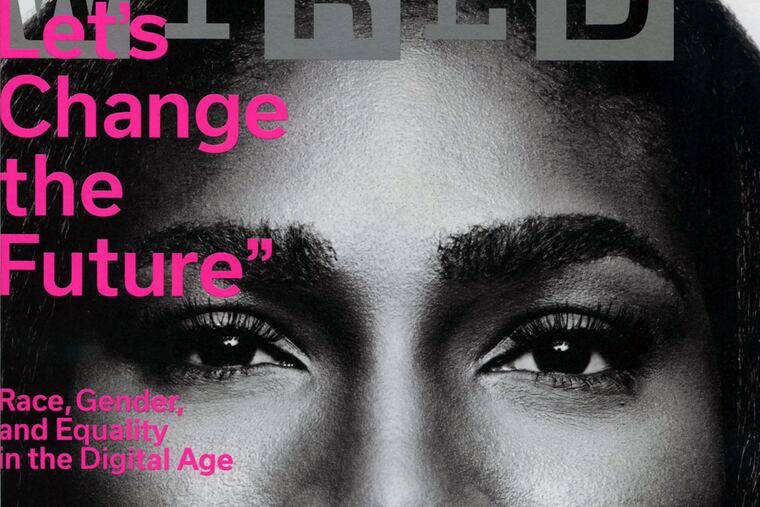
More than a decade later, Serena Williams' portrait is on the cover of this month's issue of Wired, one of the country's most influential tech magazines. The issue, titled "Let's Change the Future: Race, Gender, and Equality in the Digital Age," features a lineup (curated by Williams) of trailblazers from various disciplines, including activist DeRay Mckesson, rapper Common, transgender model Geena Rocero, and NFL coach Jen Welter.
What's Williams doing editing Wired?
It's the kind of question she's used to.
And it's one felt by many minorities in technology.
In her introductory essay for the issue, Williams writes, "I'm a black woman, and I am in a sport that wasn't really meant for black people."
Scott Dadich, editor-in-chief of Wired, invited Williams to guest-edit the publication. In an editor's note, he writes, "She's been a leader in the fight for equal representation and pay in her sport." Williams and the magazine staff put together the issue to tackle what Dadich called "Silicon Valley's stubborn diversity problem."
It's a bold gesture toward a big issue, and minorities working in the tech fields, both locally and around the nation, are saying Williams' stint at Wired is a good opportunity to think deeply about diversity in technical fields, including science, engineering, computing, and social media.
Kimberly Bryant, one of the trailblazers featured in Wired, is the founder of Black Girls Code, dedicated to increasing the number of women of color in the digital space by empowering girls ages 7 to 17. She says that, like Williams, she hopes to see those girls "on the cover of that magazine as a woman of color at the top of their field."
A week after November Wired hit stands, Leslie Miley, a former engineering manager at Twitter, made news by announcing in the online platform Medium that he had left the company because of its diversity issues. He wrote that he had been proud of being part of a company that had helped elevate formerly marginalized voices (see: #BlackLivesMatter), but that Twitter had dropped the ball where diversity was concerned.
The turning point came at a quarterly engineering leadership meeting at Twitter when Miley asked the senior vice president of engineering about diversity. The startling answer: "Diversity is important, but we can't lower the bar."
Bryant says the resistance to diversification in tech is due to "implicit and explicit biases of who would be a perfect fit." As Miley cited in his piece, in the engineering and product areas at Twitter, only 3 percent of workers are African American/Hispanic and fewer than 15 percent are women. That's a poor match for its user base, of which, as Pew Research Center data show, 27 percent are African Americans, 25 percent are Hispanic Americans, and 21 percent are women.
"You cannot possibly be reaching the needs of your consumers," says Bryant, "when the makeup of your company is not reflective of the community you serve."
Niesha Miller, 28, laughs as she remembers how she taught herself to code on Blackplanet.com, an online black social network, when she was 16. But despite her affinity for coding, she pursued writing. "I didn't know anybody in technology," said Miller, who now works as a search-engine optimization associate at Trinity Insight in Philadelphia. "So I never thought about it."
Brian Artis, 26, says that, growing up in West Philadelphia, he looked up to Steve Jobs and Bill Gates. "Those were the people who propelled me forward," he said. Artis works at a tech company called Place, designing user interface and user experience for apps. He says it has been his mission to usher more people of color into technology.
"Technology propels society forward," said Artis. "As African Americans, there are a lot of people who have amazing ideas, and with the proper resources and opportunity, we can do more to change the world."
Miller and Artis hope to implement after-school programs with a strong tech focus. Bryant is already doing that. Her list of success stories is long. One young Black Girls Code participant, Kaya Thomas, now studies computer science at Dartmouth, and another, Olivia Ross, developed a game published on Google Play Store.
Black inventors have helped originate innovations from the stoplight to heart surgery. But, Artis says, "we don't have many faces in technology now." Miller and Artis say that, more often than not, each has been the "only one" in the offices where they've worked.
Wilkine Brutus, content director of Oogeewoogee.com, rejects the idea that qualified minority applicants aren't there. "The idea that it's a pipeline issue is false," he says. "It's a cultural-blindspot issue." Brutus says hiring biases based on race and gender aren't being challenged enough in a culture that is "not supportive enough."
"As a person of color, especially as a woman, you already feel" that lack of support, said Miller. "You ask yourself, 'What if I'm just a diversity hire?' "
In fact, a USA Today analysis of data from the Computing Research Association showed that "top universities turn out black and Hispanic computer-science and computer-engineering graduates at twice the rate that leading technology companies hire them."
Serena Williams' repeated ability - in tennis, in fashion, in philanthropy, and now in Wired - to walk into a white arena and excel is evidence of strong motivation. To me, a young black woman working in a predominantly white, older, male newsroom, her presence has always been a source of inspiration. Visibility matters. Resources and tech education matter. Actually wanting and hiring diverse candidates, instead of dancing around the issue, not only matters but also is Business 101.
Wired and Serena Williams call on us all to "change the future." Her face on the cover may be changing it. As we wait for Silicon Valley to catch up, the Serenas of technology are already taking the ball into their own court.
215-854-5054 @sofiyaballin