Pulled apart culturally, mining it for humor
Sayed Kashua's life story reminds one of that wonderfully inappropriate line from Steve Martin's 1979 classic, The Jerk. "It was never easy for me," Martin says, forcing each syllable with the slow, careful deliberation of the addled. "I was born a poor black child."
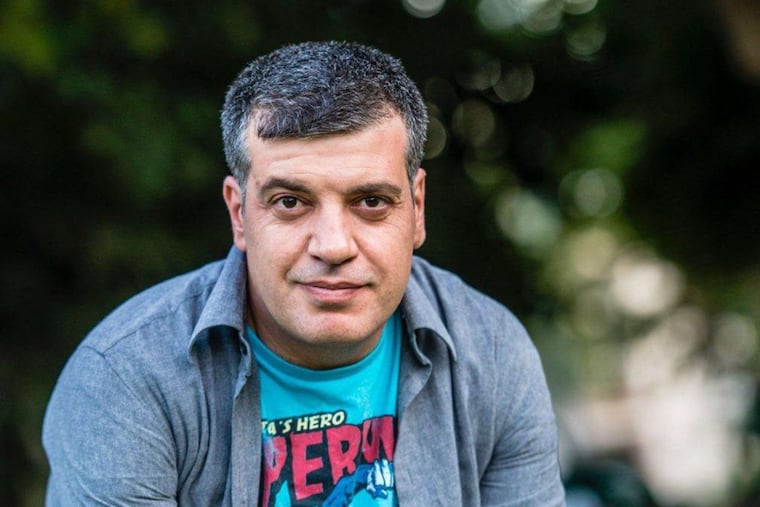
Sayed Kashua's life story reminds one of that wonderfully inappropriate line from Steve Martin's 1979 classic,
The Jerk
.
"It was never easy for me," Martin says, forcing each syllable with the slow, careful deliberation of the addled. "I was born a poor black child."
Kashua was born a (somewhat poor) Palestinian child in Tira, a small, predominantly Arab town 20 miles north of Tel Aviv. But he grew up to become one of the most celebrated satirists in Hebrew literature.
You heard right: The novelist and screenwriter writes passionately about the daily injustices faced by Israel's Arabs, yet he writes exclusively in Hebrew.
Kashua will talk about his new book, Native: Dispatches From an Israeli-Palestinian Life (Grove Press), a collection of his weekly columns for the Hebrew newspaper Haaretz, at 7:30 p.m. Tuesday at the Free Library of Philadelphia's Central Library.
Kashua, who has an acerbic, dry wit and a talent for turning everyday events into apocalyptic scenarios, gained worldwide fame with his 2002 literary debut, Dancing Arabs, a poignant biographical coming-of-age story that characterized his life as an extended identity crisis.
Kashua and Israeli director Eran Riklis adapted the novel into a stunning, critically acclaimed film in 2014. (It was released in America in August under the title A Borrowed Identity.)
Talk about an identity crisis: An Israeli Arab born to a farmer and a schoolteacher, Kashua grew up hearing of the horrors Israel's security forces had rained down upon his family and neighbors going back to 1948, when his grandfather was killed by a sniper while picking grapes.
His father, Darwish, lost his place at Hebrew University in the 1960s, when he was suspected of knowing about an impending terrorist attack and not warning the authorities. He was jailed for two years without a trial.
Yet Kashua, who joined his family to cheer Saddam Hussein's Scud rockets as they fell on Israel during the Gulf War, got a first-class Hebrew education when he became the only Arab to be accepted to one of Israel's most prestigious Hebrew boarding schools.
He was torn. Should he consider the Israelis as the enemy, as his grandmother taught him, or conform to life at the school?
He developed a passion for Israeli literature - and coeds. School won the day.
Now, Kashua doesn't quite feel at home in Tira. But he's never felt comfortable being the only Arab in the nice part of Jerusalem, where he and his psychotherapist wife, Najat, and their three children settled once he found literary success.
So in the summer of 2014, he made headlines when he swore off his homeland and moved to Champaign, Ill., where he's a member of the Hebrew faculty at the University of Illinois at Urbana-Champaign.
Kashua said he left because he began fearing for his children's safety - and his own sanity. He had spent decades writing Hebrew books about Arab characters so Israelis would learn about life as Palestinians lived it. He had hoped for decades for peace.
"Last week something inside of me broke," Kashua wrote in July 2014. "When Jewish youth parade through the city shouting 'Death to the Arabs' and attack Arabs only because they are Arabs, I understood that I had lost my little war."
Life in Illinois has brought the usual culture shock, Kashua, 40, said in a recent phone interview.
"But I was somewhat surprised how fast the kids adjusted to school, the language, everything," he said. "And the people here were so welcoming . . . they helped us adjust."
One can feel Kashua smile through the receiver. Wait - is this the same man who writes a famously pessimistic if utterly hilarious doom-and-gloom column?
Don't worry, the angst is still there. And he gets to exercise it weekly - he still writes his Haaretz column. "I think because of the distance, I am writing more directly political" columns, he said. "But I also write about being in exile [albeit self-imposed] and about missing home. My readers can read more pain in my voice."
Kashua also still works in TV.
In 2007, his sitcom Arab Labor became the only show with Arabic protagonists - and Arabic dialogue - to air on Israeli TV. His new comedy The Writer, about an Israeli Arab TV writer who makes it big on Israeli TV, is already a hit. It'll make its international debut Monday at the Berlin Film Festival.
Why would a depressive with a deeply divided cultural identity turn to comedy?
"I developed humor as a way to protect myself. It's the only thing that can make life bearable," Kashua said. Besides, "if you want to tell people the truth, better make them laugh; otherwise, they will shoot you."
215-854-2736