Two women seek the truth about a N.J. burial ground - and slavery in the Garden State
Stoutsburg Cemetery - located in Skillman, N.J., at the heel of the Sourland Mountains - has long served as an African American burial ground. Like many such places, it holds much unspoken history.
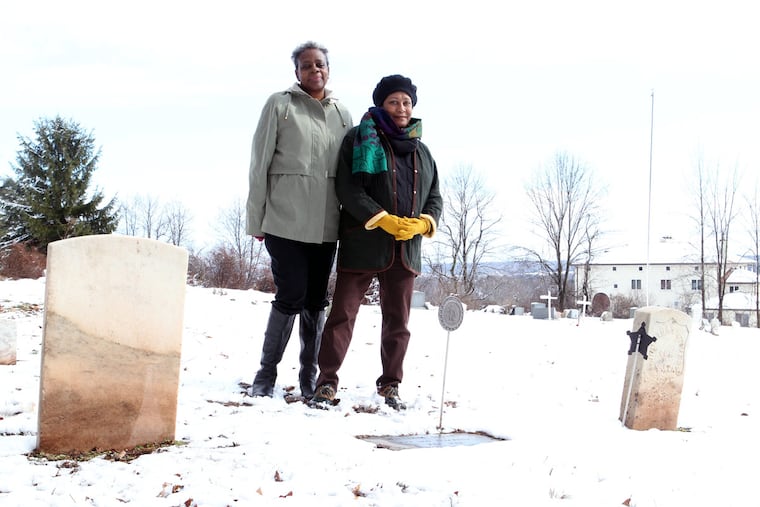
Stoutsburg Cemetery - located in Skillman, N.J., at the heel of the Sourland Mountains - has long served as an African American burial ground. Like many such places, it holds much unspoken history.
Two trustees of the Stoutsburg Cemetery Association are unraveling those secrets - the stories behind unmarked slave graves around the cemetery - for a book to be published next year.
Purchased in 1858 for people of color, Stoutsburg became the final resting place for local residents, including veterans of conflicts dating back to the American Revolution. They came from Hopewell, Pennington, Princeton, Lambertville, and other towns, where many of their descendants live today.
The burial ground had been a little-known and endangered piece of history. In 2006, Elaine Buck and Beverly Mills, cemetery trustees and descendants of men buried at Stoutsburg, swung into action. Buck got a call telling her that a neighboring landowner was going to pave a driveway over land that might belong to the burial ground.
"We gave them hell," says Buck. She and Mills contacted the state attorney general and Cemetery Board to block construction and leave the unmarked graves undisturbed. "There are 50 people buried without names or fieldstones on one area," says Mills. "Who are they, is what we wanted to know."
Not only did they want to protect the unmarked burial sites at the edge of the cemetery, which have been confirmed by extensive ultraviolet radar tests. They also wanted to know about the stories of former slaves and sharecroppers. How did they get to New Jersey? What were their journeys like? In the case of slaves, who were their owners? Buck says they want to "trace linages from colonial times to the Hopewell Township" of today.
They also wanted to trace their own roots. "We were never taught in school that there were slaves in New Jersey," says Mills. "The fact that we are descendants of some of those slaves makes everything more personal."
Then they wanted to make certain that this truth - that the Garden State was one of the last Northern states to abolish slavery, through a law in 1804 that created a system of gradual emancipation that lasted into 1865 - made it into the history books.
So Buck and Mills are writing their own book, with Princeton publisher Wild River Books. They are also curating a living-history website based on their research and connections with local families, black and white. Once the two got started, people came to them with information.
"Boxes of property deeds, church histories, slave [ownership] papers, as well as runaway slave notices in the Pennsylvania Gazette," says Wild River publishing director Kim Nagy, "finding records where records were never available. That was what fell into their lap."
Buck says her family came to New Jersey from Virginia in the 1800s. Her grandfather Robert Pullman was responsible for making many of the burial plots at Stoutsburg.
"He made the vaults in the backyard of his house on Columbia Avenue" in Hopewell, she recalls. "I would follow him as they brought the burial vaults to the graveyard. I remember tipping over gravestones." Grandfather told granddaughter of Stoutsburg's importance, how it held family members who were Civil War veterans and infantrymen in World War I.
Mills found papers affirming that Frost Blackwell, her great-great-great-grandfather, had been owned by a white farmer, Andrew Blackwell, in Hopewell Township. "Frost was actually written into Andrew Blackwell's will, that his servant man Frost would receive his freedom and $100 upon Andrew Blackwell's death," says Mills. "We don't know how exactly [Frost] wound up with Andrew, who passed away in 1816, with the will probated in 1818."
By that time, Frost had married a woman who was a slave on an adjoining plantation. They had a child - a baby born into slavery, since by law the child took on the status of the mother. "It took him another nine years for Frost to buy the freedom of his wife and his child," Mills says. "That is my beginning."
As the pair write their book and tend their website, families keep coming forth with genealogies and stories. For black and white alike, there is one takeaway: Slavery in New Jersey history is not taught in New Jersey schools.
"Where we come from in Mercer County - a particularly wealthy county - they had the free labor of slaves," says Mills. "People look at us in utter disbelief. They cannot wrap their minds around the fact that New Jersey was a slave state. . . . It's bad enough when we're talking to white people who are amazed by that fact. It's sadder still talking to black people who don't know."