Driving Miss Daisy: A look in the rearview mirror
At this moment in our American consciousness, it's slightly jarring to see Alfred Uhry's Driving Miss Daisy popping up on the stage at Act II Playhouse. For those too young to remember this gentle paean to the old New South, the first entry in Uhry's &quo
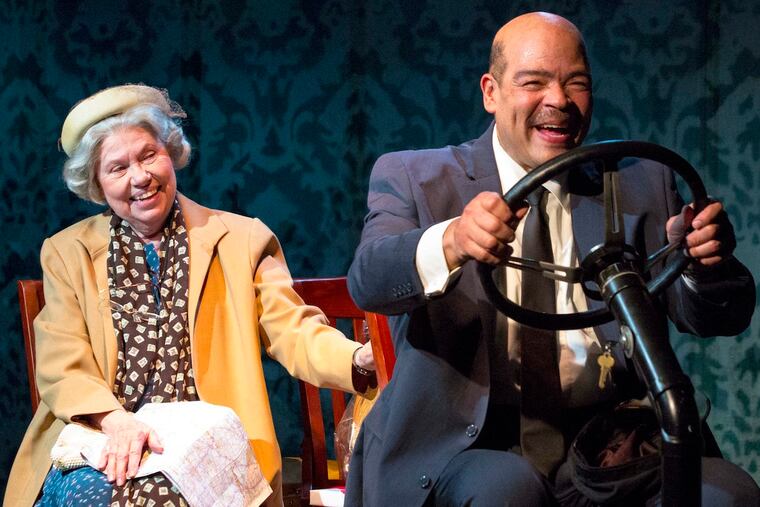
At this moment in our American consciousness, it's slightly jarring to see Alfred Uhry's Driving Miss Daisy popping up on the stage at Act II Playhouse. For those too young to remember this gentle paean to the old New South, the first entry in Uhry's "Atlanta Trilogy," it's worth noting the film version of Uhry's 1987 Pulitzer- and Tony-winning drama also took the best-picture Oscar (plus two other Oscars) in 1990, the same year Spike Lee's Do the Right Thing premiered and won nothing.
So, coming on the heels of the #OscarsSoWhite controversy, there's that. There's also its subject matter: an elderly Jewish woman, compelled by her adult son to stop driving, must accept the chauffeur services of an African American man. Over nearly 30 years - from 1948 to 1973 - their relationship grows, both Atlanta and the nation change, and they settle into a sort of friendship in which driver Hoke mostly tolerates Miss Daisy's comedic surliness and racism, and Miss Daisy learns to recognize that he's an autonomous human who sometimes has to urinate.
Act II's production, directed by James J. Christy, features Carla Belver as Daisy, Brian Anthony Wilson as Hoke, and Tony Braithwaite as Daisy's assimilated son Boolie. Belver doesn't trade in soft-focus nostalgia; her Daisy is riddled with barely suppressed anxieties, all of which leap to her face in a frown that turns all the way down to her chin when Hoke leaves her alone for a few moments on a dark country road. And while it's unsettling to see a big, powerful performer such as Wilson laugh at an unnaturally high pitch and duck his neck and shoulders in ongoing submission, that's probably the point. Their behavior - including Boolie's hale-fellow-well-met routine - reminds us throughout that we're looking backward.
Daniel Boylen's set cleverly underscores a subtext Uhry treats as an occasional interference in Hoke and Daisy's lives: Change is coming. A damask-printed scrim, Daisy's wallpaper, becomes gradually more translucent until it reveals behind it a silhouetted image of civil-rights marchers snaking across the horizon. It's a much-appreciated reminder of what's happening outside Daisy's walls and car doors.
While the play implies there's something to the claim of a "complicated relationship" between Southern blacks and whites, Uhry's physical erasure of Hoke's family (while Boolie gets ample stage time), and housekeeper Idella, who lives, cooks deviled eggs, and dies offstage, neither seen nor heard, tells another story. Which is all to say that with this production, Act II and Christy manage to both respect this massively successful piece and call attention to its flaws.
THEATER REVIEW
Driving Miss Daisy
Through March 26 at Act II Playhouse, 56 E. Butler Ave., Ambler.
Tickets: $29-$36
Information: 215-654-0200 or www.act2.org