Gallim Dance premieres at PIFA with works for dancers, choir, and organists
The Brooklyn company Gallim Dance, nearly a decade old, made its Philadelphia debut Sunday evening at the Kimmel Center's PIFA festival at Verizon Hall. Titled Attack Point, the world premiere, choreographed by Gallim founding director Andrea Miller, took place in collaboration with organists from the Curtis Institute of Music and Choral Arts Philadelphia.
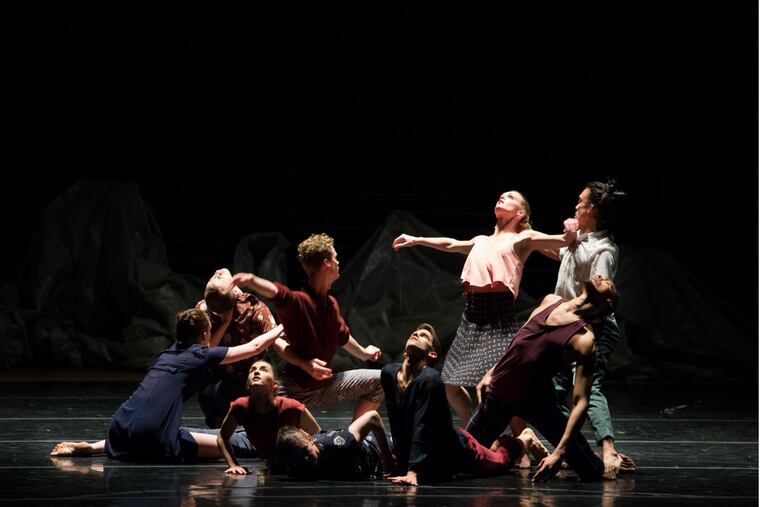
The Brooklyn company Gallim Dance, nearly a decade old, made its Philadelphia debut Sunday evening at the Kimmel Center's PIFA festival at Verizon Hall. Titled
Attack Point
, the world premiere, choreographed by Gallim founding director Andrea Miller, took place in collaboration with organists from the Curtis Institute of Music and Choral Arts Philadelphia.
The concept of the collaboration is "a night of dance listening and organ watching." So, with the grand Fred J. Cooper Memorial Organ looming relâche above us, a smaller organ reigned on stage, where we could watch the organist's feet at the pedals for the nondance works.
For a three-piece work titled Boat, Miller chose three lesser-known Arvo Pärt works, the Salve Regina, Pari Intervallo, and the "Gloria" from the Berlin Mass, all choral works that lent weight to a piece dedicated to the world's refugees, who risk death to live with dignity.
The Choral Arts choir matched the doleful choreography with solemnity, spiking it with plangent notes that Miller used advantageously. Her nine dancers moved liquidly inside the attenuated sections, leaping or falling in the spikes.
The company name, Gallim, was that of a Biblical village. Accordingly, subtle movements suggested ancient desert origins around the Mediterranean. Dancers continually made snaking human chains, as though pulling one another back from death. When hands broke away and someone fell, another dancer rushed to lift and carry her. They crashed toward us in waves that eddied off in every direction. The aura of ancient dances again pervaded, with small ring-around-the-rosy circles, or larger ones, once with one woman flying horizontally, legs out, held under her armpits by two in the circle.
Some dancers clung to the organ like a lifeboat. The entire company ran series of grand jetés and arabesques in rotation, as though wanting to go back home. In one thrilling duet, a dancer locked her feet over her partner's shoulders and unfathomably cantilevered herself rigidly up from a full face-plant on the floor. Soon, he draped her around his waist, rotating her with her limbs splayed like a starfish.
The organ soloists then performed works written for dance to an empty stage. Of them, I most responded to Clara Gerdes playing Calvin Hampton's "Everyone Dance" from Five Dances for Organ. "Everyone Dance" is a peppery piece she ground out coarsely with gusto.
This was a one-off performance, as will be the not-to-be-missed Architecture in Motion Thursday night by the great dance company Diavolo. Philadanco's Global Artistry, which includes a new work by Francisco Gella, occupies the Perelman all weekend. So as you wait for the curtain, go and gape at MacArthur Fellowship awardee Mimi Lien's The Kinetic Tree, PIFA's sculptural centerpiece that joyfully reaches for the stars in the vast Kimmel lobby.