Expressionist classic 'Machinal' to undulate on the EgoPo stage
If any company loves a good theme, it's EgoPo Classic Theater. Since its start, artistic director Lane Savadove has built seasons around Jewish theater classics, expressionism, cruelty, and Henrik Ibsen.
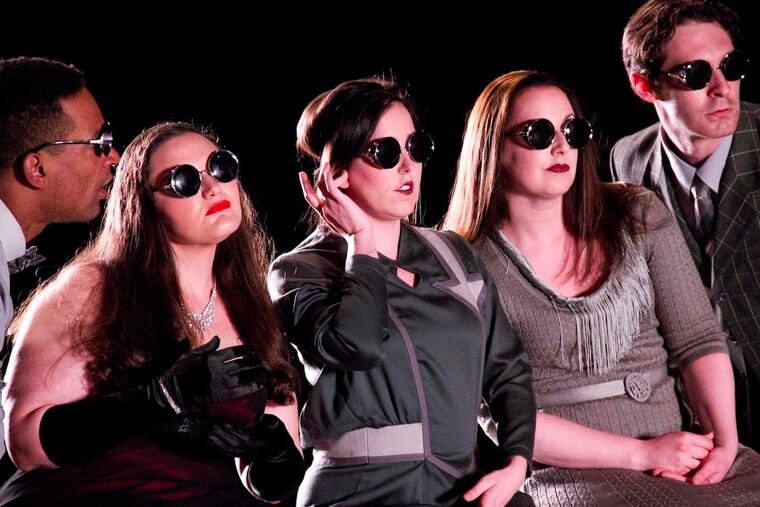
If any company loves a good theme, it's EgoPo Classic Theater. Since its start, artistic director Lane Savadove has built seasons around Jewish theater classics, expressionism, cruelty, and Henrik Ibsen. The 2015-16 season focuses on provocative stagings of plays by female American masters. First came Lillian Hellman's The Children's Hour, then Clare Booth Luce's The Women. Now comes Sophie Treadwell's 1928 expressionist play, Machinal, which opens Friday at the Latvian Society with Philly favorite Mary Tuomanen in the lead.
Machinal is based on the true story of Ruth Brown Snyder, who died in the electric chair at Sing Sing, convicted of killing her husband, Albert, after six previous attempts.
"We like them dark," Savadove says with a laugh.
EgoPo started 22 years ago in New Orleans and has floated for the last decade from space to space in Philadelphia, landing at the Latvian Society for the current season.
How are themes selected? EgoPo's board of directors hashes it out with Savadove. There's what he calls "a secret document filled with 20-some themes and ideas," chosen according to the directors, locations, budgets, and casts available. "Once we figure that out - a season's theme - we work like crazy to represent the best of what that theme has to offer." EgoPo also looks to pop culture. "We're always hoping," Savadove says, "to tap into the zeitgeist."
"What if we did a Russian season? That has certainly been on my mind," Savadove says. The 2016-17 season will be devoted to works such as Enda Walsh's Delirium (his take on Dostoyevsky's Brothers Karamazov) as well as some Chekhov and Tolstoy.
This season has explored the legacy of prominent female playwrights. Luce's The Women is a gossipy, sometimes savage classic. Hellman's The Children's Hour was, in Savadove's words, a "handsome parallel to what Arthur Miller was doing at that time - tragic, bleak, hard."
What makes Machinal expressionist? The play focuses on the life of a Young Woman who submits to social expectation, marries a superior, and eventually kills him. It's a study of social failure, personal suffering, and the fight of the spirit against larger, determining forces.
Expressionism had a short history in U.S. drama, although it's present in many plays and has thrived in movies. "By the end of World War II, expressionist drama had given way to living-room drama, which is why you rarely see expressionist work such as Treadwell's performed anymore," says Savadove. "Oddly enough, modern musicals often leap into the expressionist."
Director Brenna Geffers says Machinal is a play written from a feminine viewpoint with a female antihero. "That is not common in classic theater text," she says.
Geffers, who has directed works by O'Neill, Beckett, Brecht, Burroughs, and many other classic playwrights, seems ideal to evoke the universe of Machinal. She is known for focusing on actors' bodies and movements to create an abstract world on stage. Geffers calls it a "holistic universe, familiar and different - separate - from what we're used to." The people in Geffers' Machinal, male and female, will move with reaching, yearning, "feminine" gestures, "something undulating and fluid."
"We approach the work," Geffers says, "in a way that makes the story breathe for the audience."
THEATER
Machinal
Presented by EgoPo Classical Theater, Friday through May 8, at the Latvian Society, 531 N. Seventh St.
Tickets: $25-$35, students $12.
Information: 267-273-1414 or www.egopo.org.