Two outcasts plan to blow up school
Should a play depict the point of view of the Columbine shooters? Even to consider the question raises another question: What stories deserve to be told?
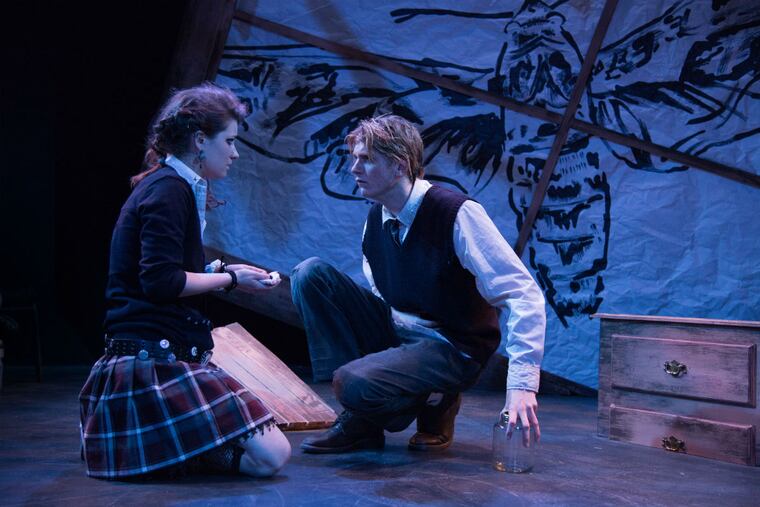
Should a play depict the point of view of the Columbine shooters? Even to consider the question raises another question: What stories deserve to be told?
At the very least, Azuka Theatre's impressive production of Declan Greene's drama Moth inspires me to ask this question. I imagine a big part of anyone's answer after seeing it stems from the degree to which they sympathize (or identify with) the perspectives presented in Greene's two-hander.
Fifteen-year-old Sebastian (Nicholas Scheppard) and Claryssa (Hannah Parke) suffer isolation and bullying at the hands of their classmates in high school. A clear dynamic emerges: The pair associate only with each other ("hanging out by the trash cans"). His infatuation with manga comics stunts (or hinges on) his diminished social skills (kids refer to him as "practically retarded"). She blankets her eyes in black liner and teases her purple hair into rat tails (but hates being called "emo"). Her affection for him both frustrates and embarrasses, and she defends him from verbal and physical bullying.
Until, after one vicious attack, she doesn't anymore. Or can't. He blacks out during the videotaped humiliation and dreams that a giant robotic moth tasks him with cleansing the world. Which means destroying it.
Greene's singular method of storytelling has the pair reenact, in stream-of-consciousness style, the events that led to their both wishing to blow up their school and everyone they know. Both actors imitate teachers, parents, bullies, other classmates, some depicted as "fat, mouth-breathing retards," few receiving any empathy, particularly from the embittered, narcissistic Claryssa. Long passages riddled with metaphor and poetry enliven the teenage dialogue, particularly a depiction of a man removing a glass eye.
John Hughes it is not. But it does share that director's mastery of tropes and types to take the audience back to their own high school experiences and to encourage some form of connection with the characters. As someone who was bullied and later did some bullying myself, I laughed and cringed at the worst moments.
Michael Osinski's even direction creates a deft thriller that doesn't tip his hand. He elicits a capable, drooling performance from Scheppard, and Parke's Claryssa blends self-centered brattiness with the kind of cruel, incisive barbs only a teenager can deliver with impunity.
Damien Figueras' epic sound design and original score augment Sebastian's psychological landscape in a manner that terrifies with moments of comic-book horror. Together with Alyssandra Docherty's haunting lighting, the 85-minute show teases out something both uncomfortable and riveting, leaving no easy verdict on this backstory to a tragedy.