'The Christians' at the Wilma: Going through hell to communicate
It's tempting to draw a direct line between Lucas Hnath's The Christians, which opened this week at the Wilma Theater, and the case of Oklahoma Pastor Carlton Pearson (although Hnath would prefer you didn't).
It's tempting to draw a direct line between Lucas Hnath's The Christians, which opened this week at the Wilma Theater, and the case of Oklahoma Pastor Carlton Pearson (although Hnath would prefer you didn't).
Pearson, profiled in a 2005 episode of the radio show and podcast This American Life, was the successful shepherd of an evangelical megachurch. Until, that is, tormented by the thought of unbaptized and sickly African infants doomed to damnation, he delivered a sermon announcing that he no longer believed in hell, and subsequently lost everything.
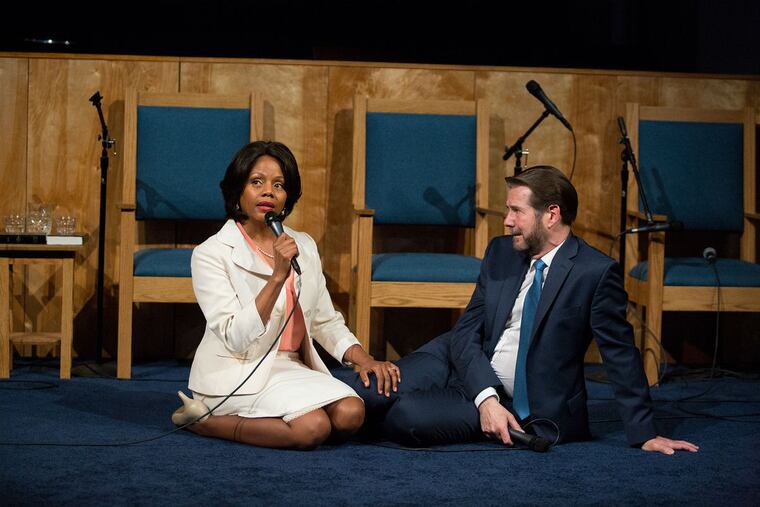
For Hnath's Pastor Paul (Paul DeBoy), the heroic young victim of a car bombing leads him to this public heresy, with many of the same results. What follows is a fascinating discussion of faith, a sort of real-time passion play delivered by Paul; his rival, Assistant Pastor Joshua (DeLance Minefee); a board member, Elder Jay (Ames Adamson); Paul's wife, Elizabeth (Erika LaVonn); and Jenny (Julie Jesneck), a troubled congregant.
After a full choir greets the congregation (the audience) from Matt Saunders' perfect replica of a contemporary sanctuary - right down to its pale wood panels and blue carpeting and upholstery - with a couple of rousing songs, each principal player delivers his or her dialogue into a microphone, punctuated with occasional narration ("he said," "she said") by Paul.
What's most interesting about the discussion is Paul's absolute astonishment that anyone might need the concept of hell in their lives, contrasted with Joshua's well-earned fury that Paul can be so cavalier about removing it. Jenny, anguished, says of Paul's new interpretation of the Bible: "It's as if you have a choice about how to read it." Paul has no good response.
Director Tim Bond blurs the line between natural and performed speech, which adds to the show's sermonlike delivery. But while Minefee burns with a younger man's sense of righteousness and purpose, DeBoy seems too tentative and low-key to have garnered such a massive following, and would do well to implement a little spark of his own.
It's a bit odd reviewing this show as a Jew. When Jenny asks, regarding the absence of hell, "What about Hitler?" - well, what about him? To us, that issue was reconciled the moment he died. Ashes to ashes, every last one.
In fact, it's shocking to me that anyone would care so much about Paul's slight - to me - variation on a theme. But then, they did care, onstage, and in life, and therein lies the crux of Paul's repeated lament, "I have a powerful urge to communicate with you, but I find the distance between us insurmountable."